Wednesday, October 04, 2006

a bookend supreme

JD Considine on Coltrane (and a nice Diana Krall concert review). [via Don't Explain] Generally good article, covers some basics, with special mention of how jazz education has assimilated Coltrane.

One sentence is pure nonsense, though: "his initial work with Davis and later ventures in the avant garde are generally seen as mere bookends to his recordings in the late fifties [1959-1961] for Atlantic Records." That means that, apart from two or three studio dates (that are far from its best work), the Classic Quartet is a "mere bookend."

Considine does nuance his statement a little bit, saying that that period "was what cemented his popularity as a soloist and bandleader." Perhaps at the time, the Impulse! recordings cemented more than just popularity, and I'd guess that they have long since become more popular than the Atlantics.

Tuesday, October 03, 2006

shaping ornette - a darius brubeck debate


In Darius Brubeck's "Shaping Jazz – an Ornette Coleman debate" (published on Jack Reilly's blog) the author perches uneasily on a fence that should long ago have been torn down. His tone is odd, especially coming from someone who's been hearing Coleman for almost 50 years, since he was 12. While I appreciate the research and primary accounts, it is unfortunate that rather than take advantage of Coleman's current high visibility to investigate his contributions, Brubeck prefers to tear him down and give ambivalent praise. This essay hasn't really been picked up by the jazzblogosphere (at least, not as far as I know), but I think that it's a serious piece that deserves a serious response.

It starts with an interesting story that shows how Coleman continued to be rejected and shut out by certain jazz musicians. Not a new occurrence for him, and Brubeck later recounts Coleman's struggles with some sympathy, but facing the rejection of one's peers on the White House lawn must have borne a particular sting. What is surprising, however, is that Brubeck turns this incident into a careerist, don't-rock-the-boat strategy:

I also think this story resonates for 21st century jazz educators who, like jazz musicians at the Whitehouse, must take a pragmatic approach to gaining and exploiting prestige – not selfishly - but on behalf of their programs, their students and institutions and, of course, on behalf of jazz as a legitimate academic discipline worth supporting with funds as well as acclaim. I suspect that playing 'avant-garde' on the Whitehouse lawn these days would be an audacious act of protest and still not the best tactic for increasing the level of NEA support for jazz.
I'm not sure if the last sentence is sarcastic or not. If not, it's rather sinister that Brubeck places pandering to the current US administration for the sake of government grants above creativity. The irony, of course, is that Jimmy Carter was a Cecil Taylor fan:
In the late seventies, Cecil played at the White House as part of a jazz program. Carter was so moved by Taylor’s solo recital that he ran after him and gave him a spontaneous hug. He practically shook Cecil’s shoulders and asked: "Does Horowitz know about you?"


Brubeck then asks:
Should students be told to play whatever they can and feel like playing? Most of us harbour suspicions about 'free jazz'. There are problems with anti-disciplinary artistic extremism despite the fact that avant-gardism keeps the music from stagnating.
This is clearly the same old red herring that's fished up again and again to maintain the misunderstanding of what avant-garde jazz is. In fact, Brubeck implicitly undermines the notion of free jazz as "anti-disciplinary artistic extremism" in the very next paragraph:
When [Coleman] practiced alone it sounded like nothing in particular was being worked on. When he practiced with Don Cherry, it was the opposite; the same phrases over and over again. I now realize they were searching for the precise, yet unnotatable phrasing and inflection that became such a striking feature of their ensemble playing.

The first sentence of the section entitled "Ornette Coleman vs. Modern Jazz" has to be one of the most depressing I've read in a while: "Ornette Coleman’s emergence and the eruption of 'free jazz' in the 1960's marks the beginning of the end of jazz modernism until it resurfaces in the academy under the aegis of jazz education." The implications of this sentence are drawn out later.

He then sets out a taxonomony of jazz circa 1959:
jazz... was an overarching style built on a core repertoire of blues and popular song with adherence to swing and improvisation, instrumental proficiency and consistent performance codes. Successful experiments with counterpoint, modes, time-signatures, orchestration and form were extrapolations from a set of 'givens'.
What is a "given" in the ultra-compressed history of jazz? The time span between Louis Armstrong and Ornette Coleman (the beginning and the "end" of modern jazz) is shorter than the Rolling Stones' career. The scope of jazz's possibilities had been constantly broadened and enriched by Armstrong's "invention" of the soloist, the work of Duke Ellington and Charles Mingus (how can you sideline what they did as "extrapolations"?), Tristano's early free-form experiments, The Birth Of The Cool, Coltrane's Blue Train and "Giant Steps" had just been recorded, etc., etc., etc.

I don't dispute the importance of the elements in Brubeck's list (though I'm not sure I fully understand what "consistent performance codes" are), but these are clearly arbitrarily-chosen, historical constructions. They cannot stand unproblematically as self-evident pillars that Coleman knocked down, because they were constantly being challenged anyway. For example, an important part of what Ellington, the MJQ and the beboppers did was to demand that jazz be considered as art, thereby challenging both performance and social codes.

Brubeck focuses very tightly on 1959-1960 and a 2005 interview (non-accidently coinciding with Coleman's new acoustic quartet). On a personal level, I can't take him to task on that, because I don't know Coleman's career well enough, but what about the other 44 years? The various trios and quartets, the symphonies and the electric bands? How can Coleman's relationship to jazz be understood without so much as an acknowledgement of all that?

Also, while in 1959 it was probably already well established that jazz was the Afro-American music form that most prized technique, that does not mean that technique summed up either jazz or African-American music. So a lack of it could not, by itself, reverse the music's historical march (towards where? hopefully not just Brubeck's academy). That Brubeck would conflate the two is perhaps unsurprising, given his point of view:
Since 1960 we’ve also heard plenty of music from other cultures using various tuning systems. Non-standard tuning is also a signifying sound used by jazz musicians laying claim to a non-western identity.
I've always felt that the "non-western" was already inherent in Afro-American music: take, for example, the foundational tale of W.C. Handy hearing a man play guitar with a knife. Or, quite simply, the existence of the blues scale and the new instrumental techniques jazz musicians invented - right from the start - to be able to play their music on European instruments.

It is clear from the quotes in Brubeck's piece that Coleman had made an imaginative leap that neither the younger musicians such as David Baker ("It never occurred to anybody that we would stop playing changes") or even the then-blossoming John Coltrane had been able to concieve of. And yet, Brubeck dismisses this as primitivism that served as a sort of high-falutin' black-face and "a public display of his ignorance of and disrespect for the musical achievements of modern jazz." It's ironic that Thelonious Monk is quoted saying "Man, that cat is nuts!" (approvingly or disapprovingly?), as 10 years earlier the same charges of lack of technique and primitivism had been aimed at him.

Brubeck leans on Mingus's famous comments to exclude Coleman from jazz modernism. Even on Brubeck's terms (instrumental proficiency and compatibility with the academy), Coleman's modernity has been ascertained: his music is studied and performed (even by the not-exactly-cutting-edge J@LC) and his style has inspired many traditionally virtuosic players. Charlie Haden, Billy Higgins and Ed Blackwell were certainly far from incompetent. Don Cherry's subsequent work, enabled by what he had done with Coleman, aimed for much more than a techno-bureaucratic vision of progressive modernism. Cherry's humanistic goals (along with, say, Ellington's) are disregarded in Brubeck's modernism (as it is displayed here). All this indicates that Coleman carried the music forwards, rather than backwards towards some primitive state. Indeed, Mingus says as much.

When the issue of imagination is brought up - extremely obliquely - it can only be in derogatory terms: "It seemed unfair that he gave himself authority to change the game to suit his needs, like playing tennis without the net." To say Ornette took an easy path, or even cheated his way to fame, while elsewhere evoking his suffering ("I was being beaten up, my horn thrown away") is unsettling, to say the least.

The substance of Coleman's innovations is further marginalised when Brubeck declares that his
long-standing attempt to systematize his musical universe appears as unrealized and irrelevant as it ever was... Since his music is not set within normal conventions anyway, why the obsession with certain technical terms (transpositions, pitches, notes, unisons and modulations)? None of this relates to what he plays and how he improvises.
So why not detail some of the new possibilities Coleman's work brought to jazz? After all, there's already been plenty of discussion, in this article, of what he wasn't doing in 1959.

This makes the conclusion ("Ornette Coleman’s career demonstrates that there are people who simply don’t follow 'the rules' and have more to give as a result.") ring hollow, at very best. Once more, Coleman's career is framed in confrontational terms as an attack on "formal training and historical grounding," when it's actually a gift, a contribution. Isn't a non-confrontational approach what Coleman himself suggests?
That's why music is so free for people to cherish and so open – because it's how the idea is affecting you, and how you express what it means to you, regardless of what the style is.

Monday, October 02, 2006

Soweto Kinch - 30/09/2006@AB, Brussels


Soweto Kinch - as, rap (website | MySpace)
Abram Wilson - tp
Femi Temowo - g
??? - b, el b
Troy Miller - d

Talk about a come-down: after the acoustic bliss of the previous night, the first note of Soweto Kinch's over-amplified concert felt like an aggression. The sound was unnecessarily loud (unless you really believe that a trumpet cannot be heard from 10 metres away) and confrontational rather than enveloping. We quickly moved to the back of the room. Afterwards, I was told that the amplification made the blend of jazz, hip hop and sampled elements easier. It's a real shame that the sound system also muffled the rapping: it's dense, but vivid and often hilarious. I got used to it after a while, anyway.

I won't repeat myself too much: see a July concert review and my review of Conversations With The Unseen.

After a brief rough spot at the beginning, Kinch was spitting *fire* on all his solos - far, far better than the somewhat empty technical display he put on at Klinkende Munt. Abram Wilson had an earthier, soulful vibe that brought a welcome balance. I was worried that they'd play material I was already fairly tired of in July, but luckily they only did the brand-new second album (which I haven't heard yet, but is partly available on MySpace, and, coincidentally, was produced by the guy who produced The Bad Plus's upcoming album). The only songs I already knew were "Adrian's Ballad," a detailled portrait that highlights the quality of Kinch's lyric writing, and "A Friendly Game Of Basketball," an uptempo bop head. The two sum up the poles between which Kinch's music swings.

In fact, 70% of what he does is contemporary straight-ahead, really. Even the way the hip hop grooves are phrased evokes jazz. He also frequently used horn section samples to beef up the group sound, which he hadn't done this summer. That he has the ability and charisma to get people - young people - really enthusiastic about hearing bebop makes me happy.

There was one radical departure from the formula, called "Out There." The bassist picked up an electric bass, Kinch applied a warbling FX pedal to his saxophone and the band veered into rock. They returned to acoustic jazz for the soloing section, and ended with another electric part, but this time funkier. I'm not sure the collage made sense as a whole and it certainly wasn't as out as Kinch seemed to think it was, but at least he's keeping his options open. Overall, though, a very good concert.

Afterwards, on the way back to the car we dropped by the Beursschouwburg's bar for a little while. A band was playing a sort of acoustic downtempo Hooverphonic thing, with a bit of an An Pierlé vibe as well. They looked great on stage: three girls in front (l-r cello, keyboards/vocals, keyboards) and three boys in the back (l-r bass, drums, guitar).

more sidebar hi-tech

Finally, HaloScan has enabled a "recent comments" feature. The last eight comments are now listed in the sidebar. If you've not been commenting for fear of lack of recognition, you no longer have an excuse!

Furthermore, I've just found out how to link to the comments' RSS feed. The link is also at the top of the sidebar. Oh, happy day (for be.jazz commentors everywhere)!

more on Artist In Residence

UPDATE: Godoggone reproduces Nate Dorward's Signal To Noise review. I'm less bothered by AIR's "scrapbook" nature than Nate is.

Godoggone loses his Moran virginity and comes out of the experience both titillated and disappointed.

He also provides a link to another blog review, which is threaded with interesting quotes. On "Milestone:" "the guitar of Marvin Sewell imitates the voice timbres and melodic movement in swooping figures." I'd originally said something similar in my review, but removed it from the final draft. Maybe I'll put it back in for the French version.

A new (to me) thought: doesn't Moran use the avant-garde kind of like pop does? Folding it unostentatiously into a different style and thus reconnecting it with the rest of society (or of the listening public). Peruse Destination: Out and you sometimes get the feeling that the mainstream lost touch with the avant-garde and broke off the back-and-forth that binds the two. Of course, a band like the AEC could do that back-and-forth (and much else besides) all by itself.

I didn't know about Words and Music, it looks good. The review is logically followed up by a post on Cecil Taylor (and how organised his freedom was: "the fiery brio with which it is played disguises, perhaps, the underpinnings"), and a bit on the Moran-Sam Rivers connection.

There's also discussion of Giuffre's Free Fall, an album which failed to grab me so far, despite several attempts. However, since then I've come around to Messiaen's Quatuor pour la fin du temps (and some of Giuffre's earlier work, the trios and arrangements for Shelley Manne's septet, not that they sound much like FF), so maybe I should give it another shot.

Sunday, October 01, 2006

more on super hearing


Steve Smith adds an erudite rejoinder to my superhero listening list:

Captain America may in fact be a square, but he's a Glenn Miller man through and through -- as one might expect of any American soldier frozen in an iceberg during World War Two. When he lightens up -- which is seldom -- he dances a wicked Lindy.

I should add that I'm not at all a real comics connaisseur and that many of the assertions (such as Superman being a terrible dancer, or Punisher's entry) are personal extrapolations. Spawn did sing "Stayin' Alive," though. A couple of faves that have me stumped:

Jesse Custer (from Preacher): What music could capture Garth Ennis's insane mix of violence, perversity, debauchery, vampires, mutilation, conspiracies and religion - and the cool, down-home intellect with which Custer takes it all in? Southern rock that that both loves and abhors the south might do it.

Cerebus: The evolution from slapstick Conan The Barbarian parody to political/religious intrigue to über-intellectual concepts (I'll admit that tedium got the better of me when Cerebus and Jaka were on the boat, everything referred to F. Scott Fitzgerald and every issue came with lengthy annotations) surely has few comic book parallels. And, anyway, what do libidinous aardvark super-warriors listen to?

Suggestions and further entries are most welcome.

Nicolas Kummert Quartet - 29/09/2006@Sounds, Brussels


Nicolas Kummert - ts
Aleksi Tuomarila - p
Anja Naucler - cello
Lionel Beuvens - d

At this concert in particular, for some reason, I really felt a generation (mine, from mid-20s to early 30s) coming together. Partly because Nicolas and Aleksi (who's Finnish, but studied and has spent a lot of time in Belgium) have both moved to Paris, along with others, like Jozef Dumoulin, who are starting to break into that scene. I guess there's always been that movement (René Thomas in the '50s, David Linx and Eric Legnini in the '90s), but it kind of feels like everyone's leaving (growing up?), at the moment.

I don't think the move has fundamentally changed Nicolas's playing, but it has probably sped up his development. His playing has always had a real gentleness to it, but over the last couple years his sound has become really big, in all registers and dynamics and, when necessary, deliciously creamy. Though unamplified, he effortlessly filled the room and at times even threatened to smother all but the drums.

Nicolas and Aleksi have been playing together since their conservatory days and have built up a common repertory; Aleksi's "Sacrament" and "No ID" and Nicolas's "Two Elephants Are Always Right," all from Aleksi's quartet CDs (a new one is coming out soon), were played. To my surprise, and even that of the other band members, three Ornette Coleman tunes were also performed. I thought maybe Ornette's current two-bass band had inspired Nicolas to apply a cello to them, but it turned out that he had simply recently come across some sheet music and been listening to the classic quartet albums like This Is Our Music.

"Lonely Woman" opened the concert, tenor and cello voicing the melody slowly and with depth, but perhaps a little too slowly and without the shrillness that makes the original version so arresting. Afterwards, we discussed intonation in Coleman's music and Nicolas argued for not forcing himself to play out of tune just because it's Ornette. I'm of the opinion that well-applied out-of-tuness never hurts. "Congeniality"'s stop-start head provided space for a more chaotic, wilder energy.

One of the concert's great joys was in seeing how fluid and flexible the music was in terms of passing leads and solos around, forming duos and trios, slipping into unaccompanied passages, varying dynamics from forte to near-stillness and making it all seem spontaneous. The traditional and rigid head-solos-head format still has a place, but a more organic, unsystematic mode of organisation is, in my view, the nec plus ultra. This, combined with the instrumentation, gave much of the music a chamber feel, and the audience responded to that: you could hear a pin drop.

Anja's less of an improviser than the other three, so her parts - the occasional lead and lots of bowed or plucked accompanying figures - seemed more pre-planned. Still, everyone commented on the freshness and lightness the cello brought.

Aleksi really came into his own during the second set, notably for an absolutely superb unaccompanied solo which let the silence around it be heard, with notes sparkling in the darkness.

Lionel is another player who's really been stepping it up recently, becoming a great orchestrator and humorist. He's been playing with the Bulgarian pianist Sabin Todorov for years, and that's an excellent group to hear him with, but word has gotten out, and he's almost ubiquitous now. A highlight was when he mischievously accompanied one of Aleksi's solos solely with the squeak of his hi-hat pedal.

Saturday, September 30, 2006

super hearing


Last night, I was talking with Nicolas Kummert (see upcoming concert review) and the topic of what superheroes listen to briefly came up. This seems to me totally bloggable. Nicolas came up with Spiderman's entry right away, the rest are mine.

Superman: Doesn't listen to music, or even partake in any kind of cultural activities, really. When the only thing that can harm you is kryptonite (and no-one's managed to kill him with it in, what, 60 years?), what do you need music for? Clark Kent might listen to the radio and like a few hits, but he's a terrible dancer. Cyclops (of the X-Men) and Captain America are squares, too.

Spiderman: Spidey is definitely a Bad Plus fan. Hip and ironic/sarcastic. Peter Parker listens to emo.

Batman: He's into Wagner, but harbours a secret fondness for decrypting the psychological turmoil in Kylie Minogue. Bruce Wayne can discuss opera and the latest indie band. He's like Steve Smith, minus the depth.

The Incredible Hulk: Metal, obviously, but none of that hipster crap.

Namor/Aquaman: Namor's a serious guy. He doesn't actually listen to music, he reads Adorno. Maybe the occasional Schönberg, when he's feeling frivolous.

Spawn: In one issue, Spawn actually sings "Stayin' Alive," but I attribute that to Todd MacFarlane. Spawn clearly is/was a soul guy.

Rorschach (from The Watchmen): Whatever the Columbine killers listened to.

Marv (from Sin City): Johnny Cash murder ballads, but also Destiny's Child, with a kind of paternal affection.

Wolverine: A classic rock kind of guy, with a penchant for the genre's bad boys, obviously.

The Punisher: He used to hate punk, but totally got into gangsta and hardcore rap in the mid-80s. He's old, but keeps up with the times: he's into Atlanta and Houston at the moment.

R2D2 (one of the greatest heroes of them all): Timbaland, because they speak the same language.

Octurn - 01/09/2006@CC de Meent, Alsemberg


Bo Van Der Werf - bs
Magic Malik - fl
Guillaume Orti - as
Laurent Blondiau - tp
Jozef Dumoulin - kb
Fabian Fiorini - p
Jean-Luc Lehr - el b
Chander Sardjoe - d
Gilberto Nuno - laptop

The meeting between baritone saxophonist Bo Van Der Werf and flutist "Magic" Malik Mezzadri has become an important turning point for Bo's Octurn, as Malik has gone from being a guest on their latest album, 21 emanations, to the ensemble's principal composer. This was the third time I'd seen this line-up this year and Malik's presence has brought a softer and more accessible feel, though the music has lost none of its formal complexity: Malik spent several minutes explaining the rhythmic and harmonic patterns one composition was based on, ending with "and with all that, we made rock 'n' roll."

Malik combines serious and frivolous sides excellently. One composition welded together the ultra-modern elements with medieval polyphony, while the concert ended with a joyous, relatively straight-forward and un-selfconcious mazurka (of the Carribbean, not Polish, variety). As a player, he's instantly recognisable, because of his instrument of course, but especially thanks to his homemade harmonic system. I don't know its details, but it's what's most distinctive about him.

This was actually the first day of a two-day recording session with a small audience. Unfortunately, I couldn't make it to the second day. The instruments were set up in a wide circle and the audience in an even wider circle around it. We were invited to feel free to change seats between songs, but getting a good balance between instruments was difficult: at one point, I was overwhelmed by the piano, of all instruments! So I'm curious to hear what the recording sounds like.

The first composition was dreamy and ambient, with a lot of free-flowing subterranean activity, the highlight of which was a musicbox-like piano-Fender Rhodes duet. The whole first set was relatively subdued, perhaps overly so. Still, as one of Bo's solos showed, quietness is in itself rather attractive, especially when it's a collectively-played, slightly eery kind of quietness.

Excellent contributions came from all involved. Two things in particular contributed to the overall mood. Chander Sardjoe would vary dynamics within a single phrase, for example landing very softly on the crash cymbal after a louder fill. A bunch of little details like that added depth to the music. Gilberto Nuno produced translucent textures which sparkled like light playing on melting icicles, while also discretely sampling the instrumentalists in real-time.

I guess the album should be coming out some time next year. Octurn + Malik will be at London's Vortex on December 1st.

Friday, September 29, 2006

mr. bo is in the house, tbp are in the can and ww is in your face


I've just found out about Brian Olewnick's blog, Just Outside. If you've been reading Brian's writings at All Music, Bagatellen, Jazz Corner or elsewhere, you'll already know how great he is. If not, check out his thoughts on eai's use of pop songs, the smelliness of the No Fun Festival or the pros and cons of Ukrainian wedding bands. Brian's review of McCoy Tyner's Sahara is what made me get that great album.

+

The Bad Plus have recorded their next album. If this summer's concert is any indication, it will be great (and will the criticisms fade now that the Columbia-fuelled hype has?).

+

I haven't read it, but Wilbur Ware-ophiles may be interested in this doctoral thesis: AT ONCE OLD-TIMEY AND AVANT-GARDE: THE INNOVATION AND INFLUENCE OF WILBUR WARE by Karl Erik Haddock Seigfried.

MSG - 28/09/2006@Sounds, Brussels

Rudresh Mahanthappa - as (website | MySpace)
Chander Sardjoe - d
Ronan Guilfoyle - acoustic bass guitar

I first heard Rudresh Mahanthappa as sideman on a Belgian CD a few years ago. He stood out. I've also been following parts of Vijay Iyer's career (Fieldwork, mostly), so I've been aware of Mahanthappa for a while, but I'd yet to hear him live or on one of his own CDs. Then came Will Layman's article back in February (with the devastating quote: "The first time my name showed up in the Downbeat Critic's Poll, I couldn't afford to buy the magazine.").

The setting made a lot of sense: Chander Sardjoe is Indo-Dutch, has post-Steve Coleman tendancies and is an academic over-achiever. Lately, I've seen him several times with Octurn and he always brings a winning, human energy and a broad smile to often-complex music. Last night especially, Sardjoe's volcanic side was on full display. It's kind of like what Elvin Jones did to melt swing into a bubbling magma, only with a different starting point.

Ronan Guilfoyle is Irish.

Mahanthappa began the concert unaccompanied and instantly established a strong, arresting tone that had an Oriental keening but turned lusher on ballads. The other two joined in and quickly created a body-rocking swirl. Here, tone - or even individual notes - was less of a concern than the group's overall sound. One of the trio's characteristics is its constant intermingling of improvised and written material: amid furious rhythm topped with sheets of alto sound, a motif or unison passage will fleetingly appear, seemingly snatched out of thin air, or the group might shift directions, unexpectedly drop from high density to almost nothing, on a dime. It's power trio stuff, which only got more exciting as the intensity increased.

A few melodies pointed clearly to Indian roots, as did an occasional bass drone, and there's the attraction to complex rhythmic cycles, but, refreshingly, there was no overt fusion (or Fusion), no outsider view. Indeed, his jazz roots are treated much the same way. At a couple of points, it seemed to me that Mahanthappa was stringing together flayed quotes of standards, and the encore kind of sounded like the first couple of bars of "You And The Night And The Music," boiled down to very little.

The last song of the first set slid through a number of rhythmic feels, including the first appearance of straight swing. Listening to players born and raised on swing who then branch out, but continue to dip into it, is generally like snuggling up on an old favourite sofa. That wasn't the case here: it sounded quaint. The second set started out with a tune that explored walking bass swing more thoroughly and, though it wasn't quaint, it sounded less relaxed than the other stuff. Over a more regular, less involved base, Mahanthappa's soloing paradoxically seemed much more effortful, was dragged down rather than buoyed. I don't want to overstate the point or make it seem like some "Mahanthappa can't play straight jazz" diatribe, because it's not. In fact, the second set ended with a ballad perhaps intended to bring us down after a mostly high-octane evening. Here, the altoist's tone was delicate and breathy and his lines sweet. Then, via a bass solo, they launched into a burning sort of bastardised Headhunters, with Sardjoe dropping into a quasi-second line beat.

In a way, MSG's music was conceptually related to Mwandishi: applying a loose, jazz-oriented methodology to jazz-rock, but in MSG's case, minus the electricity and with mathematics that are both more complicated and more intuitive. A track title from Steve Lehman's Interface trio album captures the feel: "Structural Fire."

MSG is recording its first album this saturday. I picked up two CDs: Raw Materials, a duo with Vijay Iyer that has a very promising first track, and Codebook, Mahanthappa's latest quartet album. It comes with a disc that allows you to decipher a message written on the digipack's inside cover. I've cracked the first few words: "It is the."

Wednesday, September 27, 2006

jazz and blogs #8


Terribly overdue: a link to Kellen Yamanaka's Song With Orange. A recent post discusses the decreasing portability of jazz compositions:

Today, it seems like "great" compositions are those that not only accomplish what all pieces must accomplish but also are unique to that composer, something inimitable and inherently, inextricably linked to that composer's voice and performance. (...)

Could Rosenwinkel's pieces be convincingly played by Scofield? Could Douglas's compositions be covered by Jeremy Pelt? (...)

Still, it's interesting that when we think of the "great" compositions of the past, we often value them for their universal "playability"; when we think of "great" compositions today, they are the ones that, in spirit, belong almost exclusively to the person who created it.

I would answer "yes" to both questions and say "not quite" to the last paragraph. Partly because people play tunes by Rivers, Motian, Hill, Corea, Holland, Marsalis, Mehldau, etc. (perhaps not the most idiosyncratic, but still) and The European Real Book was published recently (so somebody's playing or studying all those modern compositions), but mostly because the combination of an abundance of compositions and the fragmentation of the global scene makes dissemination much more difficult than it was in Monk's or Shorter's time.

Also, perhaps too much importance is placed on compositions. Insofar as jazz is an improvisational art, the dissemination of improvising techniques/concepts/approaches and of the ways in which composition and improvisation intersect is just as important, perhaps even more so. And that's definitely happening, as the 1973-90 lists (amongst other things) show.

+

A trumpeter's blog, by Ian Carey. Check out the gig announcements, or the Kansas City trip.

An old post has a weird Liebman quote:
Back when I was living in New York and taking the subway every day, I started making "mix" tapes for myself with stuff I really wanted to absorb; this was based on some advice I got from Dave Liebman that "you're not in the business of listening to music 'for fun' anymore. You need to listen in a focused way."

Liebman's somewhat overbearing asceticism aside—this was right after he'd told us that the air column in a saxophone looked like a "johnson," which was why "chicks [counldn't] play"
By that logic, men shouldn't be able to play trumpet.

+

A reminder: Los Angeles trumpeter Kris Tiner's Stop The Play And Watch The Audience. Another Jewish Angelino will be joining the blogroll: godoggone. He's been active lately.

brax in bxl

I don't usually do gig announcements, but four days of Anthony Braxton in a Brussels bar is worth an exception:

Anthony Braxton Quartet
plays standards

23,24,25 & 26th november 2006 at 09pm

Anthony Braxton : saxophones
Alessandro Giachero: piano
Antonio Borghini: double bass
Cristian Calcagnile: drums

Doors open at 08 pm

Price: 15 €
Student (- 26 years old): 10 €
Four-day pass: 40 € (Student: 35 €)

Ticket on sale at PP Café from October 1

28, rue Jules Van Praet - 1000 Bruxelles

Organisation & press contact : info@champauditif.com

It's also in the calendar on the right. Speaking of which, does the blog seem slower to load, to you?

Tuesday, September 26, 2006

keeping up with the joneses

I've added two hi-tech widgets to the right-hand column:


  1. a del.icio.us roll of links that may or may not be properly blogged about (but can always be accessed or RSS'ed via ...all links...)

  2. a Google Calendar of upcoming concerts that replaces my old hand-made list. It doesn't really blend with the new sleek look and isn't quite as flexible, but is easier to maintain and may encourage me to list slightly more concerts.

Monday, September 25, 2006

taking the rough over the smooth


Sholto Byrnes's account of a Randy Brecker concert with a Russian band is slightly condescending, but also touches on a good point.

The Russians did not sound totally au fait with developments in jazz over the last decade or so, and played Brecker's inside-outside bop compositions as though they were as new as they must have sounded when the trumpeter first cropped up in Horace Silver's quintet in the late 1960s.

But the benefits of this relative lack of sophistication soon showed... The music mattered deeply to them, precisely because it did sound contemporary in their hands... the group seemed to have a direct connection to the earthiness of bop and post-bop that smoother Western groups have lost. The rawness bred excitement, and the quintet produced some fiery, compelling playing.
I think the technique-over-emotion argument is often overdone - or maybe I just don't come across the legions of soulless virtuosos as often as others claim to - but the last time I had that feeling was with the Dutch saxophonist Tineke Postma: contemporary bop, maybe, but extremely cold. Of course, I'm a Steve Coleman fan, so what do I know?

Sunday, September 24, 2006

a lifetime ago


Do The Math celebrates Coltrane's 80th by listing their favourite moments and offering you a blistering "Creation."

Dave Douglas and visionsong took on the J@LC's "Did Coltrane Lose His Way?" panel. The description is more balanced than the title. Did anyone participate or obtain a transcript?

"Coltrane 101" was supposed to be the umpteenth presentation of J@LC's activities, but Ben Ratliff managed to turn it into something worthwhile.

Stephen V. Funk runs down his top ten tracks.

A very bizarre personal story of Coltrane discovery based on Soultrane.

debating prizing blogging


UPDATE: Darcy schools me on Colbert in the comments. I'm perhaps not the only one to have missed the sarcasm.

Ornette Coleman: debated by Darius Brubeck, talks with Ben Ratliff.

Sound Grammar still has not reached Belgian shores, shockingly.

+

Regina Carter and John Zorn win MacArthur grants. Colbert comments, resurrects the old "I could do that" argument, ironically proves that he couldn't. I wonder if someone there was hip to Zorn or if they simply picked a recent CD at random. I'm leaning towards the latter. What really puzzles me, though (because "noisy free jazz: not popular" is not exactly news), is how anyone could find deep sea exploring boring.

+

Young Armenian pianist Tigran Hamasyan wins Monk Competition. A Citizen Jazz colleague has been raving about Tigran for about a year now, calling him "THE jazz pianist of the next 30 years."

In his report, Ben Ratliff rightfully shoots down "the glib encomiums paid to [jazz]:" "No art should have to live up to such clichés." Indeed.

+

Trumpeter Kris Tiner has a good blog. The discussion of jazz textbooks and his addition and substraction of electronics from his trumpet are of particular interest. [via Don't Explain]

artists, cohabiting

The Bandwagon and The Bad Plus play double bills, but also talk to each other (I became a "Fleurette Africaine" fanatic the first time I heard the opening ghostly bass notes). The Iverson-Moran conversation confirms Darcy's comments on their similarities and should deepen his justifiable puzzlement with the differing media receptions.

The pop blogosphere regularly gets press, but I think that Ratliff's concert review is the first time the jazz blogosphere has gotten big Old Media exposure. We've definitely come a long way since 2003.

Speaking of Moran: is this any indication of what a duo with Ghostface would sound like? [via Do The Math] I spoke of Moran's Artist In Residence below.

Speaking of TBP: a video of a performance of the last section of "Physical Cities." [via rainblog] Here's what I wrote this summer:

Reid is an awesome composer, whose pieces tend to have a rock song feel to them. The first encore, "Physical Cities," was the biggest and best of them: it switched between ascending piano arpeggios over a hard-driving riff and a stabbing hip hop groove. The downshift from the stomping latter to the low-lying former was particularly delicious. And then, out of nowhere, came this unison morse code staccato section, with lots of dramatic rests. Imagine the rhythm of a Tim Berne composition, played on one note. It might have lasted 90 seconds, but what was so thrilling about it was that I truly had no idea how long it would go on, or what would come next (which happened to be a massive beat based on the morse code).
Of course, the song makes less sense truncated and it's slightly less suspenseful with the time slider along the bottom.

Saturday, September 23, 2006

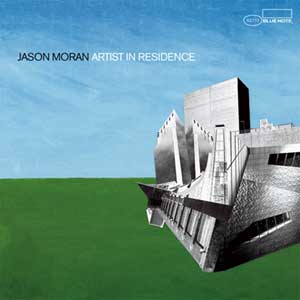
Jason Moran - Artist In Residence, or groove and the abstract truth


The playlist, like the cover art, mashes together different points of view: various commissions, settings and ways of dealing with similar material. The title itself suggests a non-linear approach closer to an art gallery than to a traditional album. Adrian Piper's "Artists Ought To Be Writing" manifesto suggests in part that artists should expose their creative process as well as the finished product. The concept of residency allows Jason Moran to do just that.

Piper's speech is used in raw form on "Artists Ought To Be Writing". Her flat voice provides far less melodic information than "Ringing My Phone"'s Turkish speaker, but Moran manages to derive an interesting phrasing from it. On "Breakdown," he chops up Piper's voice in a way that blends DJ Premier's use of horn samples (stabbing punctuation over a groove) and the RZA/Kanye West school of embedded vocal samples. Thus, the main points are hammered down: barriers, audiences and other impediments to communication need to be removed.

"RAIN" is the longest, most energetic track and, as general consensus rightly has it, AIR's centrepiece. Like the rest of the tracks involving the Bandwagon, it is squarely within the style the group has created for itself. As Ben Ratliff puts it, its "sound swims along, waxing and waning through elisions of its repertory, growing abstruse and stretching to the limit of coherence, then coming together into full coordination."

"RAIN" also shows why Moran's use of recorded materials is not a gimmick. Ralph Alessi's cylical melody initially has a slow, sad beauty. As it accelerates, it keeps the somber tone, but the tempo invites dancing. A complex question on the malleability of historical experience is posed here: can we dance now, while reminiscing on slavery? The transition to a bright, funky section provides a clear answer. After this questioning, "Lift Ev'ry Voice"'s rolls, swells and hints of stride are clearly intended as cathartic. "He Puts on His coat and leaves...," the album-closing solo piece, brings a final calm, as it lurches hypnotically between two chords upon which cycling rhythmic patterns and melodic motifs are patiently built.

A general point: Moran's use of pre-recorded material seems novel, but could very well stem from something like John Coltrane's "Psalm," where spoken cadences drive the melody. This reinforces the point that Moran is a very free thinker strongly rooted in the tradition (or, at least, a tradition). Indeed, he describes "Arizona Landscape" as "The West meets Willie 'The Lion' Smith meets Jason Moran." Listen to, for example, Smith's Music On My Mind after AIR; the commonalities between the two pianists are patent.

A series of solos and quasi-solos are nestled in the album's centre. The introduction to "Refraction 1" is wonderfully suspended and floating, while hinting at the chords to come. Unlike the quartet version of the same composition, it never leans into the groove. Instead, Moran lightly anchors his scrambled lines with a couple of bass notes. Joan Jonas's percussion is ambient, distanced from the piano's flow. It functions almost like Moran's mini-disc recordings on other tracks, but occasionally influences the pianist's playing, for example in the way Moran dissolves into the ether on the coda.

Only once does concept overrun music. If you don't know that the scratching sound on "Cradle Song" is an evocation of Moran's late mother taking notes during his childhood piano lessons, when the sound stops before the end of the song, it's a relief, rather than poignant.

AIR doesn't have the unity or driving force of Moran's other albums, but its more episodic nature provides an excellent account of several of Moran's modes and moods. Also, he could easily churn out excellent variations of his trio or solo music, but this album and recent performances (live, or on Don Byron's Ivey-Divey) show that he truly is an avid searcher.

Jason Moran's website.

My partiality towards Jason Moran.

Darcy's review.

Thursday, September 07, 2006

sonny pleases


Blogging has been slow lately, a trend which should continue for another week or so. Important events and discussions have passed me by, but I'm sure you saw them elsewhere (Dewey Redman, Do The Math's '73-'90). However, since I've become something of a Sonny Rollins fanatic of late (A Night At The Village Vanguard, The Freedom Suite, Our Man In Jazz and East Broadway Rundown are recent acquisitions), I wanted to pass along Rollins's 76th birthday page, which features one-song videos of mostly European performances ranging from 1957 (with Henry Grimes, whose face is more recognisable from back then than his playing) to 2006.

I particularly like the staging of the Rome 1962 video (with Grimes, Don Cherry and Billy Higgins) and its variety show intro music: the avant-garde square spotlights kind of make it look like a proto-iPod ad. There's plenty of melodic Rollins, but for his volcanic side, see the "Oleo" (Copenhagen 1965) with NHOP and Alan Dawson. Rollins's unaccompanied intro to "Four" (Copenhagen 1968) is another highlight. "Moritat" (Tokyo 1981) unfortunately features a lot of crowd pandering (and George Duke is listed as playing piano even though he's not), but, interestingly, sounds a lot like a precursor to Acoustic Ladyland, only based on Kurt Weill rather than The Stooges. The later dates have relatively unresponsive bands. Rollins has always been an autonomous energy source (as the solo spots show), but still...