Showing posts with label movies. Show all posts

Wednesday, August 22, 2007

vivre sa vie, Jean-Luc Godard


In the aftermath of Vivre sa vie's abrupt final scene, is it possible to not feel like a Philistine? I mean, during the long philosophical discussion in the café with the old guy about the relationship between thought and speech, I felt like I was watching a literary show on TV (perhaps because the old guy was the only one in the whole film to speak naturally?). I feel kind of defeated, but at least I know Godard feels the same way I do about Anna Karina's face.

Tuesday, July 31, 2007

Michelangelo Antonioni - The Passenger


Thanks to a more traditional narrative, The Passenger seemed both clearer and weirder than Blowup. Jack Nicholson's David Locke lets himself go into the unknown of another man's identity and wonders what's become of himself, surrounded mostly by stony-faced (African or Spanish) locals who offer him little to latch on to. Logically, then, he seems most at ease when interacting with the lady behind the Avis car rental desk.

Once again, absences come to the fore. Not only that of the desert's emptiness or the characters' lack of explicit motive, but also the lack of music and, to a degree, of movement between obvious climaxes. Those moments that could seem portentously symbolic (Locke "flying" in the cable car, Maria Schneider doing the same in the car, the amazing slow zoom out of Locke's room at the end) are cut short, as if to ward off the idea of a possible pivot point, one moment being more important than another. Even the moment when Locke decides to change identity is underplayed.

While this takes us out of the usual cinematic manipulation, where every action or emotion is articulated and commented upon (music, acting, etc...), isn't Antonioni's removal of those signposts equally manipulative? It does suceed in putting the viewer in a certain state. But maybe this a wrong question to ask: isn't the point of art to manipulate, whether in clichéd ways or not?

I wondered if some of the elements weren't more about Antonioni himself than the film. Notably, the scene in which an interviewee turns the camera on Locke seems like an admission to the viewer.

I met my photographer friend Alexis (who did the photography for Melanie De Biasio's album) at the screening and we had a great, long talk afterwards, on the film (I am unable to do justice to his insight, even though I got a few of the ideas above from him) and his view of photography. Alexis still uses traditional cameras and develops his own shots, which he framed in similar terms to the CD vs. vinyl debate. I hadn't seen his work before; check out his gallery on MySpace, it some fantastic stuff that makes great use of the organic side of traditional photography.

Coincidentally, Antonioni passed away the same day.

Tuesday, July 24, 2007

Michelangelo Antonioni - Blowup


I know I'd promised the next movie I'd go see would be Transformers, but I was overcome with a sudden craving for something serious and went off to Flagey, which will be showing a few Antonioni films this summer. It didn't help that I dozed off a couple of times (likely at crucial moments, although I'm not sure there are any, in this movie), but I probably bit off more than I could chew (comfortably recognisable Herbie Hancock soundtrack aside).

So, what is Blowup about? A photographer, Swinging London, models, a woman, a murder, beautiful shot composition, mimes? I was mostly left baffled by the meaning of what was going on: the concert (loved the clothes and stock-stillness of the crowd)? the propeller? the groupies that come to the studio? How do these elements fit in? Even the things that might have been centrepieces (the murder, Vanessa Redgrave's character) are regularly left aside. Everything remained mysterious, cognitive dissonance abounded (an early example is the scruffy guy in tattered clothes getting into the posh car; the guy turns out to be the fairly well off main character). The photographer's photos were all undeniably amazing, though. Perhaps they hint at the longing to be compassionate/meaningful that pushes him to investigate the mystery?

Bill, the painter, says early on of one of his own pieces that they look like a mess at first, until you find something to hang on to and it all makes sense. He could have been describing the film (an exquisitely rarified kind of mess, of course), except that I haven't yet really found anything to hang on to. They're showing other Antonionis, such as The Passenger (with a young Jack Nicholson, who would have made such a great Wolverine in X-Men) soon, so maybe seeing a couple more will help me understand the director's work.

Thursday, July 19, 2007

Harry Potter and the Order of the Phoenix


I watched Harry Potter and the Goblet of Fire for the first time on DVD a few days ago. It not only confirmed that the HP films had been getting steadily worse since Harry Potter and the Philosopher's Stone, it was simply terrible, all disjointed and bland. Everything that had initially made the series fun (magical details like people moving in photographs and staircases randomly changing places, colourful characters, comaraderie, a sense of fun, etc.) were replaced by an obsessive focus on the least interesting part of the whole thing, the three Tri-Wizards Cup challenges.

So I went into Harry Potter and the Order of the Phoenix with little hope. It turned out to be great, possibly the best yet. Whereas Harry Potter and the Goblet of Fire felt over-stuffed, Harry Potter and the Order of the Phoenix is densely-packed and coherent. You actually care about the main characters again and the secondary ones (the Wesley twins, Imelda Staunton, a few gravely hissed words from Snape) add life. And, there's lots of magic!

Next up: Transformers. Lots of gigantic robots! High culture, you see.

Wednesday, March 21, 2007

We Feed The World


"According to the Food & Agriculture Organisation, we currently produce enough food to feed 12 billion people. So every child who dies of hunger today has been murdered." Jean Ziegler's statement is at the heart of We Feed The World, Erwin Wagenhofer's agro-industry documentary. Through a series of examples, the film points out some of the absurdities, inequalities, biases and injustices of the global food industry.

Wagenhofer does away with any lingering Malthusianism: in Vienna, we see enough bread being thrown away to feed Graz, Austria's second city, while in Brazil, a massive agricultural producer and exporter, up to 25% of the population suffers from endemic undernourishment.

There are ecological issues, when vast tracts of the Amazon are razed to grow soja to be exported and fed to European farm animals, social issues, as in the (probably illegal) African migrant workers who live in squalor while tending to the vast greenhouses of Almería, Spain, economic issues, such as the well-known example of subsidised European produce being sold in Dakar, Senegal at half the local prices, quality issues in the limp, damaged fish resulting from industrial deep-sea fishing. There are a few others, and there could be many more.

WFTW culminates with an interview with the Nestlé CEO, who is allowed to simply state his company's outlook. It's edifying to learn that, for him, considering access to water a fundamental human right rather than just another food commodity is an "extremist position."

I think the film could have been just a little punchier, but the section focusing on a chicken farm makes for an arresting series of images. We see the chicken life-cycle from conception, incubation, hatching, dispatching (imagine Modern Times but with thousands of chicks instead of one Charlie Chaplin), raising and slaughter. The slaughter machine is both Rube Goldberg-esque and ruthlessly efficient. It is actually made somewhat more sinister by the in-built "humane" component. It's far removed from the travails of human slaughter by an avant-classical musician. There's nothing quite "wrong" with the whole process, but it does illustrate how disconnected we are from agricultural processes and how they themselves are increasingly divorced from nature.

Tuesday, January 23, 2007

Zéro DB + Nic Thys/Pierre Van Dormael/Stéphane Galland - 21/01/2007@Théâtre Molière, Bruxelles


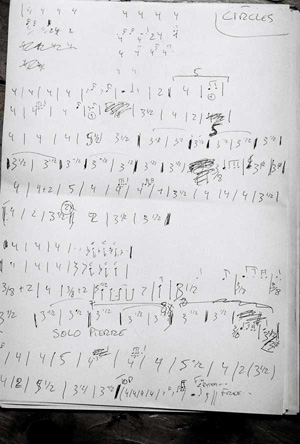
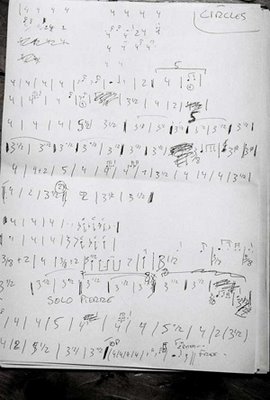
Zéro DB, directed by Aurélien Bodinaux, follows Nic Thys in New York and Brussels as he works on and records a composition called "Circles." He composed it 15 years ago, but didn't do much with it at the time and it was never performed, or even titled.

The film recounts the process through which an idea takes form outside the musician's mind. In this case, how "Circles" becomes a recording. In the beginning, Thys talks about the process in general, and its dangers: that the actual music might not sound as good as imagined. During an early brainstorming session, the director blurs the voices of the three people in the room, creating a metaphor for the process. Unfortunately, the film soon abandons this poetic aspect to become little more than a slightly quirky documentary following the flow of events: Thys recording some demos by himself, rehearsing with Pierre Van Dormael and finally all the musicians playing their parts in the studio.

Thys has just returned to Belgium after 7 years in New York, so the showing also served as a welcome back party of sorts, with many friends, family and colleagues in attendance. Everyone in the large crowd was amused to see Thys's increasingly hirsute beard and touched when Otti Van Der Werf dropped by the studio to add some handclaps.


Nicolas Thys - el b
Pierre Van Dormael - acoustic g
Stéphane Galland - perc

After the film, a clean-shaven Thys came onstage to play duets with Pierre Van Dormael. The first two pieces were sort of Belgified country songs that hid their contrapuntal and structural complexities under unassuming melodies and relaxed yet alert playing. Thys remarked that his older songs were more complicated than his new ones, because his life was more complicated then. It seems to me that he is perhaps better able to communicate and challenge simultaneously. I've recently noted a similar change in Octurn's music, due to Magic Malik's influence, though their level of complexity is much higher. Maybe it's a generational thing.

The third and last duet was inspired by Thys's visit to his wife's family in New Mexico and its amazing landscapes. He started alone, playing a steady bass line and a melody above it. It was relatively simple and, appropriately, sounded like Johnny Cash singing a cowboy song. When the guitar joined in, the form was stretched and extended, but the basic feel was never lost.

Stéphane Galland joined them at this point, on tubs, a metal pipe and a few other metallic implements I couldn't see. It was amusing to hear him play his amazing Galland-isms on these much brighter and drier surfaces, using just sticks, no feet. The opportunity was there to create a sort of hi-tech washboard band, but that connection wasn't explored, fortunately or unfortunately. It did, however, allow for really clear interaction between the three instruments. They played "Can Festis," which you can hear on Pierre's MySpace and "Circles," the evening's running theme.

The crowd called them back for an encore, to which Thys replied: "Well, this is unexpected. When you've run out of written and rehearsed material, what do you do? You play jazz." They then proceeded to play "Moment's Notice" - at least, that's what I thought at the time, but I'm not so sure any more. In any case, they brought their 3-way counterpoint and the weird harmonies they, Pierre especially, are masters of, to a more standard jazz form, which the guitarist acknowledged with a winking "St. Thomas" quote.

Thursday, November 30, 2006

alea jacta est

what, no babes?


Believe the hype: Casino Royale is very good. Steve Smith breaks it down better than I could. We differ only in our appreciation of the title song: I didn't like it. I would also add that, while it's good that Bond's first mission isn't of save-the-world proportions, the villains lack personality and appear and disappear incomprehensibly. If you go see it, don't be late: the opening scene is amazing. Stylistically, it's almost alternate-universe Bond, like Superman drawn as a manga.

The real comedy came after the film, as IVN and I were walking back to the car. I was showing her a storefront window and walked into a lamp-post. As a lover of slap-stick comedy, that amused her immensely. It was when, a few steps later, my foot slipped off a ledge and I nearly tripped, that it all became too much and she literally howled with laughter for minutes afterwards.

Saturday, November 11, 2006

bring your own bag


[UPDATE: Speaking of Borat, Clap Clap is back!]

We went to see Borat last night. We missed the first few minutes because IVN and friend V, who came to see the film with us, spent 20-25 minutes attending to a guy in the theater's lobby who was having an epileptic fit of some sort. When the paramedics arrived, they (V and IVN) hooked the guy up to an IV drip and he was wheeled away. A doctor's work is never done.

There was more drama to come: shortly after we were finally seated, there was a problem with the reel and the showing was interrupted. When it eventually resumed, a part of the film had evidently been skipped, the picture had trouble aligning itself with the screen and for a long while, the upper-right hand corner of the picture was obscured. If that's the level of service one gets for 8.10 euros, it'll be hard to regret the disappearance of mulitplexes in favour of home cinema systems. Still, the room was packed and the laughter uproarious.

I first saw Ali G when it was the best part of the Eleven O'Clock Show. To see that it has come to this is hugely satisfying.

Saturday, September 03, 2005

You are now leaving Basin City


Public transported (gas prices you see, and also for some reason I don't like that drive) up to the Heysel Kinepolis to see Sin City, finally. I say "finally" because it's been out for such a long time and have liked the comic books (sorry, graphic novels) for years. I can just make out the cover of "Family Values" in an open cardboard box in the corner of the room.

The Kinepolis is right next to the Atomium. The Atomium is, without a doubt, this city's greatest landmark. It's one of those things that sounds cheesy on paper ("an giant representation of an iron molecule?") but is awesome in reality. I was dumbstruck the first time I saw it, as delusions of cheesiness dissipated, and am duly impressed whenever I see it, be it from far away on the Ring or close up. The monument is being renovated. A lot of the balls (sorry, atoms) are finished and look great. Shiny, stripey silver like brand-new pétanque boules. For a temporary construction from 1958, it's doing pretty well for itself.

Sin City is probably the most (successfully) faithful comic book adaptation I've ever seen. Even the rainfall recalls Miller's white streaks breaking up chunks of black. The way the story arcs are grouped, echoing each other but remaining independent, timelines crossing in the Old Town bar, perfectly captures the experience of reading the trade paperbacks or one-shots as they come out.

The prostitutes, as hyper-women struggling to balance independence, love and the explosive nature of their relationship with the men who simultaneously empower and undermine them, appear as a kind of flip-side to Kurosawa's samurai wife. If real-world prostitutes looked like Frank Miller's, I'd understand their business's impermeability to business cycles. Real prostitutes (well, the ones I've crossed, anyway) looking as they do, I don't.

And Alexis Bledel. I'd always wondered if the way she speaks on Gilmore Girls is Rory or Alexis. Apparently it's Alexis. She even briefly breaks out into some GG double-time. It's enough to make you think that, when she bucks orders and phones her Mom, it's Lorelai on the other end.

I need to dig out my Sin City's and thumb through them one more time.

At 22.00 I walked out of the multiplex, waited a few minutes for the subway, got to Gare Centrale with a few minutes to spare before the train arrived. Perfect timing. It's a good thing I didn't drive, it could have been a dangerous ride back. I've always been uncomfortable with the liberal/free speech claim that violent entertainment cannot be blamed for violent behaviour. Of course, the link is not so simple, but the necessity of that radical position seems to me to occult the powerful effect that art does have on the psyche. If it didn't, there would be no point to it. Recent studies claim that the effects of violent entertainment on children are short-term. I still believe that subtle long-term shifts occur (again, not necessarily in a violent in-violent out way). And why only consider violence? Imagine the millions of women whose lives have been made tolerably miserable by fairy tales and romantic comedies.

Walking home after seeing The Matrix, I casually jay-walked in front of an oncoming car. It took me a moment to realise that I could not, in fact, stop it by raising my hand. Last night, walking to and sitting in the subway and train, I took a hard-boiled look at everything. It's only a bit after I got home, an hour later, that I had sunk back into reality. Or, should I say, the movie had seeped back out of my pores.

Thursday, October 28, 2004

Tuur Florizoone + "The General" - 27/10/2004, Brussels


Not much to say about the film apart from

Slapstick 4 evah!

The show was scheduled to start at 9PM. At about 8:55, as I was making my way there I spotted Tuur ordering a durum and then walking away from the bar.

He followed the movie much more precisely and concretely than Dumoulin did a few of weeks ago, imitating trains, playing musette, tango and pseudo-military songs. Good fun.

---

In random be.news that I'd forgotten to report, Nicolas Kummert says that 4, who released a good album on Mogno, has recorded a new one and is looking for a label.