Showing posts with label jason moran. Show all posts

Thursday, March 22, 2007

Jason Moran and the Bandwagon - 21/03/2007@Ancienne Belgique, Brussel


Jason Moran - p
Tarus Mateen - el b
Nasheet Waits - d

From time to time, I wonder: is it the Blue Note hype? the hat? the (I must admit, super-cool) way Tarus Mateen slouches in his chair like a lackadaisical B. B. King? I was rapidly reassured that it was the music, creativity and imagination that get to me. And the hat rocked, too.

The brief recorded sound collage that began the concert was expected, but the sudden, prolonged drop into silence wasn't. The maelstrom that followed made for a satisfyingly uncompromising beginning. Even though a few tolling piano chords deftly cued the slight, gospel-tinged groove of "Gangsterism on the Rise," there was never anything merely functional or teleologically climactic about the Bandwagon's free playing: they do it for real (elasticity and unpredictability are maintained), but not forever (it's set within a wider framework), while letting something of the tune lurk in the depths.

in several places at once

Some of the material was taken from Artist In Residence (review). The lovely "Milestone" prompted a bit of self-congratulation: "That shit was inspired" was Moran's assessment. "He Puts On His Coat And Leaves" placed the hypnotic piano surface of the album's solo version on top of the Mateen-Waits bustle and was as close as the Bandwagon got to the likes of E.S.T. I think I heard the slow, thick, tremulous chords of "Lift Ev'ry Voice" at some point. "Artists Ought To Be Writing" and "Breakdown" were logically performed as a medley.

While not really a highlight (without Marvin Sewell, "Breakdown" lacked the snap of the album version), but the AOTBW's voice-as-score approach was interesting to watch live. It put the voice on two levels at once: on top, sonically, as it boomed from the speakers, but also at the bottom, since the whole composition emerged from it. My favourite part of Dave Douglas's Keystone: Live In Sweden (I don't have the studio Keystone album) is part 4 (if I'm not mistaken) of the "Fatty and Mabel Adrift Suite" when Dave interacts with a manipulated sample of Arbuckle's voice. For a brief moment, his lines and the voice come together in a really fascinating way, one unique to that particular instrumentation.


A few other recurring Moran themes were explored: the blues with "Jump Up" and "Let Me Play The Blues For You", a Jaki Byard tune with a de rigueur stride section that thankfully melted into a more personal, less didactic take on the idiom and, as encore, an elastic-tempo swinger that liberally quoted (sampled?) from tunes already played.

The real standout, though, was "Crepuscule With Nellie," totally reconfigured yet totally Monk. For example, thematic material (some belonging to the tune, some written by Moran) was organically looped in the piano introduction in a way that related to Monk's occasional anti-solo solos, the ones that were little more than slightly adjusted restatements of the theme. Moran said that he was currently exploring, among other things, "the sexual aspects" of Monk's music, which explained why they played "Crepuscule With Nellie" as "an r'n'b tune."

Monday, October 02, 2006

more on Artist In Residence

UPDATE: Godoggone reproduces Nate Dorward's Signal To Noise review. I'm less bothered by AIR's "scrapbook" nature than Nate is.

Godoggone loses his Moran virginity and comes out of the experience both titillated and disappointed.

He also provides a link to another blog review, which is threaded with interesting quotes. On "Milestone:" "the guitar of Marvin Sewell imitates the voice timbres and melodic movement in swooping figures." I'd originally said something similar in my review, but removed it from the final draft. Maybe I'll put it back in for the French version.

A new (to me) thought: doesn't Moran use the avant-garde kind of like pop does? Folding it unostentatiously into a different style and thus reconnecting it with the rest of society (or of the listening public). Peruse Destination: Out and you sometimes get the feeling that the mainstream lost touch with the avant-garde and broke off the back-and-forth that binds the two. Of course, a band like the AEC could do that back-and-forth (and much else besides) all by itself.

I didn't know about Words and Music, it looks good. The review is logically followed up by a post on Cecil Taylor (and how organised his freedom was: "the fiery brio with which it is played disguises, perhaps, the underpinnings"), and a bit on the Moran-Sam Rivers connection.

There's also discussion of Giuffre's Free Fall, an album which failed to grab me so far, despite several attempts. However, since then I've come around to Messiaen's Quatuor pour la fin du temps (and some of Giuffre's earlier work, the trios and arrangements for Shelley Manne's septet, not that they sound much like FF), so maybe I should give it another shot.

Saturday, September 23, 2006

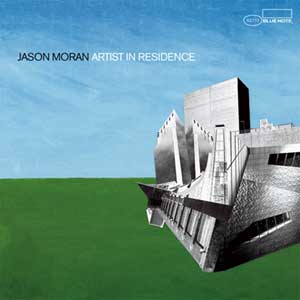
Jason Moran - Artist In Residence, or groove and the abstract truth


The playlist, like the cover art, mashes together different points of view: various commissions, settings and ways of dealing with similar material. The title itself suggests a non-linear approach closer to an art gallery than to a traditional album. Adrian Piper's "Artists Ought To Be Writing" manifesto suggests in part that artists should expose their creative process as well as the finished product. The concept of residency allows Jason Moran to do just that.

Piper's speech is used in raw form on "Artists Ought To Be Writing". Her flat voice provides far less melodic information than "Ringing My Phone"'s Turkish speaker, but Moran manages to derive an interesting phrasing from it. On "Breakdown," he chops up Piper's voice in a way that blends DJ Premier's use of horn samples (stabbing punctuation over a groove) and the RZA/Kanye West school of embedded vocal samples. Thus, the main points are hammered down: barriers, audiences and other impediments to communication need to be removed.

"RAIN" is the longest, most energetic track and, as general consensus rightly has it, AIR's centrepiece. Like the rest of the tracks involving the Bandwagon, it is squarely within the style the group has created for itself. As Ben Ratliff puts it, its "sound swims along, waxing and waning through elisions of its repertory, growing abstruse and stretching to the limit of coherence, then coming together into full coordination."

"RAIN" also shows why Moran's use of recorded materials is not a gimmick. Ralph Alessi's cylical melody initially has a slow, sad beauty. As it accelerates, it keeps the somber tone, but the tempo invites dancing. A complex question on the malleability of historical experience is posed here: can we dance now, while reminiscing on slavery? The transition to a bright, funky section provides a clear answer. After this questioning, "Lift Ev'ry Voice"'s rolls, swells and hints of stride are clearly intended as cathartic. "He Puts on His coat and leaves...," the album-closing solo piece, brings a final calm, as it lurches hypnotically between two chords upon which cycling rhythmic patterns and melodic motifs are patiently built.

A general point: Moran's use of pre-recorded material seems novel, but could very well stem from something like John Coltrane's "Psalm," where spoken cadences drive the melody. This reinforces the point that Moran is a very free thinker strongly rooted in the tradition (or, at least, a tradition). Indeed, he describes "Arizona Landscape" as "The West meets Willie 'The Lion' Smith meets Jason Moran." Listen to, for example, Smith's Music On My Mind after AIR; the commonalities between the two pianists are patent.

A series of solos and quasi-solos are nestled in the album's centre. The introduction to "Refraction 1" is wonderfully suspended and floating, while hinting at the chords to come. Unlike the quartet version of the same composition, it never leans into the groove. Instead, Moran lightly anchors his scrambled lines with a couple of bass notes. Joan Jonas's percussion is ambient, distanced from the piano's flow. It functions almost like Moran's mini-disc recordings on other tracks, but occasionally influences the pianist's playing, for example in the way Moran dissolves into the ether on the coda.

Only once does concept overrun music. If you don't know that the scratching sound on "Cradle Song" is an evocation of Moran's late mother taking notes during his childhood piano lessons, when the sound stops before the end of the song, it's a relief, rather than poignant.

AIR doesn't have the unity or driving force of Moran's other albums, but its more episodic nature provides an excellent account of several of Moran's modes and moods. Also, he could easily churn out excellent variations of his trio or solo music, but this album and recent performances (live, or on Don Byron's Ivey-Divey) show that he truly is an avid searcher.

Jason Moran's website.

My partiality towards Jason Moran.

Darcy's review.

Tuesday, August 08, 2006

wannabe


It's serendipitous that Francis Davis should say that Bill Evans was the jazz musician he "identified" with, because over the last few days I've been thinking the same of Jason Moran. That doesn't mean that he's my very favourite, but simply that his public persona and his music are the closest thing to an idealised mirror of myself: perfect-son-in-law looks and demeanour, well-educated, great eyebrows and his music is left-of-center without being left-field. Mingus and Monk are too out there as personalities for me, Miles too... Miles, Coltrane too intense, Duke Ellington too old school and (to take someone else around my age that I've been listening to of late) Robert Glasper too conventional. It helps him that I'm more drawn (in the self-identification sweepstakes) towards pianists, having taken piano lessons in the past.

I've been listening to Moran a fair amount lately. I have his last four albums and a couple with Greg Osby (Banned In New York and Symbols of Light (A Solution)), but am missing his first two. His live album received a luke-warm reaction, if I remember correctly, but I like it a lot. "Gentle Shifts South," which layers fragments of friends' and families' conversation and anecdotes over a very gentle ballad, eases the music out of the social void jazz too often takes place in. It's interesting that the studio version on Modernistic is purely instrumental, while the live version uses samples, as that's still rare in a traditional acoustic jazz setting. "Ringing My Phone (Straight Outta Istanbul)" makes different use of the human voice by deriving its twisty, start-stop melody from a recording of a woman speaking Turkish. When a one-bar loop is extracted from the conversation, the song becomes irresistable.

"Out Front" and "Planet Rock" are both the kind of romps Moran is becoming a master of (cf. "You've Got To Be Modernistic," "Jump Up" and "I'll Play The Blues For You"). Further, connecting Jaki Byard to Afrika Bambaata is particularly astute. The solo version on Modernistic starts anemically and gets better as it goes along, especially when the reversed sounds come in, but the live trio version makes sense right from the beginning. Just yesterday, I discovered Albert King's version of "I'll Play The Blues For You" and Moran's doesn't suffer for the comparaison. Jazz covers of soul and hip hop often end up sappy, but Moran consistently avoids that trap.

Then, there's Black Stars, which may end up having the same relationship to the rest of Moran's discography as Compulsion!!!!! does to Andrew Hill's.

As forward-thinking and all-embracing as Moran is, whatever he does "comes across as a statement of love and respect for the jazz piano tradition" (David Adler): he's worthy of his mentor Jaki Byard's heritage. Maybe I'm listening to Moran too much: even Tarus Mateen's solos are starting to make sense.

Tuesday, May 16, 2006

Jason Moran - Steve Coleman - Reggie Workman - 13/05/2006, deSingel


We were lucky to have a concert at all: Sam Rivers was originally billed, but dropped out and a Parisian concert was cancelled altogether. At 82 years old, I hope he's doing okay. I was listening to "Fuschia Swing Song" the other day, it's such an amazing album. "Beatrice" has become a jazz standard, but there are other, equally great tunes on FSS. My favourite moment is perhaps the very beginning of the first (and title-) track: tenor and bass alone for a few seconds, Ron Carter walking furiously while Rivers cruises through these magical intervals in a manner that evokes a speeding sleek, obsidian, oblong object. Around the same time, check out his soprano on "Ghetto Lights" (on Bobby Hutcherson's "Dialogue"): it illuminates an already wonderful polyphonic Andrew Hill composition.

Back in the concert hall, Steve Coleman flew in from the USA to save the day. Pianists haven't found much of a place in Coleman's recent work, but on his latest album, "Weaving Symbolics," there are two trio tracks with Moran and young drummer Marcus Gilmore that are somber and mysterious and unexpected (listen to "Tehu Seven") that I love (I love the album as a whole: it's a sprawling two-CD monstrosity that probably triggers the same follow-the-clues neurons in listeners as the "Da Vinci Code" does in readers. I say "probably" because I'm part of the ever-shrinking minority not to have read DVC.) and used to warm up before heading out to Antwerpen. I left the bullet-proof vest at home.

The trio played chamber music that drew on "a menagerie of compositions by (...) a whole bunch of people," according to Moran. The only one I recognised was "Beatrice," although I thought I caught a glimpse of "All The Things You Are," but that was probably the result of my having listened earlier in the day to Monk and Milt Jackson smuggle subversive messages into the song behind whoever was crooning it. Maybe it was where I was sitting, but Moran's attack generally sounded incredibly soft: he depressed the keys like they were pillows. There was none of the Bandwagon's frantic sugar-rush excitement or skittish change-ups: it was all about three musicians, each one a leading member of their generation's re-interpretation of a common heritage, coming together and improvising, quietly.

The music wandered, sometimes fixated on a soulful downwards riff, briefly free-wheeled in a zone somewhere between Sonny Rollins playing cowboy tunes and Jimmy Giuffre's "The Western Suite," once declaimed a series of interconnected unisons, occasionally giving way to sudden eruptions of fury (in a moment of unintentional comedy, Workman's aggressive arco sounded like a cavernous evil leader laugh) and regularly coalesced around duos. With no amplification save the bass amp, everything sounded exquisite, floating, unresolved and thus, liquid, not quite graspable: there were frequent micro-changes in mood, tempo and accompaniment.

Coleman maintained his warm "standards" tone (as opposed to the steely one he generally employs for his own music). When he played alone, on the last song before the encore, the hall's natural resonance was heard to full advantage. Workman shone throughout, but never brighter than when he began the encore alone on bow and intoned a grave quasi-lamentation that almost sounded like something out of the "Crouching Tiger, Hidden Dragon" soundtrack.

Afterwards, as Workman was ready to leave deSingel's basement bar, he stopped in front of me and said: "We haven't had a chance to talk." That was precisely the last thing I was expecting, and I only managed to bumblingly assure him of my enjoyment of the concert. We shook hands. I believe it was the first time I had done that with someone who had played with Coltrane. Which brings me back to Sam Rivers. Rivers is actually older than Coltrane and Miles (as are Toots and, I believe, Yusef Lateef), which means that there's no real reason for them not to still be around and playing, apart from the fact they're dead. Just another reminder of how short jazz history actually is.