Friday, August 18, 2006

be.mp3: rackham - olga und barnabe

Rackham is:
Toine Thys - saxophone
Laurent Blondiau - trumpet
Benjamin Clément - guitar
François Verrue - bass
Teun Verbruggen - drums

Toine Thys works in a lot of different contexts (the two-tenor Walrus quartet is a treat if you get to hear it in the right context) and is a big Paul Motian fan, but Rackham shows his contemporary jazz-rock side. If I understood correctly, Clément and Verrue are straight-up rock musicians, whereas Blondiau (leader of the excellent Maak's Spirit) and be.jazz friend Verbruggen operate in several of Belgium's most interesting jazz groups. In concert, Clément's distorted/noise solos are particularly crowd-pleasing.

From the website:

Here is just a list of truly inspiring artists who influenced Rackham's music in one way or another: Stevie Wonder, David Bowie, Radiohead, Calexico, Jim Black, Chris Speed, Brasilian Girls, Brian Blade Fellowship, Madonna, Jeff Buckley, Nic Thys, Björk, Ryan Scott, the Bloomdaddies, Nirvana, (more to come..

"Olga Und Bernabe" is taken from a 3-song demo recorded in February that Toine gave me a while ago. The song's German title is misleading, as it starts with an Indian-sounding guitar riff and its theme consists of pop/rock inspired stuff that reminds me a bit of the melody of Human Feel's "Not About You" and a lot of André Canniere. What Europe/US divide?

Rackham - "Olga Und Bernabe"

"Spine," another of the demo tracks, is in a similar vein, but less succesful. "Juanita Kligopoulou" is better, and has an acoustic guitar and a Texan trumpet that give it a Calexico-y Far West ambiance. The debut album is expected for the end of the year.

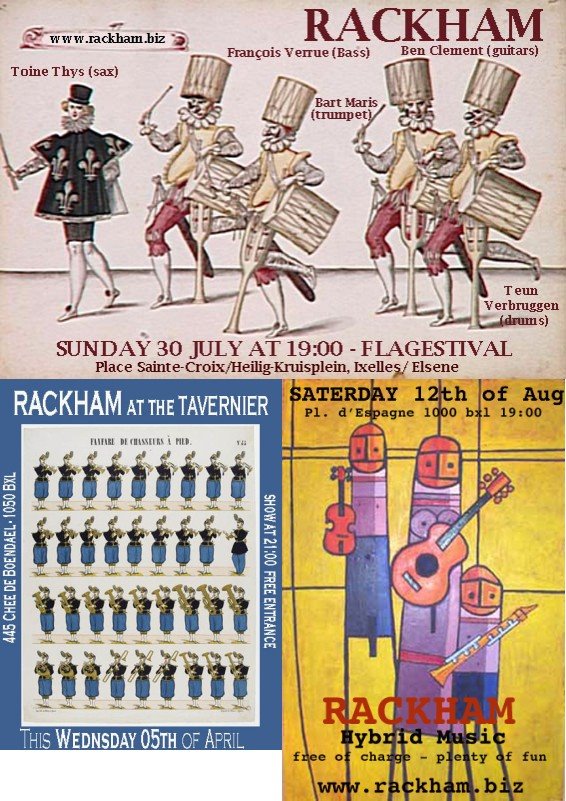
I've also been accumulating some nice e-flyers in my inbox over the last few months. Here they are.
Sunday, August 13, 2006

typewriter music

The fingering would be relatively easy to program, but I'm curious about the breath control mechanism, though. I wonder if a similar kind of robot could be combined with interactive, semi-improvising software like Olivier Sens's Usine. It'd be more interesting than the robot conductor.


[via Rifftides]

Friday, August 11, 2006

be.mp3: vvg trio - untamed


As a trio, Bruno Vansina (alto, soprano), Gulli Gudmundsson (from Iceland, bass) and Teun Verbruggen (drums) started out playing bop, then progressively opened up to more improvised music. In Orbit is the VVG Trio's second album, a two-CD affair. The first CD, a studio record, allows the group to flaunt its togetherness and combination of improvisation and melody. The second CD is live, with pianist Jozef Dumoulin and flutist Magic Malik sitting in. Neither knew the music and hearing them learn it in real time is fascinating, as they don't hesitate to push the trio around a bit. So there's a good balance between studio perfection and on-the-job rough edges. It's a risky move and sometimes the music drags (20 minutes of "All Or Nothing At All" is just way too much), but there are enough unexpected moments of beauty for it to be more than worthwhile, for example, on Kenny Wheeler's "Mark Time" there's a simply gorgeous passage where the whole band blends together into something fluid and full-bodied. Maybe that's the meaning of Whitney Balliett's "sound of surprise:" not that you've never heard anything like it before, but that the music is open enough for truly unscripted incidents to occur.

The second CD is also a too-rare opportunity to hear Dumoulin on acoustic piano. The Archiduc's has a real jazz club piano tuning (as defined by Eric Dolphy's 5 Spot albums), but Dumoulin's work on Fender Rhodes has made him a real expert at texture, and he gets some nice ones here. He kind of reminds me of Keith Tippett at times, actually.

"Untamed" is just the trio. It starts with a vigorous Vansina solo, then states a head that's boppish in a Greg Osby way, but less cerebral. I like Gudmundsson's twanginess and how Teun starts thwacky, then gets into straight-ahead swing. Vansina charges ahead intelligently for nearly 6 minutes, but then, after a brief bass interlude, returns with a melodic riff that serves as accompaniment for a roiling drum solo. The track kind of shows several sides of the VVG Trio at once.

VVG Trio - Untamed

two in one


Yesterday, I was surprised to learn, upon his death aged 84, that Duke Jordan had still been alive.

Today, I was surprised to learn that Miguel Anga Diaz had died, only 45 years old. I first heard him on Orishas's debut album back in 2000, then on Buena Vista-affiliated stuff. I saw him give a good concert with Omar Sosa late last year. Their encore duet was a highlight.

snippets of hope


?uestlove has posted some ads for Game Theory on his blog. They sound really good.

Thursday, August 10, 2006

textile promiscuity


The cover video industry has taken off. The weird thing is that no official, run-of-the-mill sexy-in-the-club video, regardless of budget, can beat a cute girl, a puppet, a fixed camera and disco lights.

hot 'n' brassy


Re-listening to Steve Coleman's The Way Of The Cipher, part of the legendary Live At The Hot Brass trilogy, after a long time. These albums, and some of Coleman's others from the early-to-mid '90s had a really big impact in France. I've heard several people call them crucial high-school experiences and a lot of European (well, Franco-Belgian, at least) musicians have been influenced by Coleman in some way.

One thing that's always puzzled me is that one of the three rappers (who, officially at least, is not Black Thought) quotes The Roots's "Proceed," which could only just have come out, back in 1995. Anyway, the album continues to be one of the best jazz/hip hop mixes I've heard. The flaws are obvious, but are more a matter of execution than conception: the rappers could be better (imagine teleporting Dizzee Rascal into this) and there could have been a little more preparation/arrangement (things sharpen up whenever some collective stop 'n' go is initiated). The cutting contest rap format means that things start off slowly, but improve steadily.

The main reason for the album's success is obvious too: Gene Lake and Reggie Washington (who lives in Belgium now) are phenomenal. They're intense and always focus on providing an unstoppable beat, never showing off or letting the energy sag. Andy Milne adds some discrete rhythmic comping, Coleman and Ralph Alessi occasionally add a theme or background riff and, even more infrequently, there's a solo. So you have a stellar stark, driving backdrop for freestyling that ranges from mediocre to quite good. Coleman has a couple of good solos: on the first one especially, he seems to be trying to translate a rapper's flow to saxophone by investigating a riff at length. It's kind of the hip hop equivalent of the George Adams/Don Pullen group: a greasy kind of avant-gardism, minus the exuberant instrumentalism.

More varied rapping (in terms of themes, flow, dynamics, etc.) with the same energy level, would have made The Way Of The Cipher the Holy Grail. The search continues (and certainly doesn't end at Tale of 3 Cities, a lacklustre studio album).

Wednesday, August 09, 2006

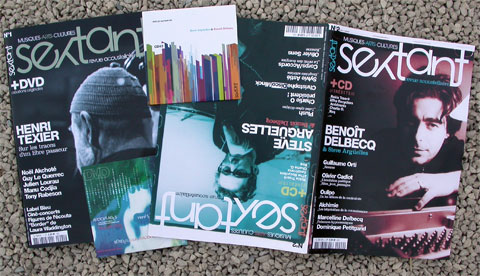
Sextant: revue acoustellaire

Sextant covers
(photo by Jean-Jacques Birgé)

I was initially hipped to Sextant, a new French magazine, by Samizdjazz (back in January!), then reminded of it by Jean-Jacques Birgé when the second issue came out. I then ordered both issues. It doesn't hurt that "acoustellar" is a great description of a great album by a great band that happens to almost bear my name.

In a nutshell, Sextant is a good example of what I think music magazines should be, post-Internet. The old news/interviews/reviews tied up in a neat publicity-driven bow is now totally redundant: you can not only read all that for free online, you can hear it, too. Sextant's website complements the magazine with more up-to-the-minute news and reviews, as well as audio/video. If you can get all your fast-food online, then paper has to be a lavish home-cooked meal, and that's what Sextant is. It's a bit like a hugely expanded version of The Wire's primers, made slowly and lovingly, totally unrelated to music industry business cycles and it takes a good while to read. The layout is spare and sleek, with a few details (eg. the pointers at the top of every page, the way articles interrupt the main interview) acknowledging the influence of the Internet on graphic design and information organisation.

Each issue is based around one or two musicians. #1 featured a long Henri Texier interview, broken up by interviews with collaborators such as Sébastien Texier, Noël Akchoté and photographer Guy Le Querrec and articles on artforms Texier is peripherally connected to. There's a DVD that I haven't watched yet. #2 does the same with Steve Argüelles and Benoît Delbecq. It comes with a CD that has a lot of exclusive or unreleased stuff. #3, coming in October, will feature Birgé and cellist Vincent Courtois. The interviewees are all progressive, challenging types and I hope that remains the magazine's approach.

I wouldn't call the writing extraordinary. Simply, it's at the level all magazines should be at, rather than the usual here's-my-latest-CD puff (Vibrations, the one music magazine I subscribe to, would do well to take some cues from Sextant). By dint of sheer length, the interviews can reach interesting places. Unfortunately, the articles, especially in the Texier issue, use the insufferably pretentious and obtuse academic prose France is rightly ridiculed for (but that language comes very naturally and sounds a bit less pretentious in french than in english). Is it really so bad to use "historical context" instead of "diachronic context?" However, that's just about my only complaint.

A final point, but an important one: there are no ads. Well, there was one (1) on the inside cover of the first issue. So when you buy it, you get pure content, 50 pages worth in #1, 62 in #2. That's non-negligeable and makes you feel like you're actually supporting something, rather than just pumping up circulation numbers to be shown to prospective advertisers.

handling business

Who needs record companies? and a sobering reply (via Darcy).

It seems to me that it's a career decision rather than a necessity. Ani DiFranco was never on a major label. Rappers have consistently been able to "drive Phantoms" by building up a strong regional fan base without being big nationally. I wonder if the success:failure ratios of self-run, indie and major labels are significantly different.

While the Fortune article talks about megastars opting out of the system or redefining their relationship with it (Ice Cube, in this example, another could be Prince), it should be possible to go bottom-up as well: do well enough on your own so that there's no at-all-costs pressure to sign a major label deal. And is this really all that new? Tim Berne has been running Screwgun for a long time.

In the end, if the aim is to make a living and own what you create, then alternatives to the major record deal (which isn't even an option for a huge part of the world's musicians) look pretty good, from my totally outsider perspective.

Tuesday, August 08, 2006

wannabe


It's serendipitous that Francis Davis should say that Bill Evans was the jazz musician he "identified" with, because over the last few days I've been thinking the same of Jason Moran. That doesn't mean that he's my very favourite, but simply that his public persona and his music are the closest thing to an idealised mirror of myself: perfect-son-in-law looks and demeanour, well-educated, great eyebrows and his music is left-of-center without being left-field. Mingus and Monk are too out there as personalities for me, Miles too... Miles, Coltrane too intense, Duke Ellington too old school and (to take someone else around my age that I've been listening to of late) Robert Glasper too conventional. It helps him that I'm more drawn (in the self-identification sweepstakes) towards pianists, having taken piano lessons in the past.

I've been listening to Moran a fair amount lately. I have his last four albums and a couple with Greg Osby (Banned In New York and Symbols of Light (A Solution)), but am missing his first two. His live album received a luke-warm reaction, if I remember correctly, but I like it a lot. "Gentle Shifts South," which layers fragments of friends' and families' conversation and anecdotes over a very gentle ballad, eases the music out of the social void jazz too often takes place in. It's interesting that the studio version on Modernistic is purely instrumental, while the live version uses samples, as that's still rare in a traditional acoustic jazz setting. "Ringing My Phone (Straight Outta Istanbul)" makes different use of the human voice by deriving its twisty, start-stop melody from a recording of a woman speaking Turkish. When a one-bar loop is extracted from the conversation, the song becomes irresistable.

"Out Front" and "Planet Rock" are both the kind of romps Moran is becoming a master of (cf. "You've Got To Be Modernistic," "Jump Up" and "I'll Play The Blues For You"). Further, connecting Jaki Byard to Afrika Bambaata is particularly astute. The solo version on Modernistic starts anemically and gets better as it goes along, especially when the reversed sounds come in, but the live trio version makes sense right from the beginning. Just yesterday, I discovered Albert King's version of "I'll Play The Blues For You" and Moran's doesn't suffer for the comparaison. Jazz covers of soul and hip hop often end up sappy, but Moran consistently avoids that trap.

Then, there's Black Stars, which may end up having the same relationship to the rest of Moran's discography as Compulsion!!!!! does to Andrew Hill's.

As forward-thinking and all-embracing as Moran is, whatever he does "comes across as a statement of love and respect for the jazz piano tradition" (David Adler): he's worthy of his mentor Jaki Byard's heritage. Maybe I'm listening to Moran too much: even Tarus Mateen's solos are starting to make sense.

Monday, August 07, 2006

school benches

Settled In Shipping describes his education.

Bebop, swing, and the blues are either the Holy Trinity, or dusty relics that are relegated to their time in history.
A sad state affairs, and one that doesn't correspond to the reality of progressive jazz of any era: Steve Coleman, Jason Moran, Greg Osby (his latest CD, Channel Three, is quite good), Mal Waldron, Steve Lacy, Andrew Hill, Monk (although, there is that "we changed all that" quote)...

SiS also points to the way out: personal initiative.
I was fortunate enough to have Jeff as a teacher and mentor, and we often talked about avant-garde/free music; I got a balanced education that way.

Luckily, I got involved with CKUT my second year of university, and their library houses a whole world of improvised music not much discussed in the faculty
I think that this applies to any education: your teachers aren't going to spoon-feed you everything (no matter how much you pay), either because of personal bias or cirricular strictures.

Also, I hadn't realised David was so young!

Friday, August 04, 2006

sad

I haven't seen this mentioned anywhere: Rufus Harley dies

moving in with brad (part 2)


Had House On Hill come out straight after AG, I certainly would not have bought it. Now, however, looking back on the Rossy period seems pertinent. Two of the tracks were recorded the day before Day Is Done, creating an odd, Janus-faced moment, but the seamless blend between sessions 2.5 years apart confirms the necessity of change. "August Ending" and "Fear And Trembling" (the two tracks from the later session) do point towards a new mood, but I think it took Ballard to make it explicit. My first impression was that the album was strong and that I needed to get Anything Goes: I'd probably be better able to appreciate its qualities now. Then, listening further, a few things started to bother me: the tracks drag on a bit (but it wouldn't be Mehldau without a bit of bloat) and, especially, the sequencing is puzzling.

The first five tracks are micro-variations on a particular musical place, skewed slightly more sad or Latin or dissonant; the differences are audible but not really impactful, and therefore their succession becomes a bit monotonous. The sequence of "Boomer" and "Backyard" is emblematic of this: the end of the former sounds a whole lot like the beginning of the latter. "Backyard" has more of a feminine, soft-focus elegance once it gets going, but the difference isn't that big.

"Boomer" also makes Rossy play a back-beat, but all evidence available to me shows that that's not really his strong suit. Rossy is amazing at varying and implying rhythm through texture and colour. While a swing-derived (or, at least, cymbal-based) beat gives him ample room to do that, a drum-focused back-beat doesn't.

The last four tracks inject the much-needed variety (unfortunately, no one listens past track 5). "Happy Tune" is precisely that, carried by a dancing bass line and a buoyant groove that shows that Rossy can play a fairly static groove, if it suits his cymbal-driven nature. "Fear And Trembling" is angsty and unsettled: just before the 4 minute mark, a melodic ascent ends not in release, but in chords that imply a drop, and is followed by a theme recapitulation that sounds shattered. "Embers" has a Nick Drake-ish head and a lot of quite melodic improvising that's far from cloying. "Waiting For Eden" slows the tempo down a bit. By the end, it seems that what's been waited for isn't quite what arrives.

I'm not sure how much of my reaction is due to sequencing and how much to the compositions themselves. It seems odd to front-load a CD with a lot of similar stuff and open it up at the end, but maybe Mehldau had pointedly decided to write improvisatory vehicles rather than songs.

The liner notes are long and great. I like them because Mehldau really forces himself to expose his thoughts clearly and methodically; his arguments develop inexorably and forcefully. He focuses on music (Bach, Brahms, Monk, Mehldau's own trio) and references to philosophers are kept to a minimum. I think that Mehldau's discussions of the head-solo-head form and of the tensions between composition and improvisation, to take just two of his topics, while not revelatory, lay a very strong foundation that any critical discussion can build upon.

The two bars of "Boomer" that are reproduced in the liners are interesting, too. They show a 7/4 used in a way I'd never thought of: instead of emphasising the seven beat meter, the piano's left hand plays four groups of 7 16th notes and the bass plays four double-dotted quarter notes. So the bass is playing four regularly-spaced notes per bar, creating the illusion of 4/4. The effect is that, if you unsuspectingly try to treat it like a regular 4/4, or even an off-kilter one, you'll feel something's wrong, without quite being able to say what. It's a cool way of creating a vague uneasiness.

Now, I'm waiting for a second Ballard trio album that reflects their growth and then, hopefully, something entirely different from Mehldau. Maybe that "something entirely different" is Love Sublime, but I'm still hesitant to get that. Any opinions on it?

Thursday, August 03, 2006

moving in with brad (part 1)


I first heard Brad Mehldau at a solo concert in Salamanca, Spain, in early 2000. I went because I'd vaguely heard about him being one of the best young jazz pianists. The next day, I bought Art of the Trio Vol. 4. I initially had a tough time with that album, as I hadn't been listening to jazz for very long. What was easy, though, was the last track, Radiohead's "Exit Music (For A Film)," even though I'd never heard Radiohead beyond "Creep" and had little idea who they were (cf. Alex Ross's Mehldau-Radiohead tidbit). I was also intrigued by the several minutes of looped post-concert audience chatter that ended the CD. In fact, I still don't know why it's looped (a Radiohead-ish gesture?), but it's kind of cool.

By the time Anything Goes came out, I was kind of sick of Mehldau and I got the feeling many others were, too. I didn't (and still don't) have all of his albums, but I had enough to get a "ho hum, more of the same" feeling from listening to MP3s of AG. I still continued to go see him whenever possible: the trio in Brussels's Palais des Beaux-Arts and Antwerpen's beautiful Bourla theater, solo at Flagey. The solo concert (and label shift from Warner Jazz to Nonesuch) piqued my interest enough for me to get Live In Tokyo. But it was the excellent Day Is Done and the replacement of Jorge Rossy by Jeff Ballard that really made Mehldau relevant again to me. The trio concert (perhaps the Citizen Jazz article I'm proudest of) I saw in February of this year in Turnhout was the best overall.

During that concert, I was constantly astounded by how deeply personal and unusual the music was and impressed that Mehldau seemed not to fall back on anything easy or on his own clichés. Even his body language displayed very little of the tortured artist twistiness of old. When playing solo, he tends to erect huge structures that are technically daunting, but also distance him from the listener. In Turnhout, virtuosity was brought to the fore only once, on Coltrane's "Countdown," which is kind of logical, considering the original recording's torrential saxophone-drums duet. Otherwise, the music was profound, often singing, exploratory and weirdly beautiful rather than pretty. Counter-intuitively, his playing was more intimate with others around him.

Mehldau's successive Radiohead covers partially encapsulate his evolution: "Exit Music (For A Film)" builds towards cathartic melodic climaxes, "Paranoid Android" is gigantic to the point of excess and "Knives Out" is more ambiguous and ungraspable. In Turnhout, Ballard played a tambourine with his foot, fudging the tempo and emphasising the mystery. This brings us to House On Hill.

handy guides

TBP's 8 reasons why we love Hank Jones. I'm disappointed the original goal of 100 reasons was abandoned. I would have settled for 88.

+

I felt like posting this over at a certain favourite forum of mine, but that would break the code of conduct I put in place yesterday. Still, here's the executive summary:

How to Suppress Discussions of Racism

1. Control what your audience sees.
2. Attack the person, not the argument.
3. Argue against straw men.
4. Deflect attention away from the specific criticism.
5. Racism, however ugly, is better than the alternative.
6. Prove your opponent has mistaken some other quality for racism.
[via hip hop music dot com]

+

Just because you work for a daily newspaper, doesn't mean old news can't be offered up as novel insight:
The backdrop switches to an LED display, flashing with the words Buy It, Use it, Upgrade It... visually representing the intro to "Technologic". The audience erupts, but that's more down to Busta Rhymes sampling the intro on current single, "Touch It", rather than its status as a Daft Punk classic.

The LED switches to strip-lighting synchronised with the pounding beats of "Technologic", and it seems that Daft Punk are Kraftwerk's heirs apparent.

Wednesday, August 02, 2006

jazz musicians on 9/11

J.B. Spins predictably disagrees with Mat Shipp's take on September 11, 2001, one of many in the lastest issue of Jazz Times. He quotes:

With the type of cold-blooded capitalism that is practiced in western uncivilization, terrorism is an inescapable consequence. This country cannot be involved in wholesale corporate imperialism like it is and not expect some type of blowback.
While I don't agree with such karmic explanations, I find Spins's own spin at least as fallacious:
What we are experiencing “blowback” for is the fact that we allow musicians like Shipp the freedom of artistic expression... We are experiencing “blowback” because we allow women like Joanne Brackeen to perform, teach students, and show her face in public, not veiled beneath a burqa. We are experiencing “blowback” because we let people worship as they please, or even live a completely secular life.
The Jazz Times website hasn't been updated yet, but as it's highly unlikely I'll be buying the issue, I was wondering if anyone could share more of what Shipp and others said.

bring us your bored

Bassist Wanted, a comic strip about music - the bands, the gigs, the fans, the stores, the internet - is often very funny.

[via The Rambler]

+

I wonder if the saying "met the emu" could become a "jump the shark" knock-off. Less powerful, as it represents an incongruous encounter rather than a tipping point, but you never know. "That was the day I met the emu" sounds good to me.

+

Keith Jarrett shows no signs of slowing down the diva routine. Choice cuts for the French-deprived:

2001 demands:

no photographers, no smoke, no noise, no movement, no late-comers, no drinks, no cooking smells, no other bands, etc.
The usual. In 2006:
two class S Mercedes (one for him, one for his sidemen), free of tobacco smells and driven by professional chauffeurs. Keith Jarrett doesn't appreciate festival volunteers. He also excluded them from his concert, after having deprived them of a warm meal (still because of the kitchen odours).
And then, a dessert crisis: the one on the menu didn't suit him, so someone was dispatched to get a charlotte au chocolat from a local restaurant. This led to a 13 minute delay:
Nothing serious, except that [he] had demanded that all spectators be in their seats by 8:45, with the concert beginning at 9:00 (under a closed tent)...

...Volunteers armed with bagfuls of mineral water bottles went down the aisles (since the bars were closed) to rehydrate the suffocating audience.
You'll be unsurprised to learn that the writer didn't enjoy the concert.

selection

I would like to commend Mosaic Records. I ordered the Andrew Hill Select (my first Mosaic purchase - those big boxes are just too expensive) on tuesday morning (EST) and it was delivered friday just before noon (CET). Hard to beat that kind of service.

Unfortunately, I only got my hands on the set on monday: as no-one was home on friday it was deposited at a near-by gas station. Actually, it was with this precious package in hand that I met the emu.

Mosaic is releasing a second Hill Select in October, which I plan to order, along with the Grachan Moncur (even though I already have Destination Out!, I don't feel like waiting around for Blue Note to reissue One Step Beyond and who knows when - or even if - Moncur's own albums will ever come out again) and Don Pullen Selects. I'll start putting money in the piggy-bank today.

As for the set, from what I've heard so far (bits of all three CDs), it's all over the Hill-ian quality map: from breath-taking to messy. But it wouldn't be Andrew Hill if it wasn't like that, now would it?

Tuesday, August 01, 2006

Hank Jones, 88

Via Riff Tides, a celebration and homages. Jones is an example of a kind of elegance that is, I feel, routinely ignored outside of black communities, apart from a few exceptions such as Duke Ellington.

"One time we got into the train station and there was a driveway next to the path when you walked by the station. We had our bags lined up on the sidewalk next to the tracks and some guy with a truck came along and ran over our bags."

Jones' eyes grow large and fill with fire.

"We just had to take that stuff. What are you going to do? You were in the deep South, and all they wanted was an excuse to beat you or lynch you. If I had been like some guys -- hot-tempered -- I might have gotten killed."
(...)
"After [Art Tatum's] last set, we'd go hang out at some restaurant or private home and play until daylight," says Jones. "I sat right next to him. Or next to the case of Pabst Blue Ribbon beer. Nobody could get between him and his beer.

"I'd watch his hands, but you couldn't learn very much from watching because his hands moved so fast. You'd listen to the harmony and what he was playing and you began to hear certain things and after a while you recognized what he was doing and then why he was doing it, which was more important."
(...)
"Even today, I don't think I'm a full-fledged bop player," he says. "When I'm improvising in that vein, I'm reaching out for it. I'm trying to capture the essence of it."
(...)
"When we played New York, every great pianist from George Shearing to Kenny Barron would come in," says [drummer Dennis] Mackrel. "Hank was very subtle, but when someone of a high caliber came in, he'd get more advanced harmonically or rhythmically. It would always go up a notch. Not to say, 'Look at me,' but just to let them know he was still the cat."
+

Reading stuff like his account of an Ahmad Jamal & Belmondo/Yusef Lateef double-bill, makes me wish I could write like Samizdjazz. He's one of the best young jazz writers around. I'll keep on trying.