Showing posts with label pierre van dormael. Show all posts

Wednesday, January 24, 2007

pierre van dormael


[I initially planned to put this in the Zéro DB post, but since that turned out to be more about Nic Thys, this didn't fit in any more. I hate to lose an opportunity to gush about Pierre Van Dormael, so here it is, in its own post.]

In the late '80s and early '90s, Pierre Van Dormael (myspace) led Nasa Na, a quartet made up of Fabrizio Cassol, Michel Hatzigeorgiou and Stéphane Galland. It is an almost mythical ensemble, as no recordings were ever officially issued. Its legacy partly lives on, however, in a little trio his sidemen went on to form, called AKA Moon.

Like Nasa Na, Pierre's career is great, yet mostly obscure: he seems to often be hidden at the root of things. He claims that it is after seeing him in concert that Steve Coleman started employing multiple tempos. He also wrote or played on a number of pop hits, as a session guitarist. A couple of years ago, he even toured in Canada with the Québecois version of Star Academy (Fame Academy in the UK, or American Idol + the reality TV element of all contestants living together and being filmed 24 hours a day).

In 2002, Pierre released Vivaces, a masterpiece that went pretty much unheard. In it he laid out his worldview: complex rhythmic superpositions perfected during a 3-year stay in Senegal and esoteric harmonic relationships are balanced with sweeter, almost sugary melodic elements. A few years ago, he told me that he stopped being a session guitarist because it had sucked all enjoyment out of music. He then had to rediscover the "degree zero" of being able to take pleasure in the sound of a single note.

The result of that rediscovery is visible: on stage, he's just as likely to tear through a harmonically idiosyncratic and fascinating run as to let a single note ring out and throw his head back in the ecstasy of simplicity. Djigui, his album with electric bassist Otti Van Der Werf and kora player Soriba Kouyate included a supremely relaxed "Ain't No Sunshine When She's Gone" recorded in the hotel bar after the show that constitutes the bulk of the music. When Bo Van Der Werf, the leader of Octurn, commissioned a composition from him, he replied "Is it okay if I write something that can be popular?"

De Werf has just released the result of that commission, Octurn's North Country Suite. You can hear some of it on Pierre's MySpace page. I haven't heard the album yet, but judging by the samples, it picks up where Vivaces left off, and leavens Octurn's more sour pre-Magic Malik style with references to his own pop loves. Pieces are anchored by a lush, repeated sequence of piano chords and an unobtrusive rhythm section, but the lines played by the guitar and horns above that criss-cross at odd angles and speeds. The melodies are affecting, yet twist in improbable directions.

That kind of sums up Pierre himself. A conversation with him can veer off into deep topics, stop abruptly and resume at any point. Or he'll just down a few Orvals and ask the audience to sing along.

Tuesday, January 23, 2007

Zéro DB + Nic Thys/Pierre Van Dormael/Stéphane Galland - 21/01/2007@Théâtre Molière, Bruxelles


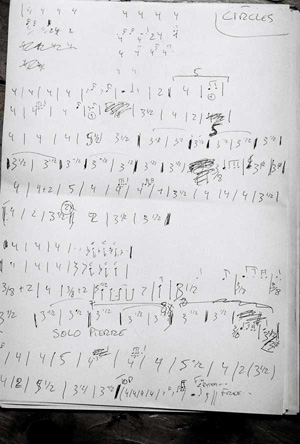
Zéro DB, directed by Aurélien Bodinaux, follows Nic Thys in New York and Brussels as he works on and records a composition called "Circles." He composed it 15 years ago, but didn't do much with it at the time and it was never performed, or even titled.

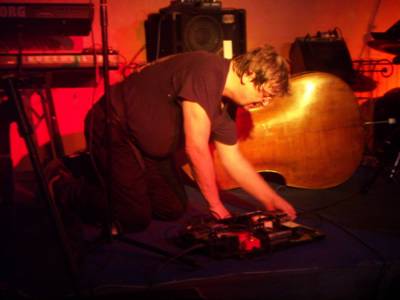
The film recounts the process through which an idea takes form outside the musician's mind. In this case, how "Circles" becomes a recording. In the beginning, Thys talks about the process in general, and its dangers: that the actual music might not sound as good as imagined. During an early brainstorming session, the director blurs the voices of the three people in the room, creating a metaphor for the process. Unfortunately, the film soon abandons this poetic aspect to become little more than a slightly quirky documentary following the flow of events: Thys recording some demos by himself, rehearsing with Pierre Van Dormael and finally all the musicians playing their parts in the studio.

Thys has just returned to Belgium after 7 years in New York, so the showing also served as a welcome back party of sorts, with many friends, family and colleagues in attendance. Everyone in the large crowd was amused to see Thys's increasingly hirsute beard and touched when Otti Van Der Werf dropped by the studio to add some handclaps.


Nicolas Thys - el b
Pierre Van Dormael - acoustic g
Stéphane Galland - perc

After the film, a clean-shaven Thys came onstage to play duets with Pierre Van Dormael. The first two pieces were sort of Belgified country songs that hid their contrapuntal and structural complexities under unassuming melodies and relaxed yet alert playing. Thys remarked that his older songs were more complicated than his new ones, because his life was more complicated then. It seems to me that he is perhaps better able to communicate and challenge simultaneously. I've recently noted a similar change in Octurn's music, due to Magic Malik's influence, though their level of complexity is much higher. Maybe it's a generational thing.

The third and last duet was inspired by Thys's visit to his wife's family in New Mexico and its amazing landscapes. He started alone, playing a steady bass line and a melody above it. It was relatively simple and, appropriately, sounded like Johnny Cash singing a cowboy song. When the guitar joined in, the form was stretched and extended, but the basic feel was never lost.

Stéphane Galland joined them at this point, on tubs, a metal pipe and a few other metallic implements I couldn't see. It was amusing to hear him play his amazing Galland-isms on these much brighter and drier surfaces, using just sticks, no feet. The opportunity was there to create a sort of hi-tech washboard band, but that connection wasn't explored, fortunately or unfortunately. It did, however, allow for really clear interaction between the three instruments. They played "Can Festis," which you can hear on Pierre's MySpace and "Circles," the evening's running theme.

The crowd called them back for an encore, to which Thys replied: "Well, this is unexpected. When you've run out of written and rehearsed material, what do you do? You play jazz." They then proceeded to play "Moment's Notice" - at least, that's what I thought at the time, but I'm not so sure any more. In any case, they brought their 3-way counterpoint and the weird harmonies they, Pierre especially, are masters of, to a more standard jazz form, which the guitarist acknowledged with a winking "St. Thomas" quote.

Saturday, April 15, 2006

unknown...underrated...undervalued

JazzWord follows up on recent debate by making a distinction:

"But it's one thing to be underrated, but another to be underrated and unknown."

Indeed. This sentence made me think of the 3 U's of this post's title. The difficulty in applying them to the jazz world is that of context: it's such a minority interest that very few jazz musicians register on any radar beyond specialised circles. Still, there are some egregious cases.

In the unknown category: Frank Hewitt, dead at 66 before his first record was released and could show what a great, intense and maverick player he was; Herbie Nichols, dead almost literally from neglect, stuck in dixieland bands despite his advanced bop ideas. Both were known by very few in their time. Ironically, it's almost ontologically impossible to know how widespread this phenomenon is.

Underrated: Armen and JazzPortraits claim that Parker and Gillespie are vastly underrated and even looked down upon among certain circles. Not having frequented jazz schools, I don't know if this is true, but as Darcy points out in the comments to my first post on this topic, great players, avant or not, will have accumulated extensive historical knowledge. That certainly entails going back to Parker, Gillespie, Powell, Armstrong and others of later avant-gardes (from the AEC and Weather Report to Ellery Eskelin and Ben Allison, according to your sensibilities), especially if you want to hear people on the cutting edge, before everything had been theorised.

JazzWord puts Booker Ervin in both the underrated and unkown categories, but I find the two to be contradictory. So I have a third category.

Undervalued, a local example: guitarist Pierre Van Dormael. I was shocked when he told me that "Vivaces," an incredible masterpiece, sold 250 copies. Even in Belgium, that's nothing. Granted, Pierre isn't the best self-marketer, but neither is he unknown. There might be a better term than undervalued, because it is rather synonymous with underrated...).

Saturday, September 04, 2004

Mons en Jazz - 04/09/2004, Mons


Mons seems to be a lively place. Driving in, I passed by a couple of 16-18-year-old (let's say 17) girls, one with hair dyed a lively pink, passed out in front of a public establishment, their friends around them, assisting. It was 8 PM. When I left the city, at 2 AM, things were only just getting started (that is, for those who hadn't already passed out). Police and a TV camera surrounded my car, never a good sign (especially when you consider the duct taped state of my rear bumper). It turns out they were breathalyzing people. Unfortunately (because I've never done it and would have passed), I didn't get tested.

Last year, the festival took place mostly in the nearby Hall, but now it's being held entirely in the K.fee, a great club I've already mentioned, presumably because of last year's disappointing turnout. Also, this year's line-up is 100% Belgian. The place was packed. Festival's in a club don't seem to be much of a tradition here, but it does generate a nice atmosphere straddling festival formality and logistics and club intimacy.

The Bart Quartier Quintet kicked off proceedings in surprising fashion, playing Dave Holland's "Looking Up." It was the first time I'd heard anybody cover a recent Holland composition, but it makes sense, as they're often great. The line-up was pretty similar to Holland's Quintet as well: Quartier on vibes, leader of Belgian mainstream sax Bart Defoort on tenor and curved soprano, Nico Schepers on trumpet, the inimitable Jean-Louis Rassinfosse (see below) on his signature 5-string double bass and the ubiquitous Jan de Haas on drums.

They gave a rather tepid set. When you've heard the Dave Holland Quintet several times, it's difficult for others to compare, especially when sticking to a similar arrangement. Defoort sounded thin and Rassinfosse weirdly agressive. A couple of bland Quartier compositions followed, before "8 AM" started kicking the set into gear: during the head, drums rolled, vibes and bass looped very cool independant chord cycles (the vibe chords dissonantly echoing the 9 PM church bells that had just rung outside). Unfortunately, they abandoned thorniness in favour of straight-forward funk for the solos. On the following ballad, Schepers made a powerful, heart-felt theme statement and the strong, not-too-complex harmony offered the soloists nice melodic paths, which they exploited effectively. A Mike Mainieri tune was the first real uptempo burner, and Schepers wowed, letting loose a Hubbard/Morgan salvo. The group was obviously gelling, Defoort's sound was getting thicker, but while they were winning the battle against lack of group identity, they were losing the one against festival set time constraints. They closed with another Quartier tune, "Doodle," a sort-of blues that found everyone far funkier than before.

Philip Catherine's trio took the stage next (don't worry, he was only briefly on all fours), with regular drummer Joost Van Schaik and irregular bassist Sal LaRocca filling in for Philippe Aerts. I'm not much of a fan of this trio, they just seem overly cushy with each other. This was made clear earlier in the year during the Brussels Jazz Marathon, when Rosario Giuliani sat in on "Mr. P.C." and blew them apart in the space of a few minutes, forcing Catherine to get up from his chair and respond in kind. A similar thing happened here, but in a quieter vein, when guitarist Pierre Van Dormael stepped onstage for Catherine's "L'éternel désir" and the standard "Autumn Leaves" (which was amusing to me, as only a few days ago I discussed learning "Autumn Leaves" with Van Dormael). The second guitarist made the leader space out his phrases and consider the weight of each one more carefully.

Before all that, though, the trio wound its way through a couple of Catherine tunes, which allowed him to display his usual melancholy iridescent pedal-controlled chords. "Letter From My Mother" was especially strong, with a great melody hiding gushing emotion under the British restraint of a little waltz. They blew on "All The Things You Are" and "Bewitched, Bothered and Bewildered" (which contained a great, "how's he going to resolve this" harmonic digression from Catherine) and closed with "More Bells," the two-beat of which allowed Van Schaik to loudly and joyfully play around with the off-beat during the song's climax.

The previously-seen Van Dormael followed with a quartet that's played several times now (a notable feat, as most of the guitarist's groups have, by his own admission, played only once). Van Dormael has a totally unique harmonic sense that allows him to sculpt intricate melodies out of seemingly inhospitable intervals. Mix this in with his blues leanings, African sensibility (notably in his approach to space) and desire to unite the intellectual and the emotional, and you have a musician who never ceases to amaze me. The first time I saw this quartet, I was amazed and transported for about 25 minutes. This time, I was a bit disappointed. Van Dormael was consistently fascinating and bassist Otti van der Werf (on his battered 4-string electric) has a pared-down, deeply groovy style, but throughout the 1.5 hour-long set, the tempo and general feeling hardly budged. Anne Wolf, excellent on piano in her own trio, continued to annoy on keyboards, using mostly cheesy pan pipe patches (the same as she always uses, aren't there any other settings on those things?) and occasional strings, with a balafon/marimba sound at one point that was, I must admit, rather nice. Still, though, I have yet to hear her play anything on keyboards that sounded really good, as she mainly restricts herself to weak, often out-of-the-groove blues scale + modulation wheel noodling. But I'll repeat how good her own trio is: very (which makes her performances with Van Dormael all the more puzzling).

The set ended with Dylan's "My Back Pages," whose melody provided a more focused and forward-moving context and Van Dormael's "Hip Hop Etude no. 11" which had a great, funky bass line inevitably de-intensified by the above-mentioned keyboards. Things started getting crazy when Van Dormael took the mic down the first row, making people shout "Woo!" into it. Then Rassinfosse got a hold of it and started scatting. When that ran out of steam, he turned to free-associated and free-morphing words rather winningly (anyone who's seen him on stage knows he's a great entertainer). Then Van Dormael played a famous disco-funk bassline I can remember but can't place and sang a bit of "I Shot the Sheriff," all for no apparent reason, but it was fun.

Second and final day of the festival tonight.