In the comments to an It Is Not Mean... post on Ken Vandermark, The Improvising Guitarist asks:
I have a slightly different question regarding Vandermark’s enterprises. Why? Specifically, what are his goals that it compels him to start a cover band version of 'East Broadway'? I’m not saying that it's a ridiculous thing to do, or a worthless thing to do, or that it's a pointless thing to do, but I am wondering what longer-term objective Vandermark sees it achieving.
Considering Vandermark's huge output and ceaseless activity, that's a fair question. I think that some answers are to be found below.
The interview, conducted after
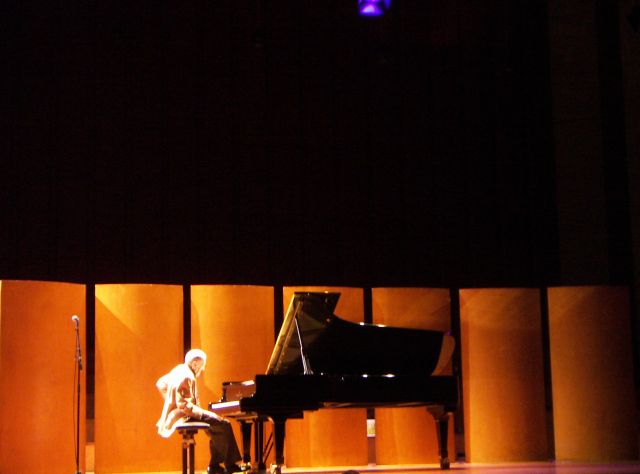
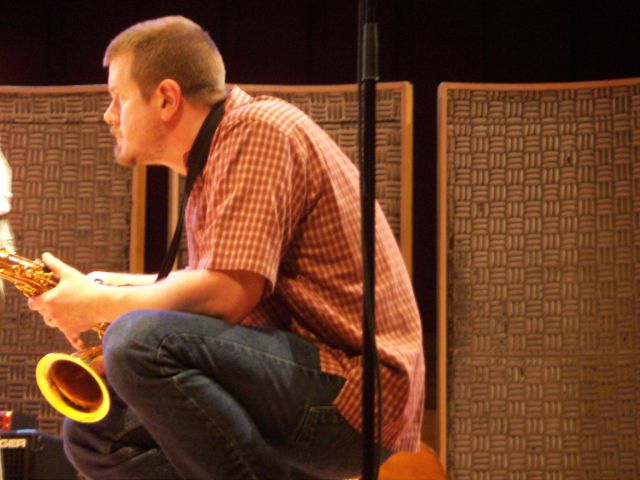
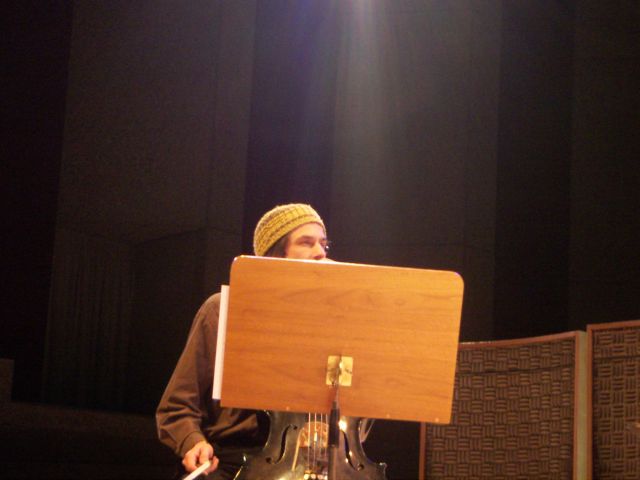
this concert, isn't really an interview: my initial enquiry prompted a detailled 18-20 minute response during which Vandermark clearly explained a number of his working methods and goals. The focus is on the Frame Quartet he had just played with, but much of what he says is relevant to his work and thought process in general, too.
Below is an edited and slightly rephrased version of the interview. If you want the whole thing and/or have a craving to hear my seductive baritone and natural way with the spoken word, you can also
download the MP3.
Thanks to Pierre-Michel Zaleski for setting up and filming the interview.
Mwanji: On stage, you said that created this quartet because there were a few particular ideas you wanted to explore. Could you elaborate on what they are?
Vandermark: I've been trying to figure out how to construct different ways of organising material, the way the written or pre-determined parts of the music interface with the improvising parts. For me, one of the big challenges has been finding a form for the improvisers where they can't learn the form.
Take the really basic kinds of forms. Head tunes like an Ornette tune where you have the theme and then a series of improvisations and then go back to the theme, or a bebop tune with a harmonic cycle that repeats. With Ornette you leave the cycle but you keep some kind of tonality or pan-tonality. Or the modal music, even, of Miles or Coltrane, a circular kind of form.
Ellington did quite a bit of the linear, narrative form, which starts in one place and moves as a suite to another place. I've done a lot of work in that way with the Vandermark 5. The problem - challenge is a better word - is that even if you try to make a form that isn't theme-improvisations-theme but a theme and a theme and a theme, human nature steps in: you try to figure out how to get from one point to another point. If you solve the problem, the tendency is to always solve the problem in the same way. Even if you don't want to and especially if you're on tour and you're tired. It's not that you'll play the same material, but maybe the band goes to a similar place to get from point A to point B. Charles Mingus's solution, frequently, was to yell at people to get them to do something different. It was effective, but maybe not my style.
In the 5, I started to introduce factors that the musicians could choose to bring in. I think that the ICP Orchestra has done that effectively, allowing a piece to have a loose structure, with elements that people can introduce from concert to concert. The problem is that with the nature of the music and the concern of the musicians in my groups to try to play it well and play it right, so to speak, even if I pushed them to do these things, they wouldn't act on them, it was against their nature. So I wanted to find another way to do things.
The Free Music Ensemble was the beginning of the creation of a system that was modular. There was a series of thematic material that was more fragmented - pieces of pieces. These could be re-assembled from concert to concert and set to set. So, you may know the thematic material, you may know how the interactions work from the melodic, harmonic, rhythmic or sonic standpoint, but every night the sequence of events could be shuffled. How you got from point A to point B one night wouldn't necessarily solve the problem on the next night, because instead of going from one to two, you might go from one to five, meaning a different set of solutions.
That's an effective way to work with the trio because you have this triangulation of interactions which are very easy and fast when you know the written and conceptual material. It's easy to understand what someone is doing: "They've left the path, do I trust where they're going? Do I work against it?" It's all very quick. Especially working with Nate McBride and Paal Nilsson-Love because they're fantastic musicians and we all have history together, so the communication works well.
One of the problems of the trio is that you can orchestrate things - quite a lot, actually, I think there are a lot of things you can do with orchestration that don't get done - but if you add another musician, suddenly you have this exponential increase in orchestration potential. With the Frame Quartet, basically I want to have more orchestral possibilities than FME and build off of the idea of restructuring the music as it goes, to take it further. With FME, we knew the pieces and we would make these suites, break the stuff up. With the Frame Quartet, I'm excited about it because it's taking a bunch of developments that have worked with the different groups and finding a way to keep it surprising all the time.

There are a couple of basic things involved. One is that there are two scores. One is thematic material that's notated more-or-less conventionally: it's pitch- and rhythm-related. Then there's a page that's more of a flow-chart and a set of activities. It has three columns. One is material or ideas that I can cue at any time. There are one to four or five of these per piece. No matter what's happening, I can cue a jump-cut into a different space, and when I cue out of it, we go back to where we were, no matter what it was.
In addition to the jump-cut territories, there's a flow-chart that's grouped up into pairings. It varies from piece to piece, but let's make it conventional: one pairing is bass and drums. They'll have a specific set of activities that moves from top to bottom: "play theme 2," "open improvisation," "silence" or whatever it may be. Nate or Tim Daisy could cue when they move through these things, depending on who's leading it. It's an open choice on their part. There's the "free" element, who in the particular piece I'm talking about would be Fred Lonberg-Holm and myself. We have another set of activities, which may be other thematic material, other sensibilities, improvisation or silence, whatever. Usually, I cue them because it's easier for people to see me. It's hard to cue things from the cello chair.
I cue when the two of us make a change, but the decision of what to do at the change is up to the individual. I might go and play theme three, but Fred decides to do nothing. If I cue again and play theme three, Fred might do something that's all sound-based. I don't know what he's going to do and he doesn't know what I'm going to do. Tim and Nate don't know what either of us are going to do. In addition, I can cue the jump-cuts to go to something else.
I can signal a circular motion, which means to move on. The rhythm section would move to their next event in their line of activity, Fred and I would jump to whatever our next choice would be out of our material. Also, the jump-cut material can be overlayed on top of what's happening. If the rhythm section is doing open playing in an energy, freer space and I cue a determined cello theme as an overlay that moves on [gestures two different signals], that means that Fred would play on top of what the rhythm section was doing and when I cue again, we would all move to our next events.
In addition to the possibilities of superimposition material and open choice material, there's a structural element. I don't know when Nate is going to cue Tim to move to the next section, but I know what they're going to move to, which gives us something to push against. If I know he's going to go to something specific I want to deal with, I can wait. We can reconstruct the material in a lot of different ways. This is a new group, so we're moving along the columns, but we could also go from bottom to top. The elements of non-determination are really high, which means that people have got to be very concious. They can't coast on "Okay, I know how this is gonna go." We also have to be familiar with it so we don't have to just focus on this cueing stuff. It's not about the cueing, it's about breaking things apart and responding to what's really happening in the moment, which is what I find exciting about improvising.
The reason I wanted to do all this is inspired quite a bit by Peter Brötzmann's groups, particularly the trio with Han Bennink and Fred Van Hove and Last Exit. He showed me a videotape of half-hour performances by each group. To watch them back-to-back, they're totally different aesthetically, with different musicians with different sets of ideas. On paper, it shouldn't work. Bennink would be playing and he'd walk off and be gone and they'd be in the middle of something. Van Hove would be playing something so quiet you couldn't hear it and Bennink would come back in with some chairs. And yet, it worked musically. Both groups had these musical and aesthetic antagonisms but the momentum is always moving forward, it didn't fall apart. Of course, this was due to a large extent to them being such phenomenal and creative musicians. They had maybe a narrative sensibility to the way they approached improvising.
There were also the soundtracks of Ennio Morricone. I was recording with Bridge '61 and one night we watched
For A Few Dollars More. I'd seen it before and for some reason, I was really attracted to the soundtrack. The more I listened to it, the stranger it got: if you just listened to what he was doing musically, it really didn't make a whole lot of sense. He'd have a theme, and then suddenly there'd be odd sounds and then a music box and then the sound of wind blowing that was so totally obviously not from the set. Yet it was really amazingly effective as music. I bought the record afterwards because I thought maybe the narrative of the film was making it make sense for me, but it totally works. Like Brötzmann's groups, somehow it all held together. I was really becoming consumed with this.
I think that there's a sense of determination, the reverse of indetermination in Cage's sense, an actual sense of trying to accomplish something specific, in the music of Brötzmann and Morricone. Even if what's trying to be accomplished goes against something else that's happening simultaneously, if the events are true to themselves and you listen openly, it may not be a conventional sensibility, but there's a musicial activity that happens that is riveting.
All those kinds of elements were pulled together for this group, to try and synch them up and apply them to a group that deals with improvisation and composed elements. Last Exit and Brötzmann's trio are improvising groups and I was wondering if it was possible, with composed elements, to create that sense of risk, where you really don't know. In this quartet, maybe we don't.

Mwanji: What you're doing with this group, isn't it sort of examining the mechanics of improvisation, things that were done instinctively?
Vandermark: That's not the way I thought about it, but that is really a big part of what is going on. It's now 2007 and as a music fan and someone who's really invested a lot of time and energy and curiosity into jazz and improvised music and all those histories, the responsibility lies with the musicians to come up with something else.
Tonight, hearing Sal Mosca play, that's his music. He's speaking a language that he grew up with, with those tunes on the radio. There's no way I could play that music and have it be my music. I want to find my music, in this time. The only way I can logically get to that is look at what's been happening over the last few decades. How did they do it? How do I make sense out of what was done, whether it was in Europe or Japan or the United States or wherever? Even outside of the jazz lexicon, what am I really interested in? What do I like about reggae? In and of itself, the music is fantastic, but what out of those things can I take and apply in my own music?
What was done organically, in the case of the groups with Peter, and filmically, in the case of Morricone, and building off those elements and a different way of constructing things and getting at the essence of what excites me so much. It's like creating mechanisms to somehow compositionally organise things that weren't supposed to be compositionally organised.
Mwanji: You seem to approach making a new band as a way of addressing a problem or set of problems that you're not able to address in one context, so you have to find another.
Vandermark: The bigger and more central element is the conceptual issue. I have an idea about what I want to do and then about the people I want to do it with. Inversely, the people doing it affect the idea. As a group evolves, maybe the personnel shifts a bit, but the conception, the motivation for the writing stays. The person then affects the writing: "I thought they would do this but they're doing that."


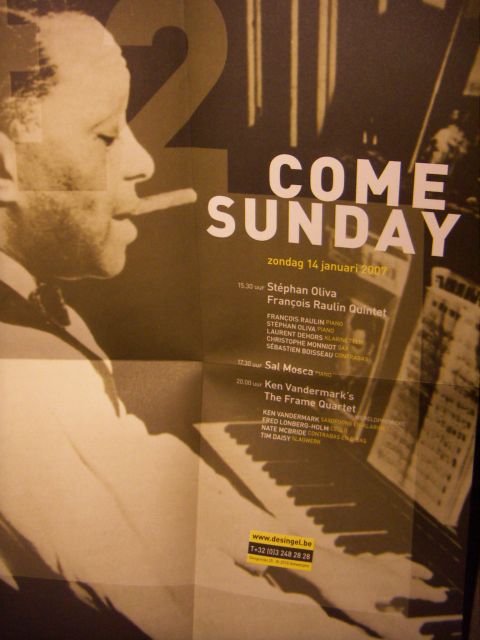
 Raulin is on the right, Oliva on the left