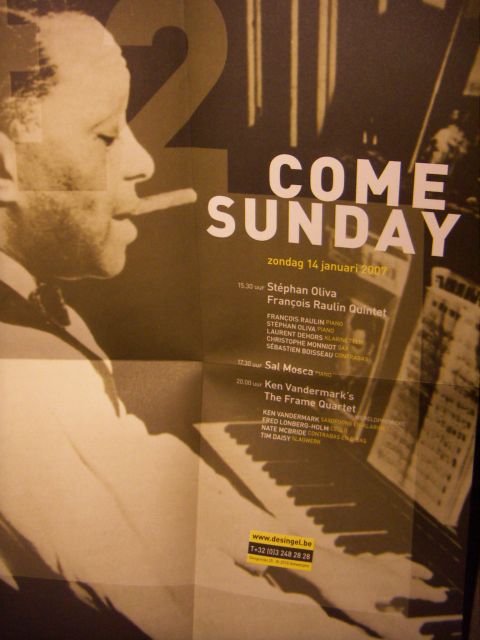
Come Sunday #2 - 14/01/2007@deSingel, Antwerpen
Before leaving the house, I was quite saddened to learn of the near-simultaneous deaths of Alice Coltrane and Michael Brecker. Both were unfortunate surprises: I hadn't heard that Coltrane was doing poorly and thought that Brecker was getting better after his transplant and the surprise appearance at a Herbie Hancock concert.
Stéphan Oliva/François Raulin Quintet
Stépha Oliva, François Raulin - p
Laurent Dehors - cl, bcl, contrabass cl
Christophe Monniot - as, bs, sopranino
Sébastien Boisseau - b
 Raulin is on the right, Oliva on the left
This quintet, along with guitarist Marc Ducret, did an album of Tristano repertoire a few years ago, and now they're doing something similar to the compositions of stride and ragtime-era pianists such as James P. Johnson, Willie "The Lion" Smith, Fats Waller and Earl Hines, as well as a piece by Bix Beiderbecke. It was inevitable that I be reminded of Air's own take on ragtime standards, even if Destination: Out hadn't posted a couple of tracks from Air Lore recently. In both instances, a fairly direct line was drawn between two nominally different eras: the collective energy of the 30s was always close to exuberant cacophony anyway, which, I guess, makes it a prime candidate for translation to a post-free jazz context. It also helped that the arrangements by Raulin and Oliva were impressively thought-out. Except for one bass solo, the basic material was never left behind, never a mere frame for free playing. In this regard, I found the progression from one era to another more satisfying than at the Dave Burrell concert.
Christophe Monniot provided gutsy, barn-storming r'n'b-inflected solos, while on "Carolina Shout," Laurent Dehors's clarinets linked dixieland whoops to free jazz shrieks. Solos were concise, in keeping with the spirit of the times. Both François Raulin and Stéphan Oliva are fearsome pianists, who, Schlippenbach-like, could slip distant rhythmic echoes into modern, abstract playing. They also knew how to have a good time: on the last piece, Raulin dashed across the stage to join his partner for a 4-handed stride romp.
Recasting old music in this way throws up a lot of questions and establishes connections. While the Beiderbecke piece was more obviously proto-Cool Jazz than the rest of the material, Willie "The Lion" Smith's "Morning Air" and "Echoes Of Spring" (I particularly love the latter, with its introverted-but-intense, stroll-in-the-park joy - check it out) showed that black musicians, too, had developed their own cooler forms (and Bix's "In A Mist" draws its own connections to stride and rag rhythms). The music, often organised into suites of interconnected themes, solos and collective improvisation, betrayed a huge amount of work and might have seemed over-intellectualised had Monniot's over-the-top body language not underlined how much fun the music was, too. I mean, if you can't party with ragtime - you can't party at all. So, rather, it came to seem that they were drawing out the intellectual possibilities already embedded into the music, but perhaps more visible with a few decades' hindsight.
Sal Mosca
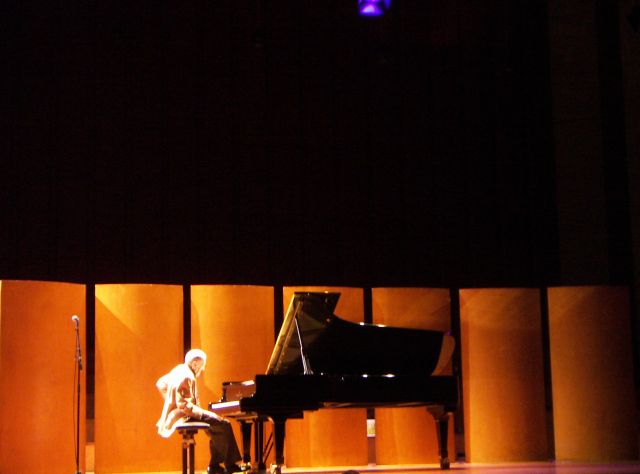
I'd barely heard of Sal Mosca, but was intrigued by his past as a Tristano disciple. Despite the occasional brief hesitation (which were, I think, more a matter of remembering how a tune went than of technique), Mosca played a short and wonderful set of standards. His sound, touch and style were decidedly of his era: the under-the-armpits trousers said it all, while the slightly arpeggiated chords he used on the opening number - something you'd never hear a post-60s pianist do - confirmed it. It was a reminder that, when these songs are played by people who actually have them embedded in their DNA, they're still awesome. Ken Vandermark would tell me afterwards that there was no way he could ever play that music the way Mosca had, and this observation applied to the Oliva/Raulin Quintet as well: you didn't get the impression that Mosca really "did" anything to the tunes, the way the Frenchmen had to, to make it interesting even though he actually really personalised each one. So, the next time you get that "not standards again" reaction, blame the interpreter, not the material.
That said, all three pianists applied forms of loving deconstruction to the standards that, in the end, weren't as conceptually distant as might have been expected. What was modern and interesting (or maybe just puzzling) about Mosca's playing way back when was still exciting yesterday. Both Mosca and Raulin/Oliva did "Ain't Misbehavin'," and Mosca's version recognisable than the quintet's, because it decidedly wasn't a romp, but I also kind of suspect that he didn't really play the song's chords.
When Mosca played "Somwhere Over The Rainbow," it was easy to imagine it as a big Hollywood production number, swirling harps and string orchestra included, but he managed not to make it sappy. At the end of most songs, he would use the sustain pedal on the last note, but abruptly cut it off long before it had decayed, as if to ward off any excess sentimentality. On "All Of Me," left and right hands scrambled together, creating a thick but impressively non-dissonant texture.
According to AMG, Mosca is turning 80 this year, so no-one was surprised that the set was fairly short, at just about 40 minutes. That's more than can be said for his 21-year-old saxophonist student who, I learnt after the concert (as it wasn't announced in the program), was meant to accompany him: apparently he fell asleep at the hotel.
Ken Vandermark's The Frame Quartet
Ken Vandermark - ts, cl
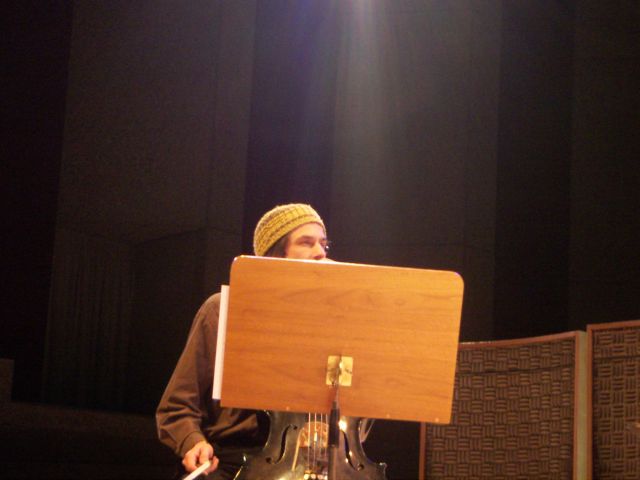
Fred Lonberg-Holm - cello
Nate McBride - b, el b
Tim Daisy - d
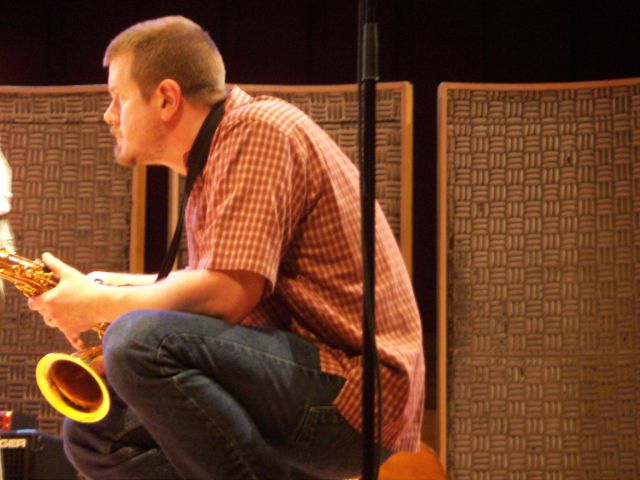
The posters claimed that this was a world premiere, but in reality this group had already performed once in Chicago, and the members are long-time associates anyway. Regardless, The Frames Quartet is the latest in Ken Vandermark's seemingly endless string of bands. After the concert, I interviewed him (thanks to camera-man extraordinaire Pierre-Michel, who's practically a member of Vandermark's road crew, it seems), and he laid out very clearly what he was trying to do with it. I hope to have a transcript and maybe audio (and even video?) of that up in a few weeks. In short, the compositions for this band are made up of pre-determined modules whose sequence and interactions are determined in real-time through a series of cues. His two aims were to continue delving into the composed/improvised interface and to create structures that could not be learnt, so that the problems the musicians had to solve changed every time, forcing them to come up with new, or at least different, solutions. To me, the results were very interesting, though still raw. The injection of pre-determined forms, cues and strategies gave a sense of external structure, but nonetheless created an overall sound inherited from total improv.
Vandermark hasn't abandoned his tradition of dedicating each one of his pieces to someone. "First Papers"'s dedicatee was James Brown. It started with the tenor's r'n'b-influenced wailing over a 3/4 beat, then arrived at a more peaceful line, accompanied by turbulent free improvisation from the rest of the group, which suggested earthly confusion below and heavenly peace above. It finished with full-blown, aggressive skronk, but not before an unexpected, much quieter section of boppish tenor over a walking bass.
That bass-tenor section, as well as the sequence of unisson themes Fred Lonberg-Holm and Nate McBride played throughout the second piece, exemplified the functional pairs Vandermark divides the quartet into for each composition. While the two string instruments segued from theme to theme at (I imagine) their own discretion, Tim Daisy and Vandermark alternated leading free improvisation over the top.
The third and last piece was "Straw," which was anchored by a percussive loop of what I think was a grating, staccato cello chord. Daisy and McBride struck up a funky back-beat over which Holm could play heavily distorted arco, somewhere between a noisy, textural rock guitarist and computer static.

Due to a misunderstanding, the group played for only about 45 minutes, about half the time that had been allotted to them. This was a shame for the audience, as even an extra half-hour would have been very helpful in really apprehending the music.
In parting, some advice: if you're ever invited to partake of the musicians' post-concert dinner at deSingel, do so, immediately. It's delicious.


 The concert started great: the two percussionists were on stage doing nearly nothing for about a minute. Then, a clarinettist, trumpeter and trombonist (a dixieland frontline) entered from behind the audience and played some wonderful dixieland counterpoint walking down the aisle. Other highlights included clarinettist Tom Wouters shouting vocals over the powerful "King Ink," a great piano-brass-vocals rendition of "What a Wonderful World," featuring wonderfully soft brass voicings, which was followed by an 5-reed tune over a bass clarinet vamp that had a feeling similar to a slow "Caravan." "Caravan" itself closed the set, the synthesizer (of some sort, looked pretty old and had a sci-fi sound) rendition of the melody shows the kind of irreverence FES does well. The encore consisted of an off-mike trio of vocals, tuba and brushes-on-floor song playing something about "Mr. Monotony." Halfway through the song, the rest of the band members (who were off-stage) suddenly leaned out from behind the side curtains to add some group vocals.
