Wednesday, July 26, 2006

the hard e-sell

Chuck Mitchell, a former head of Verve/Polygram, writes to Rifftides:

I'm unconvinced that there is enough consumer demand for most deep jazz catalog to justify continued CD manufacturing and retailing in conventional stores. When I was running Verve/Polygram in the mid-to-late 90s, there was a good deal more stability in the jazz reissue and catalog market than there is now, and we still had to work hard to convince retailers to hold more titles of slow sellers...

That began to change in 1996-7, as stores became saturated with product of all kinds, and we started to see a radical escalation in returns. Things kept getting worse from there. The record industry would have you believe it's all about downloading, but many other factors have brought the CD business to where it is now, beginning with outrageous pricing in an attempt to rescue a bad-margin business. The simple fact is that most catalog titles don't turn over fast enough to justify the retailers' cost of doing business, starting with real estate and shipping costs... if it was tough to sell Dizzy a decade ago, how does it make sense to try to get Chubby into whatever stores are left today?

Which makes the "long tail" of digital distribution the only hope for the continued existence of the highways and the back roads of the riches of our recorded musical archives.

ready ornette


After The Roots, something else to look forward to: Ornette Coleman's Sound Grammar. After all the ecstatic live reviews of his two-bass band, apparently the album doesn't disappoint. Phil Freeman says:

his new album is just as brilliant and beautiful as you're hoping it will be. It's live from last year, with the two-bass band he's been traveling with since '03, and...well...it's hard to describe just how fucking awesome it is. It's called Sound Grammar, it comes out on 9/12, and if you don't buy it, there's no excuse you can offer - I just don't want to be your friend anymore.
There's some more info in a USA Today blurb:
"Sound Grammar is to music what letters are to language," says Coleman, 76, who is launching his own Sound Grammar label with this release. "There are only 12 notes, but they are used by everyone to compose and sing."

The album showcases eight Coleman compositions, including a remake of Song X, the title of a 1985 album, and Turnaround, from 1959's Tomorrow Is the Question.

"What is unique about this record is that the melody and the playing are all equal in relationship to ideas," he says.
Coleman's current publicity boiler-plate is here. Looking up those Coleman quotes, I found a possible, but probably remote, reason why TBP have been hanging out with Ornette lately: they have the same publicist

Tuesday, July 25, 2006

roots play again

Lately, I've been wondering about The Roots. Namely, has let's-save-the-music ideology overtaken innovation? Do You Want More and Illadelph Halflife represented a phase of ambitious sharpening and tightening, which culminated in Things Fall Apart. Phrenology sprawled and reached for new things, just as ambitiously. The Tipping Point's back-to-basics, quasi-preservationist drive seems to have devolved into blandness, at least on Game Theory's first single, "It Don't Feel Right." Even the rock edge of "Long Time" doesn't really help: the chorus is weak (but the backing on the verses is nice), Black Thought is enjoyable, but doesn't really bring anything new (but Peedi Crack's verse injects some energy). Hopefully it'll all sound better in the context of the album (not to mention on CD rather than on a lo-fi MP3), which the singles from The Tipping Point certainly did.

It's not like I was ever not going to buy the new album (I mean, I have Organix, the From The Ground Up and The Legendary EPs, the two-CD edition of Come Alive and both volumes of Home Grown! The Beginner's Guide To Understanding The Roots), but Status Ain't Hood has unexpectedly heightened my expectations. However, his last sentences ("I wouldn't call it a masterpiece, but Game Theory is certainly a triumph for the Roots, a breakthrough to a new sensibility. They're onto something special here, and I hope they keep going with it.") show he still has a little ways to go to understand this band.

Is it plausible that someone in the Roots' camp will stumble across Ulrich Beck and the next album will end up being called Risk Society?

of jazz blogs and dictators

J.B. Spins mixes jazz and right-wing politics. J.B. does a lot of reviews of jazz-related books and films, which is unusual and refreshing. His writing is matter-of-fact and concise.

The jazz and the politics regularly cross paths. For example, in a discussion of Bobby Previte's Coalition Of The Willing. I don't share much political ground with J.B. (or his appraisal of Previte's cover art), but I've long wondered what Che t-shirts (not a new phenomenon) were supposed to mean. Even more puzzling is when his effigy is brought to peace rallies. At the same time, I've never seen anyone wear a Martin Luther King, Jr. or Gandhi t-shirt. Those t-shirts must surely exist, but I've never seen any and I'm certain that they aren't fashion icons.

A few weeks ago I was surprised - maybe even shocked - to see bags with Mao's face printed on them in a shop window. Che's rebel cachet is understandable, but why would anyone want to flaunt Mao? Who next, Stalin? Franco? Pinochet? Idi Amin? Pol Pot? (actually, that one might not be too far off) Put bloody dictators from all continents in your wardrobe, collect them all!

fatha and brothers


A couple of pictures from a series on Slate.

[via UniBrow]

Monday, July 24, 2006

newton and miles


Nat Hentoff joins the Miles Davis R&RHoF induction debate (remember that?), mainly responding to Ben Ratliff's article.

Recently, hearing a radio interview with one of my favorite musicians regardless of genre—Toots Thielemans—my inability to salute Miles Davis as a rock and roller became more meaningful, at least to me. Toots has worked with Charlie Parker, Bill Evans, Zoot Sims, Quincy Jones, Oscar Peterson and many other jazz creators—as well as with Paul Simon, Billy Joel and other non-jazz performers. But he said in the interview, whatever the gig, “My center of gravity is jazz.” While Miles Davis could never purge his music of jazz—nor would he have wanted to—the performances that resulted in his becoming, posthumously, a member of rock royalty, did not have jazz at their center of gravity.
Lots of those Hentoff columns are worth reading. In April, he pre-empted my little Euro-US discussion. A year ago, he recounted some fascinating Clark Terry anecdotes.

fluffy (i want you)


I kind of feel like someone who's written ten symphonies, but is best remembered for an advertisement jingle. Okay, that's gross hyperbole. Had I known that kittens would get me my first NewMusicBox appearance and lots of first-time commentors (welcome!), I'd have done it a long time ago. After all, if Alex Ross can, why can't I? Not to worry: upon further reflection, I won't be converting wholesale to Hallmark-worthy clichés.

Initially, the kitten project was much more ambitious: a Feline Big Brother, with readers voting on which kitten to keep and which to kick out, as well as choosing a name for the winner. Regular photos and videos of their progress would have been posted. Too much trouble, as it turned out. It's probably best for them not to become media stars at such a young age, anyway. I'll now be returning to the real cats, like those who play on Ascenseur pour l'échafaud.

Sunday, July 23, 2006

i'd already guessed he didn't come from canada

Doug Ramsey (for whom, I hasten to add, I have much respect for), provides an example of the caricatural treatment European jazz often receives:

Magris is one of those European artists so steeped in jazz that in a blindfold test a listener--no matter how perceptive--would be unlikely to conclude that he was hearing somone not from the United States

sibling rivalry

Many naming suggestions have rolled in. To show my appreciation, here's a pretty good idea of what the two brothers spend half of their time doing (the other half is spent sleeping). Ours is the lighter of the two.

A warning for sensitive readers: there is a disturbing moment in which ass-kicking turns to ass-licking.

night of the amsterdamned

PICT1777b

Friday July 21 was the 176th birthday of Belgium's creation. To celebrate, we decided to drive to Amsterdam. IVN and I disagreed as to whether the last time we went was in 1997 (me) or 1999 (IVN). Any credibility those memoirs I was planning to write might have had is now lost.

PICT1695b

Hotel rooms there are expensive, so we ended up spending the night in a rather funky camping site on the city's eastern edge.

PICT1753b

We rented a couple of bikes. Definitely the best way to see this city, despite the blazing heat on Friday and the brief, unexpected downpour on Saturday. The backpedal braking system is kind of treacherous.

PICT1689b

For those less motivated, the leisure of cycling can be combined with the effortlessness of driving.

PICT1764b

This trip was totally unprepared, so we simply bought a map and cruised the canals, did some shopping and napped in the Vondel Park, Amsterdam's equivalent of Central Park, until the rain chased us away.

PICT1757b

PICT1768b

PICT1771b

Of course, there's more to Amsterdam than pretty canals, H & M and the Indonesian restaurant on Spuistraat. There are museums and the red light district as well. We didn't do any of the former, but did pedal through the latter Saturday morning on our way to a neighbourhood market. Understandably, Saturday morning is not the district's finest hour: apart from a few unsavoury stragglers, we did cross the path of a stag party. I assume the bridegroom was the one wearing nothing but sandals and a jock strap.

PICT1694b

Modern dutch design and architecture are formidable. The cars parked outside the appartment blocks in the northern dock area indicated that they were not social housing. The barrier (I have no idea what it was) outside of Utrecht, which we passed on the highway, also deserves mention.

PICT1784b

The same docks area also houses some upscale interior design shops. Upscaleness doesn't guarantee taste, though.

PICT1778b
Decades of bloody dictatorship, but at least they got a snappy name out of it (translates to Pol's Pots, Pol being a common first name or nickname).

I tried to fit some jazz into our Friday night by going to the BimHuis (another architectural marvel). I didn't know any of the participants, but they sounded good from the entrance. Still, I felt too sweaty and stinky from a full day's worth of driving, cycling and shopping in crushing heat to be truly comfortable in the BimHuis's rarefied atmosphere. The night before, Ahmad Jamal's trio had played there. I would have stunk up the place for that. Instead, we hung out on the waterfront underneath the building for a while, which allowed me to watch (from a distance) Beyoncé's BET Awards performance on some guy's Mac laptop. Without the sound, it was awesome. I don't like "Déjà Vu," but the visuals remain awesome. YouTube has it in very lo-res.

Thursday, July 20, 2006

the record store underbelly

Lucas Van Lenten points to this hard-hitting documentary on indie record store clerks. Check out Lucas's music on MySpace.

lots of echo in here


I'm know you've heard "Crazy" enough to last you several lifetimes, but have you heard the spaghetti western tune that spawned it?

I'm fairly certain you've watched the ultra-slow airline version, but have you seen the slightly faster, low budget bathrobe version? Or the fast, high budget Star Wars version?

It may now seem that Gnarls Barkley (cool website) is its own ultimate cover band, but there are other contenders: Ray Lamontagne in the keep-only-the-melody-and-strum-along category; Nelly Furtado's is a Euro 2004 throwback, rather than a 2006 Timbaland-fueled model.

Exhausted? Confused and wondering where the substance of "Crazy" really lies? Put all that aside and check out the time-travelling video for Smiley Faces.

meow

nwabhu
For the sake of parity, here's Nwabhu back when he was roughly the age the as-yet-unnamed kitten is now.

The comments to the original post have been good, please keep them coming if you can. A few things I forgot to mention initially: it's a male kitten, ideally I'd like an abstract, sounds-good-but-isn't-really-identifiable name (like Nwabhu) that works in English and French and will be accepted by IVN.

The following thoughts will probably benefit me more than anyone else...

Tim's suggestion of Mdenko is good, but maybe a bit too identifiably African. Then again, watching him prowl through our garden's yellow, dried-out grass yesterday, he did kind of look like a stripy lion in the savannah... Bootsy (as in Collins) is a cool name for a cat, but this one isn't bad-ass enough. It might have suited his brother.

Names ending in "u" are summarily rejected (sorry, G), because they rhyme with Nwabhu. Even if he were a girl, Nwabhi wouldn't work (sorry, Ethan) because it sounds like one of Nwabhu's myriad nicknames.

Musician names are difficult, because generally too identifiable and I'd feel weird regularly shouting out "Mingus, come here!" Hmmm, Shihab? Maupin? Jeff Albert?

djassmunkurinn (thanks for writing in!) suggests the Icelandic Brandur. I don't like that one too much - it's kind of harsh - but I hadn't thought of exploring Icelandic names, they should prove interesting. Kisa means cat in Icelandic and is also a pretty cool cat name. In a similar vein, Swahili offers up some interesting words for cat (topito means catapult, which would be a funny translation, but it too comical).

I kind of like Sabi (popped into my head yesterday), which is apparently both African and Japanese.

tales from the record store crepuscule

S/FJ is hosting a series of reader-submitted record store stories, starting here, spurred by an article on fading stores.

My favoured mode of purchase remains the record store: the whole trip/gathering/unwrapping experience is highly pleasurable. Scouring the web to save a euro or two is tiresome. Recently, I even had some interaction at the FNAC's till for the first time (it only took 5 years), mainly consisting of the cashier approving of my TV On The Radio purchase. I got to know P (who works or worked in the jazz section) at concerts, through a mutual friend and regular FNAC visits, so I felt at home there. And I have never had unpleasant clerk-related experiences anywhere.

I've chronicled the decline of the Brussels FNAC (a French cultural supermarket that evolved from a single store set up by a couple of ex-Trotskyists to a multi-national behemoth), which will probably force me online, as I am unaware of any other good jazz section in Brussels (if you are, please let me know). All the other good shops I know are second-hand.

further down the forked road

Settled in Shipping adds some excellent points to the US/EU debate (which I also touched upon late last year).

As I've seen it, the contentious issue regarding the acceptance of European approaches to jazz music is the non-linearity with which many European musicians regard the jazz tradition.
Excellent point (which is developed further), but wouldn't apprehending the tradition in a rigourously linear way mean confronting everything from ragtime to Armstrong to bebop to Ornette and Cecil and the AEC to Miles in the 60s and 70s to Zorn, etc.? I don't think that's even possible for an individual to do. So isn't everybody picking and choosing, and it's just that certain pick 'n' mixes have been canonised?

SiS states (and then dismantles) a couple of well-worn clichés:
It don't mean a thing if it ain't got that swing. Europeans are either regarded as inherently incapable of swinging, or of willingly ignoring it as an essential part of jazzdom.
It's a damned if you do, damned if you don't situation: Europeans can't swing, but if they can, they're merely derivative. That said, many, many European musicians love to swing and play swinging music. The whole Europe = 70s free jazz/improv equation is quite false.

Peer beyond the free jazz/straight-ahead dichotomy, and you'll see that Steve Coleman's Hot Brass recordings from the early 90s had a huge impact (in France, but also in other countries, I think) on musicians and listeners.
Europeans, by virtue of their non-American status, do not understand the jazz tradition at all. It is impossible to gloss over the bebop section of the history, and equate the early jazz and Dixieland with the avant-garde rumblings of the late '60s.
Sorry David, I don't get what you're saying in the second sentence.
I'm surprised that critics and some musicians alike still regard the treatment of repertoire from artists like Bjork, Paul Simon, Radiohead or Nick Drake (to cite only the people I've covered in my own groups) as mere novelty, and that the inevitable next step - to write music evocative of these artists - is considered as some sort of jazz heresy.
I think lots of critics are fine with it, but opinions are still pretty strongly divided (cf. the controversy around The Bad Plus playing "Smells Like Teen Spirit" on a major label (if you do it on a small label like FSNT, it doesn't matter)). I wonder if Miles got the same reactions when he played "Someday My Prince Will Come."

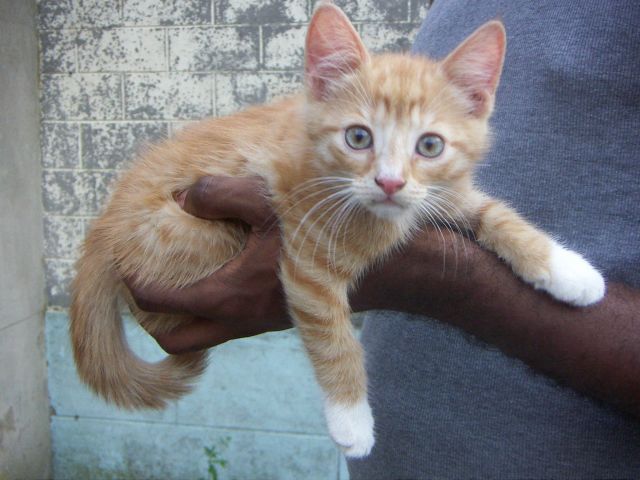
kitten like me


This kitten needs a name. If you have one handy, please suggest it in the comments box. Guidelines:
- Ginger and Socks are not acceptable
- Entries that go well with Nwabhu (the first cat) will be favoured.

The winning entry (if there is one) gets a CD.

howling forever


I think I have to admit that my great enjoyment of TV On The Radio is deeply linked to the fact that on one section of "Blues From Down Here," whoever is singing sounds a lot like Andre 3000.

Is the preceding comment merely a flimsy excuse to post a photo of myself with the cover of our new garbage can on my head? Perhaps.

Wednesday, July 19, 2006

finally, a saxophone for magicians

The Bushman Pocket Sax "sounds like a sax, looks like a clarinet and is played like a recorder... It is a true portable instrument that can be carried everywhere - in your pocket, backpack, even up your sleeve!" You will be happy to learn that "it is tuned in the popular key of C." Unless you're one of those snobbish underground types who only play instruments in the unpopular key of G#. The Pocket Sax can also improve your social life, as "its uniqueness will jump start many conversations."

+

Maybe it's not the right thing to do (and notice how I'm hiding this under the pocket sax), but sometimes, you have to call your fellow amateur critics out.

Recently I had a conversation about a certain gigantic jazz webzine and defended it by pointing out that because reviewers aren't paid, reviews naturally slide towards the positive: who wants to listen intently to bad music, for free? I could have added that its writers probably get little to no editing or outside help.

Blogcritics functions in similar fashion, except with an extra dose of anarchy. I sometimes consider starting to post there again, but then I read stuff like the staggering accumulation of haphazard pronouncements and bizarre metaphors in Larry Sakin's last two reviews:

"Pianist Monk and sax player Coltrane revolutionized music, adding a measure of soulful, spiritual rhythms which exposed the African heritage of jazz. They knew each other well, and considered each other mentors."

"[Miles Davis] is probably best remembered for his forays into be-bop in the forties and early fifties and as the progenitor of cool jazz in the fifties and early sixties"

"Listening to Monk and Coltrane play is akin to watching a splendidly exotic rose open its petals to capture the warmth of a spring morning."

"Van Gelder acts as professor here, rendering tutelage to this young, brash septet." (50+ years ago, RVG was tutoring Miles? I doubt it)

"The music on The Complete Riverside Recordings will clue jazz novices in on what all the fuss is about-- it’s exalted lovemaking as compared to average sex."

"Davis and his group ascend to the apex of musicianship on Walkin’ and they put the word 'genius' in a whole new category."

I'm opening myself up for harsh criticism, but I welcome it: the way things are going, there probably won't be any paid primarily-jazz critics at all, so us rank amateurs will have to start monitoring each other and, especially, helping each other improve our writing.

bottom of the jazz, to you

You may have been taken in by Daniel Cassidy's discovery of Irish roots for just about every English word, in particular:

Jazz: from teas, meaning heat, warmth, passion, enthusiasm. The common adjective associated with jazz is “hot”. Cassidy attributes its emergence in New Orleans to Irish immmigrants.


However, you should not believe anything Cassidy says.

[via Nate Dorward]

it's that ole devil, again

Francis Davis has apparently survived the Village Voice's recent reshuffling and is back with a bang, taking on the Euro-US issue with more subtlety than most. He uses a review of Trygve Seim's work to expand into a full-fledged discussion. A good one, but I continue to be bothered by the latent us-versus-them mentality the article's very existence implies (cf. the article's confrontational title). Also, the Europeans-struggling-for-acceptance angle is slightly distasteful, if you set it against a wider historical backdrop.

But the question I can hear the jazz police asking is whether that much originality is desirable in a foreign musician.

"Originality" has become dissociated from "origin," Raymond Williams holds in Keywords: "Indeed, the point is that [originality] has no origin but itself." The problem in a nutshell, the Stomping the Blues crowd would say... [T]heir argument [is] that jazz becomes something else, something not nearly as vital, when it loses touch with its blues ancestry... [T]he increasing dominance of elements from their own [European] cultures is [felt as] an affront to both American and black exceptionalism—though I doubt the affronted would ever put it that way.
That last sentence is quite a zinger.
If jazz were a folk music, the belief that only its originators can do it justice would have validity. But art music embraces change and claims universality, and not even Albert Murray can have it both ways.
I've never understood the hostility towards Europeans bringing their own, non-American influences to jazz. Does "if you don't live it, it won't come out of your horn" (and, especially, its implicit corollary "what you live is what comes out of your horn") not apply beyond America's shores?
In free's lasting wake, there are at least three distinctly European schools of jazz, two national (Dutch dada and British improv) and the other defined as much by a label (Germany's ECM) as by a region (Scandinavia).
That's all well and good (one would have no difficulty adding a few schools, French and Italian, for starters), but when will people start talking about transatlanticism? Ken Vandermark finds common ground between Chicago, Germany and Sweden, improvisers on the electronic edge of things meet in Vienna and Tokyo, Americans move to Berlin to record albums or paint and many European musicians you've never heard of regularly spend as much time in New York as their visas will allow. But even transatlanticism is an outdated term: pretty much the entire world meets at Berklee.
Europe is still a lucrative market for American jazz, more lucrative now than the U.S.. With jazz on the ropes commercially back home, the unspoken fear is that if it ceases to be regarded as a touchstone of African American culture, the mass media are unlikely to pay any attention to it at all. But getting used to the fact that different European outposts now have their own jazz traditions needn't involve buying into the British critic Stuart Nicholson's belief that American jazz is played out, any more than it has to mean sharing his enthusiasm for tepid Scandinavian techno.
Certainly not. Again, it's disappointing that, in 2006, such manicheistic views continue to hold sway. Then again, maybe Davis is setting up straw men (or maybe just thinking of Jack Reilly's hilarious diatribe). Speaking of whom, for those of you who missed it, the infamous Jason Moran review is back online.