Showing posts with label ancienne belgique. Show all posts

Thursday, November 01, 2007

Tied + Tickled - 05/10/2007@Ancienne Belgique, Bruxelles

Any band with two girls (cellist/xylophonist and keyboardist, plus some guy on drums) has my immediate sympathy, but, in this case, that dissipated very quickly. The unannounced opener, which remained anonymous throughout a brief set that seemed too long anyway, was undoubtedly among the worst concerts I've attended. Perhaps the worst.

They played simplistic, repetitive, my-first-chord-progression motifs devoid of any creative effort. I could be accused of taking them altogether seriously, but I think it's the other way around: they drew such disproportionate self-satisfaction from the faintest sign of creativity or humour (playing "Dance of the Sugar Plum Fairy" on kazoo, a burst of noise at the end of one song, the shaking of a banana-shaped shaker) that my loathing seemed justified.

If this was a terrible-opener-makes-headliner-look-good gambit, it totally back-fired. After a few songs of Tied + Tickled's electronica equivalent of bar-room rock, I left, fed up. I had come to this concert because of distant memories of a prior album, Observing Systems. I haven't yet re-listened to refresh my memory, but I can't imagine it sounded like what I heard here. As I went down the stairs leading outside, a woman ahead of me confirmed my suspicions when she complained to her partner: "That was so crap, compared to they used to do."

Thursday, October 25, 2007

Sharon Jones & The Dap Kings - 24/10/2007@Ancienne Belgique, Bruxelles

The album covers, the period recording equipment, the strict adherence to the rules of the genre, or rather, the codification of the epoch, even playing on Amy Winehouse's retro-soul record: all this could have made the Dap Kings' thing seem like a pose, like the vintage get-ups some in the crowd were wearing, or other audience members' less-vintage t-shirts that put quotation marks around soul clichés.

But then, this woman, Sharon Jones, shakes, shimmies, struts and dances across the stage. Her mere presence takes the band, which in the purest tradition had started the show without her, to a higher level. And then, she begins to sing: powerful and clear, grit thrown in as needed. She's electrifying. The kind of voice that hip hop producers want to sample and that house producers get to belt over four-to-the-floor beats. The kind of voice that doesn't even let you imagine thinking about listening to anything else. This is no pose, Sharon Jones isn't wearing anyone else's clothes. She is soul music, and she'll make you soul music, too. She'll pull you on stage* and insert you into her theatrical mini-production. She'll take you through a 200-hundred year genealogy of her dancing style. She'll whip you into a frenzy and cut it off early enough to leave you begging her for more. As Rob Harvilla says, Sharon Jones will obliterate your cynicism.

--
* Well, not me, but, one by one, four young, good-looking black people from down front, stage right, all seemingly at ease on a stage in front of hundreds of people.

Sunday, May 20, 2007

Battles - 15/05/2007@AB, Brussel


Tyondai Braxton - g, kb, voc
Ian Williams - kb, g
Dave Konopka - el b, g
John Stanier - d

So this is math-rock? I'd always expected something more... boring to fall under that genre heading. I mean, it wasn't all that mathematical: people were dancing - furiously - as tightly-coiled motifs locked together like funk and fell out of phase, like minimalism (one four-handed keyboard passage was almost worthy of Nico Muhly). There was a welcome confluence of electronica's obsession with constructing grooves out of improbable sounds and mutating loops and free-funk's desire to hew rhythm out of noise.

They swerved sharply from one section to another, but also frequently stopped to pound a frenetic groove into the ground. Some naïve, percussive keyboard melodies from Ian Williams and Tyondai Braxton's heavily distorted and upwards pitch-shifted singing and whistling brought a wild edge. If there was a sense of abandon, it was a meticulously-constructed one.

A comment on the crowd reaction in Nate Chinen's review intrigues me: "Near the base of the stage some fans bounced happily on their heels. That may not seem like much of a response, but it was." No, it wasn't. The Ancienne Belgique crowd was doing a lot more than happily bouncing on its heels. Then again, we can't compete with the elder Braxton turning up for the gig.


Coca-Cola Met God (met means with in Dutch; Coca-Cola and God are self-evident) is a duo with a guy from Millionaire on guitar, laptop and vocals and Eric Thielemans (last seen at a memorable Maak's Spirit concert) on drums that opened with a 30-minute set that was rougher and wilder than Battles': harsh and squealing, but fun, too. Their abandon was savage rather than meticulous and slightly surreal: when the singer donned a large white Venetian carnival mask and a draped himself in a large green cloth, it made his incomprehensible, massively distorted rantings, which ranged from screaming to proto-rapping, seem all the more superbly deranged.

Thielemans, in short red shorts and an appropriate sweater (pictures of both members' get-ups are displayed on their MySpace page), started with thudding rhythms that seemed simple but constantly reshuffled the beat, keeping the power high and the groove alluringly elusive. The second of three "songs" built up slabs of guitar noise and a chaotic undertow, then stutteringly blew it all apart. The final piece brought the volume down with tranquil looped guitar picking and incomprehensible vocals that evoked the distressed sound of the voice of a long-lost bluesman emanating from a barely-functioning 78 rpm record.

Some cool photos from the event.

Thursday, April 19, 2007

Joanna Newsom - 18/04/2007@AB, Bruxelles


I bought my concert ticket even before having heard Ys, and my blind faith was rewarded more than I could have imagined. Ys's orchestra was reduced to just violin, tambura/banjo and percussion, but there was no sense of loss: as the original arrangements use elliptical suggestions rather than brute force or strength-in-numbers, they could be effectively emulated in a stripped-down context. Of course, on the songs taken from The Mik-Eyed Mender, there was no such problem to begin with.

The very first notes of "Emily" promised a beautiful experience that only got more extraordinary with each passing song. To hear Joanna Newsom's voice on CD is one thing, but to see her, sitting behind the harp, swooping through rollercoaster melodies while subtly playing with vocal phrasing and timbre was amazing, at times almost overwhelming. Wonderful, but also courageous: who would think to sing about the differences between meteors, meteorites and meteoroids, let alone make it sound good? Would others not have attempted to eliminate that bizarre, glitch-like squeak that leads into high notes? Newsom makes it charming.

I was highly admirative of the adequation between the music and the singing: both were smart, unconventional and creative. Every percussion hit (the percussionist remained silent for long stretches of time), backing vocal (the violinist's female voice and the percussionist's male voice were applied in careful doses) or violin line fit with a tailor-made snugness.

Sure, it's difficult to follow the narratives, even one as relatively straight-forward as "Monkey & Bear," especially given such rich musical accompaniment. While I generally agree with Steve Smith's assessment that Newsom is "clearly dancing in her head," with Van Dykes Parks "inviting everyone inside," I think that the use of a limited set of recurring, catchy melodies effectively provides a cyclical counterweight to the radically linear narratives. In other words, you don't hang on to the chorus lyrics, but to the musical motifs. In any case, I don't see concerts this powerful very often.

An aside. Apparently, it's OK to use super glue to temporarily close a finger cut incurred while playing harp. While waiting for the glue to dry, Newsom filled the time with some of her endearing, slightly goofy stage patter. She told us about her brother and sister texting her in response to a very bad joke she had told in Dublin, while the glue dried. Her excuse was that it is the only joke she can remember. You can see that moment here.


Australian singer/songwriter Ned Collette opened, alone with his guitar and loop station. He too tended to spin long, hard-to-follow narratives, but without really commanding the stage enough for me to want to make the effort. They were about more standard-issue issues: in one song, he sang "You look good by bringing me down." Collette steadily increased his use of loops, building several layers, soloing for a few bars and then changing the accompaniment under the looped solo.

Friday, April 13, 2007

Bedroom Community label night - 12/04/2007@AB Club


Before the concerts started, I watched part of a documentary on No Wave and some of its immediate and more distant successors. Interviews with Arto Lindsay, Lydia Lunch and another member of Teenage Jesus & The Jerks, Glenn Branca, Michael Gira, Thurston Moore and Lee Ranaldo were interspersed with concert footage. Apart from DNA, I'd never heard any of the bands, much less seen them. The extremism of some of the performances (Swans' punishing, ritualistic intensity, The Contortions' Soul-tinged craziness, among others) was amazing.

After a while, the film suddenly jumped from 1982 to 2002 and applied the same formula to well-known bands like Yeah Yeahs Yeahs, Liars and Black Dice, and lesser-knowns such as A.R.E. Weapons (whose front-man was, in amusing contrast to everyone else, a total poseur) and others whose names I'm forgetting. At one point, Lunch said that she didn't see her music as entertainment. Judging from the clips in the movie (bad form, I know), most of the current bands, while enjoyable, were definitely on the entertainment side of things, less wildly radical, apart perhaps from Black Dice. Branca and others were also given the chance to gripe about the young'uns having it so easy, as all self-respecting old men must. Anyway, the documentary was an unexpectedly appropriate warm-up for the first act.

Ben Frost (website | MySpace)

As I walked in, the heavily-bearded Frost was hovering over his laptop, while two guitarists added short, sharp, synchronised blasts to a thudding 6-beat figure. It progressively built to a rhythmic cacophony of guitar and crackling laptop static. Massive drones that rattled chest, throat and room even at low volume and actually made it a little difficult to breathe flooded from the speakers. It was all very cool.

The second piece also started with big, slow, enveloping sounds, but this time ended with a cathartic, but tricky, modified shuffle over which the guitarists jumped around and into each other.

Nico Muhly (Nico Muhly | MySpace)

The principal reason for my attendance. Prof. Heebie McJeebie introduced Muhly to me, and after reading Steve Smith gush and Bernard Holland scratch his head, I was curious to see this new music heart-throb for myself, even if the half-filled 200-capacity AB Club is a far cry from Zankel Hall. And he is rather cute.

The programme consisted of pieces for piano, piano + laptop and piano + laptop + violin. The first one was my favourite, as piano and laptop delved immediately into head-spinning rhythmic subdivisions.

Throughout the concert, the laptop parts were elaborately stitched-together string or mallet percussion sounds, but given a particular texture, or "depth of field" that I doubt it would be possible to create with live instruments. The integration of piano and laptop (controlled by Valgeir Sigurðsson) was wonderfully seamless: somehow, they both seemed embedded in one another. I often closed my eyes to avoid the usual "where's the sound coming from?" reflex and take it in as a whole.


The two piano pieces kind of drifted along. The first (listening to the CD, I think it was "A Hudson Cycle") was a romantic mostly-waltz, more mood than melody. By setting aside the rhythmic concerns of the previous piano/laptop piece, Muhly's deceptively simple harmonic language was more apparent.

I have a real problem connecting with Classical violin, so the trio pieces didn't do too much for me. One took a very static backdrop, punctured it with increasingly aggressive tuba (?) blasts and generated a sense of dread, especially when the violin played melodically, rather than worked over repetitive riffs. The highlight of "Honest Music," the trio piece that ended the set, was when Sigurðsson fed back several violin lines at once in dynamic bursts peppered with laptop static.

The concert was good, but I'm finding the CD Speaks Volumes even better.

Valgeir Sigurðsson (Bedroom Community (MySpace)

For his own set, label owner Valgeir Sigurðsson used laptop and guitar, along with Muhly on piano and keyboard, the same violinist, a second keyboardist, a cellist and a drummer. This was the longest set, but for me very underwhelming. The overall vibe was a less pop post-Portishead and post-Hooverphonic, but somewhat unsatisfying. Sigurðsson said it was only their fourth concert, so maybe that had something to do with the timid performance. Song after song, slow, fairly static dreamscapes unfolded, all sounding very nice but just lacking in either oomph or sheerly transcendent beauty. Maybe I would have enjoyed it more sitting down or suspended in a vat of nutrient-rich jelly.

For some reason, most of the beats the drummer played sounded really dated, as if coming from the soundtrack for a trendy late-90s advertisement. When, towards the end of the concert, the beats (both drums- and laptop-generated) let go of the backbeat and structured themselves more loosely, they meshed better with the simple string motifs and the keyboards' lush chords and discrete flourishes. The best beat of all, glitchy and seemingly mapped onto Muhly's intricated piano phrasing, was too rapidly drowned in a more conventional one, but they eventually made up for it by upping the dance and fireworks quotients. After an insistent ovation, Sigurðsson returned to the stage to say "Thanks for trying. We played eleven songs, there are no more."

Thursday, March 22, 2007

Jason Moran and the Bandwagon - 21/03/2007@Ancienne Belgique, Brussel


Jason Moran - p
Tarus Mateen - el b
Nasheet Waits - d

From time to time, I wonder: is it the Blue Note hype? the hat? the (I must admit, super-cool) way Tarus Mateen slouches in his chair like a lackadaisical B. B. King? I was rapidly reassured that it was the music, creativity and imagination that get to me. And the hat rocked, too.

The brief recorded sound collage that began the concert was expected, but the sudden, prolonged drop into silence wasn't. The maelstrom that followed made for a satisfyingly uncompromising beginning. Even though a few tolling piano chords deftly cued the slight, gospel-tinged groove of "Gangsterism on the Rise," there was never anything merely functional or teleologically climactic about the Bandwagon's free playing: they do it for real (elasticity and unpredictability are maintained), but not forever (it's set within a wider framework), while letting something of the tune lurk in the depths.

in several places at once

Some of the material was taken from Artist In Residence (review). The lovely "Milestone" prompted a bit of self-congratulation: "That shit was inspired" was Moran's assessment. "He Puts On His Coat And Leaves" placed the hypnotic piano surface of the album's solo version on top of the Mateen-Waits bustle and was as close as the Bandwagon got to the likes of E.S.T. I think I heard the slow, thick, tremulous chords of "Lift Ev'ry Voice" at some point. "Artists Ought To Be Writing" and "Breakdown" were logically performed as a medley.

While not really a highlight (without Marvin Sewell, "Breakdown" lacked the snap of the album version), but the AOTBW's voice-as-score approach was interesting to watch live. It put the voice on two levels at once: on top, sonically, as it boomed from the speakers, but also at the bottom, since the whole composition emerged from it. My favourite part of Dave Douglas's Keystone: Live In Sweden (I don't have the studio Keystone album) is part 4 (if I'm not mistaken) of the "Fatty and Mabel Adrift Suite" when Dave interacts with a manipulated sample of Arbuckle's voice. For a brief moment, his lines and the voice come together in a really fascinating way, one unique to that particular instrumentation.


A few other recurring Moran themes were explored: the blues with "Jump Up" and "Let Me Play The Blues For You", a Jaki Byard tune with a de rigueur stride section that thankfully melted into a more personal, less didactic take on the idiom and, as encore, an elastic-tempo swinger that liberally quoted (sampled?) from tunes already played.

The real standout, though, was "Crepuscule With Nellie," totally reconfigured yet totally Monk. For example, thematic material (some belonging to the tune, some written by Moran) was organically looped in the piano introduction in a way that related to Monk's occasional anti-solo solos, the ones that were little more than slightly adjusted restatements of the theme. Moran said that he was currently exploring, among other things, "the sexual aspects" of Monk's music, which explained why they played "Crepuscule With Nellie" as "an r'n'b tune."

Wednesday, November 29, 2006

brooklyn in a box - 12/11/2006@AB, Brussels


Brooklyn in a Box was not the official name of the 4-band extravaganza, but it should have been: it took place in the AB's mid-size ABBox (there are also the massive Main Hall and the small ABClub) and 3 of the 4 bands resided in Brooklyn. I lived in Brooklyn (Park Slope, to be exact) in the mid-80s, from 1st to 3rd grades. It's nice to see that it's gone from a land of exile (according to Sex And The City) to a land of indie-rock (and jazz) pilgrimage. Also, it was fun to see so many indie-rock hipsters, who were little more than photos on blogs for me, up close. So, they really do wear those t-shirts! and those glasses! and those hair-cuts! The night was full of revelations.

Au Revoir Simone (MySpace)
At 5:15 PM the crowd was still pretty small. Three girls, their keyboards and their drum machine. How could you not love them? I certainly did. Annie in particular endeared herself to me by jumping around wildly, infusing the music with an energy that wasn't really there.

Plain-spoken, barely melodic voices over lush keyboards, church organ drones and gently pulsating filtered beats: it was like being at a slumber party, all pajamas and pillow fights. That quality doesn't come across as strongly on the songs on their MySpace page, which are more soothing and dreamy. I was occasionally reminded of Feist. At 30-35 minutes, the set was exactly the right length (apart from making us wait a long time for the next band). On the last song, they cooed "Young hearts be free tonight/Time is on your side" over a club beat, but the enthusiasm was bittersweet.

Mates Of State
An organ/drums duo (kind of like Rhoda Scott and Kenny Clarke) playing wordy power-pop (unlike Scott and Clarke). It was at this point that I realised how common singing drummers apparently are. I had been totally unaware of the extent of this phenomenon prior to seeing Grizzly Bear. I didn't really get into MoS until the last couple of songs, perhaps because I sat in the balcony during their concert, but also perhaps because the singing seemed to unwind the music's energy. I couldn't make out what they were talking about, but I'm not sure I really wanted to.

A friend called me during the set and I moved to the stairwell in a failed attempt to hear him. For some reason a random guy started talking to me. For the first minute or two I could not understand what he was saying. Then it took shape, sort of, and a very bizarre 10 minutes ensued. Here's a sample of how the conversation went:

[we are discussing Múm and Sigur Rós]
Me: "How are they different?" (I don't know Múm)
Him: "I prefer Múm because you really feel that, when they step outside, they see icebergs and things. There's a glacial side to the music. [glances sideways] It's like Fluide Glacial, because, you know, I've always been into comic books."

I remember that part because it was the most logical of his non sequiturs. When I told IVN about this, she diagnosed schizophrenia. I don't know about that, but was relieved when I managed to extirpate myself from the situation.

TV On The Radio (MySpace | blog)
The main reason for my presence, obviously. I managed to get myself noticed again, when Kyp Malone (from a distance, he looks like Santa Claus) asked "Who saw Grizzly Bear last night?" I raised my hand, he pointed at another group who had also raised their hands and said "You were there," then pointed at me and said it again, bringing a satisfying end to the saga of my Kyp Malone interactions.

The concert itself was pretty great. I felt that there was another level they could take it to by opening up the songs a little more, but that's my improvised music bias talking. The one song that sort of did go there was the only one from Return To Cookie Mountain I'm not too fond of, "Let The Devil In." It was made great, though, by Tunde Adebimpe shouting the beery, arena singalong chorus into a megaphone and four guys coming out to add some wild percussion. At the end there were maybe 30 seconds of freak-out noise and "tribal" drumming that offered a brief glimpse of the loosened song structures I was craving.

"Wolf Like Me" unsurprisingly confirmed its status as RTCM's best song by making certain audience members hurl themselves wildly into other people. Several other tracks are amazing ("Playhouses" and "A Method" surround "Wolf Like Me" and make for an awe-inspiring stretch) and pretty much everything is at least very, very good, but "Wolf Like Me" is irresistable from the very first time to anyone who hears it. "Staring At The Sun" drew a similar response, and, compared to the recorded version, focused more on a thumping four-to-the-floor beat than guitar drone. I kind of wished for a more accurate reproduction of the detail present in the album's various layers of guitar (from slate-grey drones to agitated noise to more fine-grained playing), but that may well be impossible to do on stage.

When I started listening to RTCM, I thought I could hear a bunch of influences from musics more commonly associated with black Americans than rock (an unfortunate state of affairs, but anyway...), but the more I listened, the more that fell away and I started hearing it as, well, rock. The concert as a whole, and the stomping last song in particular, cemented this view.

Dave Sitek's guitar had wind chimes dangling from it, a very cool, producerly, I'm-all-about-sound touch, I found.

My second encounter of the night was much better than the first: Em (?) and John from Canada and Sebastian from Norway were three exchange students (and musicians) who had taken the train from Rotterdam to see TVotR. Very cool guys, it was fun talking music with them, but especially listening to them dissect the various bands they'd seen, as their indie-rock expertise was way out of my league. Still, Sebastian name-checked Jaga Jazzist, Miles and Coltrane, while Em knew The Bad Plus.

We Are Scientists
The trio above had thoroughly lowered my expectations by calling the Scientists run-of-the-mill, but I enjoyed WAS nonetheless. Or maybe I enjoyed it because they had thoroughly lowered my expectations. I recognised one song from the radio. This was the only band whose lyrics were decipherable, but unfortunately they were too boring to bother keeping up with. It was difficult to tell if the between-song jokes the mustachioed bassist traded with the singer/guitarist were purposefully stilted or just bad. Like those Anthony Braxton heads, I kind of enjoyed that feeling.

Sunday, November 12, 2006

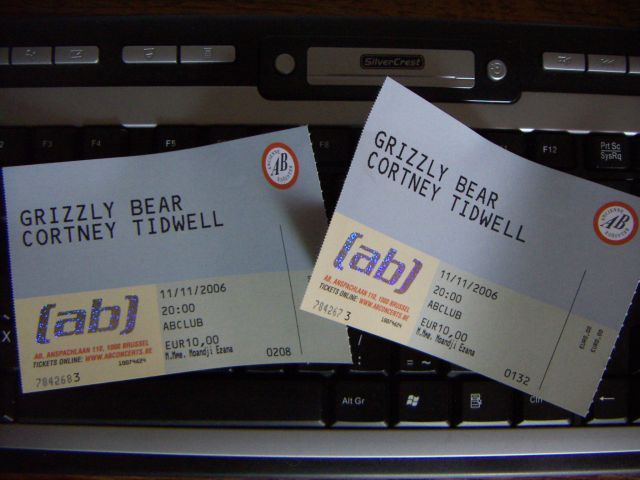
Collapse; Cortney Tidwell + Grizzly Bear - 11/11/2006

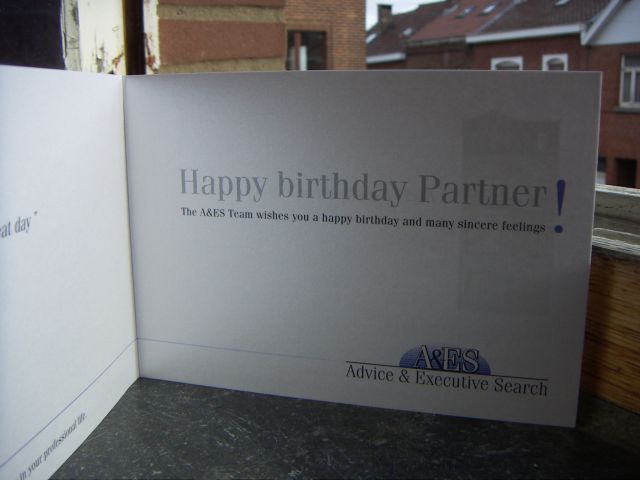
the most sincere birthday card ever


Despite seeing three bands in two locations, by far the most memorable thing to occur on my birthday (28) was a disastruous encounter with TV On The Radio.

Collapse (website)
Jean-Paul Estievenart - tp
Cédric Favresse - as
Lieven Van Pee - b
Alain Deval - d

The Archiduc is fun to go to because it mixes people who can afford to shop at the Olivier Strelli down the street (which the drink prices reflect) and those who can afford... free (as in 0 euro) jazz concerts.

Jean-Paul Estievenart recently won the New Talent Django d'Or, the best of an extraordinarily weak field, compared to previous years. Anyway, I hadn't heard him in a long time, so was curious. He's a clean-cut player, fluent but not particularly interesting. They played a few Ornette Coleman tunes (you can hear "Jayne" on their website) as straight as possible. Mingus's "Fables Of Faubus" was more fun, as was Cédric Favresse's composition "Yémen," which juxtaposed a bright, infectious rhythm with a slowed-down, Middle Eastern section. He's more expressive than Estievenart at this point, working his way through his Charlie Parker. Collapse is further proof, as if any were necessary, that even young Europeans are interested in mainstream, swinging jazz. Not all of us are avant-garde freaks, believe it or not.

We stayed for about half of the second set, then headed for a Chinese restaurant opposite our next musical stop, the Ancienne Belgique's upstairs club. It was my birthday and I was bored at home, so decided on the spur of the moment to come out for a double-bill of two bands I'd never heard of. Amusingly, the main impression I'm left with is "welcome to the blogosphere!" (at least, a different blogosphere than the one I'm used to, one where guys in the front row wear Broken Social Scene t-shirts).
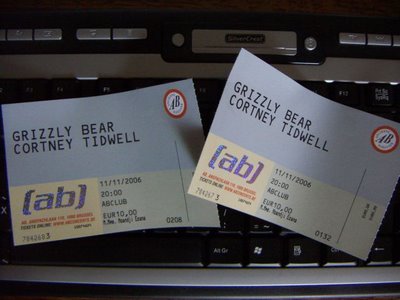


Cortney Tidwell (MySpace)

A very young band from Nashville. The singer had a Joanna Newsome-ish girliness and tortuous phrasing. The sound was pretty bad, so as soon as the guitarist, cellist and keyboardist all started playing, I had no idea what she was saying. Maybe it was the sound, but the songs kind of lacked contour and detail. Still, they could drift on a couple of floor-rattling drones, bounce on a disco beat or explode into guitar noise.

Grizzly Bear (MySpace)

Four men singing together in high-pitched harmony never goes out of style, especially when they're doing it over long, sprawling multi-sectional songs that are tinged with 70s psychedelic rock and often involve whistling. Thankfully, the sound was excellent. Interesting, but I kind of got bored after a while, whereas IVN loved it all the way through. I liked how not straight-forward it all was. One song started with a brief, hard-driving explosion, then spent the next many minutes making you think it was going to get back there, but never did.

And now, the already-legendary TVotR incident:

During the intermission between the CT and GB shows, I saw the guys from TVotR over in a corner. They were opening for We Are Scientists the next day, so I wasn't surprised to see them there. Since he's the most recognisable of the bunch, I went over to Kyp Malone (surely the best afro/beard combination in the business). The following is a transcription of our conversation, with the thoughts that whizzed through my head in brackets and italics.

*Put hand on Malone's shoulder, Malone turns around*
"Excuse me. I just wanted to say that I really really really love your album (I should show him that I am aware that his band has several albums, even though I only own one of them) Return To Cookie Monster (fuck! Could I have said anything more stupid? Now I look like an insincere idiot! *image of Cookie Monster comes to mind* Should I say nothing and just hope that the music was loud enough for him not to have really heard what I just said?) Return To Cookie Mountain (just keep smiling).
*Dave Sitek chuckles. I am increasingly nervous*
"Thank you very much."
"(Quick, re-assert your fandom)I'll be coming to see you tomorrow, I'm really looking forward to it."
"Thank you." (I don't think he cares. He probably heard cookie monster)
*I walk away, head hung in shame*

Monday, October 02, 2006

Soweto Kinch - 30/09/2006@AB, Brussels


Soweto Kinch - as, rap (website | MySpace)
Abram Wilson - tp
Femi Temowo - g
??? - b, el b
Troy Miller - d

Talk about a come-down: after the acoustic bliss of the previous night, the first note of Soweto Kinch's over-amplified concert felt like an aggression. The sound was unnecessarily loud (unless you really believe that a trumpet cannot be heard from 10 metres away) and confrontational rather than enveloping. We quickly moved to the back of the room. Afterwards, I was told that the amplification made the blend of jazz, hip hop and sampled elements easier. It's a real shame that the sound system also muffled the rapping: it's dense, but vivid and often hilarious. I got used to it after a while, anyway.

I won't repeat myself too much: see a July concert review and my review of Conversations With The Unseen.

After a brief rough spot at the beginning, Kinch was spitting *fire* on all his solos - far, far better than the somewhat empty technical display he put on at Klinkende Munt. Abram Wilson had an earthier, soulful vibe that brought a welcome balance. I was worried that they'd play material I was already fairly tired of in July, but luckily they only did the brand-new second album (which I haven't heard yet, but is partly available on MySpace, and, coincidentally, was produced by the guy who produced The Bad Plus's upcoming album). The only songs I already knew were "Adrian's Ballad," a detailled portrait that highlights the quality of Kinch's lyric writing, and "A Friendly Game Of Basketball," an uptempo bop head. The two sum up the poles between which Kinch's music swings.

In fact, 70% of what he does is contemporary straight-ahead, really. Even the way the hip hop grooves are phrased evokes jazz. He also frequently used horn section samples to beef up the group sound, which he hadn't done this summer. That he has the ability and charisma to get people - young people - really enthusiastic about hearing bebop makes me happy.

There was one radical departure from the formula, called "Out There." The bassist picked up an electric bass, Kinch applied a warbling FX pedal to his saxophone and the band veered into rock. They returned to acoustic jazz for the soloing section, and ended with another electric part, but this time funkier. I'm not sure the collage made sense as a whole and it certainly wasn't as out as Kinch seemed to think it was, but at least he's keeping his options open. Overall, though, a very good concert.

Afterwards, on the way back to the car we dropped by the Beursschouwburg's bar for a little while. A band was playing a sort of acoustic downtempo Hooverphonic thing, with a bit of an An Pierlé vibe as well. They looked great on stage: three girls in front (l-r cello, keyboards/vocals, keyboards) and three boys in the back (l-r bass, drums, guitar).

Thursday, February 02, 2006

Othin Spake vs. Nozzle Slag

Teun Verbruggen has long been a member of many local groups, some of which are among my very favourite: Pascal Schumacher Quartet, Jef Neve Trio, Quatre, Bruno Vansina's VVG Trio (which I've never seen live, but their CD is great), Alexi Tuomarila Quartet, Peter Vermeersch's (from X-Legged Sally) Flat Earth Society and, more recently, Rackham. When I learned that Teun was starting his own group(s), my hopes were immediately very high: from the personnel, it was clear that he was going in a weird-improv-rock direction; from my interactions with him over the years, I was sure it would be anything but run-of-the-mill. Othin Spake's Beurs Café show exceeded my expectations, Nozzle Slag's AB Club appearance was a let-down.

Othin Spake - 27/01/2006, Brussels

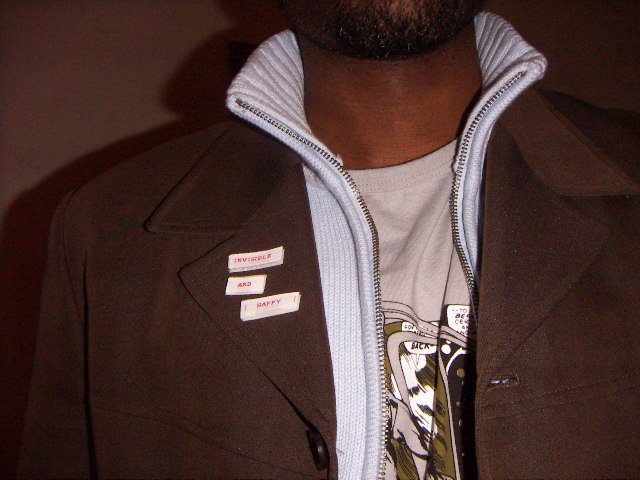
invisible and happy

Aside from the music, there were also the velcro-able "emotions" that were meant to be exchanged. They were distributed by women in figure-hugging white dresses and World War II-style nurse hats. My choice of "invisible and happy" was a combination of a homage to Ralph Ellison's "Invisible Man," a tribute to the awkwardness of going out alone and a reflection of my general state of mind these past few months (happy, not invisible).

Teun's drums were fully-miked up and reverbed, which worked well in this context. He was totally convincing as a free-improv-prog-rock drummer. The other members of Othin Spake, Jozef Dumoulin on keyboards and Mauro Pawlowski on guitar served as noise-makers, while Teun played everything from rumbling, cymbal-washing prog-rock intros to skin-tight funky grooves. Each set consisted of continuous music, everything flowed really well and naturally, there was no or little sense of anyone "taking a solo" or abruptly forcing the music in a particular direction. And when they hit a groove, they hit it hard and got everyone dancing.

Dumoulin is well-known in jazz (or "jazz") circles here for his exploration of the sound possibilities of the Fender Rhodes. Like Keith Jarrett, it's an instrument he doesn't like, but he's been punishing it for maybe 5-6 years now (maybe more?) and I've heard his ability and creativity grow by leaps and bounds over that time. Actually, listening to the "Cellar Door Sessions," Jozef has a way with the Rhodes that's similar to Jarrett's. He didn't go for either the jazz-derived lines many jazz pianists transfer to the Rhodes (and rarely, if ever, work, IMO) or neo-soul two-chord static layers, but instead created a rich tapestry that has more to do with a rock-studio-production approach. Whereas Jarrett would leaven his abstract playing with funky/bluesy stuff, Jozef does the same with pop/rock-ish melodicism or riffing. I recognised delicate, glowing crescendoes from his "Metropolis" accompaniment. Over time, riffs emerged, a second synth served to play almost-basslines (the almost is crucial, as a usual bassline would have veered the music into normalcy).

Pawlowski plays in the well-known rock band dEus (or however the capitalisation goes). He dove totally into the realm of virtuosic noise, I'm not sure he played a "real note" all night. Tapping and scraping, he added rhythm or sonic disturbance to the mix. It was often difficult/impossible to tell what was coming from Dumoulin and what from Pawlowski. The fourth person onstage was a VJ, projecting images behind the band. He had a few basic sequences (clouds, a frantic race through a maze of skyscrapers...) that he manipulated in response to the music. It worked pretty well.

Nozzle Slag - 01/02/2006, Brussels

Teun's second new group, Nozzle Slag, is a more international affair, as Trevor Dunn and Hilmar Jensson join Teun and Jozef (Jenssen's "Ditty Blei" is a nice album, with Dunn, Jim Black, Andrew d'Angelo and Herb Robertson).

I had a weird feeling about this one and was quite disappointed. IVN disliked it totally. Compared to Othin Spake, the music was much less fun, original and organic. There was a lot of written music, but it felt undigested: the various seams were fairly visible, which really irked me, for some reason. There was much less of a group sound: Jensson would solo in a fairly typical jazz-lines-adapted-to-rock-sounds jazz-rock kind of way, followed by Jozef, oh, now it's Dunn's turn... The music flowed less easily: a glance or nod would signal abrupt changes from a quiet section to a loud one, unlike Othin Spake's way of building and dissipating various moods or grooves. The writing itself didn't appeal to me: again, fairly typical aggressive jazz-rock lines that I don't really like and freer, more open sections that didn't really gel. Even the most let's-rock-out grooves didn't work that well for me.

The one really brilliant moment was when Jozef played alone for a good while. He started with abstract lines and segued into a beautiful ballad-y motif repeated over and over that reminded me of those magnificent chords that open Sigur Rós's "()," but with less pure sounds.

A quick note about the openers, The Love Substites. Pawlowski was in the band, but as drummer. My favourite moment was the encore: Teun drummed wildly, Pawlowski took the mic and repeatedly screeched/shouted something about "We are the Love Substitutes." It was pretty awesome.

Thursday, October 06, 2005

Polar Bear - 04/10/2005, Brussels

I went to the Ancienne Belgique's ABClub for the first time. Had I known earlier how nice a space it was, I'd have gone there sooner and often: small, but uncluttered (no chairs), roomy and elegant (wood floors and wall panels, semi-circle bar at the back). A rare sighting: someone else taking notes. He had a proper notebook, I had an old, folded-up bank receipt and a pen that happened to be in my jacket pocket.

Polar Bear's "Held on the Tips of Fingers" isn't a radical break with "Dim Lit" (except, perhaps, commercially, as they went from winning BBC Jazz Awards to being shortlisted for the Mercury Music Prize), but does expand the band's palette, notably through the addition of Leafcutter John on laptop. On tour, the latter is billed as "featured" and performed on about half the songs. At times he used a PlayStation-type joypad to trigger sounds: in duet with drummer/leader Sebastian Rocheford, zoink!s, crashes and screeches that flew from left to right and sounded like a THX demo gone mad, or atmosphere-solidifying metallic drones behind the full band. On the CD, his contributions tend to be chiseled, here they were often wild. While that made for some satisfying wall-of-noise or frantic electronic ping-ponging moments, a little carefully-crafted clickety-click would have been welcome. In quieter moments, Leafcutter John used a microphone to sample a triangle, a bit of crinkly plastic or Tom Herbert's bass playing.

The chiseled/wild distinction also holds for the core Polar Bear unit: the CDs don't give much indication of how aggressive the band can be on stage. Polar Bear is, for me, a concious or unconcious continuation of the late 60s/early 70s guys who had grown up on hard bop, matured with free jazz and were trying to mix the two over a loose version of contemporary funk/soul grooves. The improvising of the two saxophonists make this connection clear as they tread between refined free jazz hollers and guttural bop exclamations. The other two times I've seen them, Ingrid Laubrock subbed in for Mark Lockheart, but not last night. Overall, the music was perhaps a bit tighter for it.

The quartet + 1 wound liberally through its repertoire: new songs ("I wrote this one when I woke up," Rocheford explained, without specifying whether he meant that very morning), old songs that still haven't been recorded and, of course, album tracks, the composer's sensibilities were made quite clear. Rocheford's harmonies, simple compared to those of bop's high modernists, sometimes give off a folksy feel and allow the soloists to take off in any direction. On one tune in the second set, Pete Wareham took the bass and drums into heavy, Acoustic Ladyland-ish territory, but during Lockheart's solo, he and Herbert often hinted at calypso. The bandleader's playing makes plain the lessons drummers have learnt from hip-hop/electronica producers: orchestration (how/when each kit element or sound source participates in the beat) is as crucial to the beat's identity as the rhythm itself. The melodies often call for intertwining saxophone lines: one providing a background to the other's melody here, a pleasing clash between ascending and descending motifs there. In contrast to the barn-storming solos, the themes are often melancholy, tender or worrying. That's not always the case: before the two encores that ended the concert, Polar Bear played "The King of Aberdeen," which has a fast 'n' furious two-beat (kitted out with Herbert's Mingusian shouts), one of the band's characteristic sounds.

Rocheford seems less stage-shy than he used to be, presenting a guileless persona who seems to say whatever pops into his head. Presenting a song called "Fluffy" that used to be called "I Want You," he said, almost putting the microphone down between each sentence, "It [the title] sounds like I want a cat. But I prefer dogs. I do like big cats, though. Especially leopards."