Tuesday, September 28, 2004

so u wanna b a jazz supastar?


Okay.

'There is this whole argument that Katie Melua, Joss Stone, Amy [Winehouse] and me are part of the same thing but I don't even see myself as a jazz singer,' says [Gwyneth] Herbert, 23.

Does anyone see the other three as jazz singers? (I'll admit to a soft spot for Stone, Melua is rather loathsome, however)

The big bee is more awesome than all four of them combined, though, I'm sure.

Ask and ye shall receive

Cat & music stories (and do check the comments).

less crying

Casper points me to a far more reasonable and pragmatic text by the much-criticised Wayne Bremser.

As Tim The Rambler put it in the comments: The crunch is definitely the use of the word 'study' instead of 'listen to'. Even for those studying, the Internet adds even as it substracts. There's AMG, of course, but for labels serious about download sales, it is obvious that they should make liner notes and specific session information readily available on their websites, if iTunes isn't going to provide it.

I've never bought a download and don't intend to. I continue to see CD-R's (even one with a colour copy of the sleeve and a reproduction of the CD artwork stuck on the CD-R) as a less satisying experience than an original. But I recognise that I am part of a fringe (a non-negligeable fringe - cf. all the blogs and music websites and forums out there), but a fringe nonetheless: most people simply don't care when or where Kind of Blue was recorded, and care even less who was playing bass.


It still riles me that the Academy judged "Gladiator" to be a better film than "Crouching Tiger, Hidden Dragon." Yes, we've all known for a long time that such prize-giving institutions mean nothing, etc., but it is dismaying to see them unable to distinguish between two similarly big-budget action adventures.

Yesterday I premiered to myself the double bill of "Kill Bill, vol. 1" in the afternoon and "Hero" (I'm not sure if that's the English title) in the evening.

"Kill Bill": I guess I'll be renting vol. 2 at some point, but who cares, really.

"Hero": despite succombing to the totalitarian whims of french overdubbing because the audio and subtitles buttons on my DVD's remote had no effect (how anyone stand watching Chinese characters speak in boring MOR french voices is beyond me), a great experience. Hero goes further than CT, HD in an aspect I really enjoyed of the latter: the fight as a canvas for abstract poetic tableaux and the surreal lyricism of flowing lines.

Think of the creative barrenness of the bigger-is-better, testosterone-and-explosions-driven Western action movies. Even John Woo's "Face/Off," lauded as it was for its violent poetry, is oafish in comparaison. As in CT, HD, there is a stillness about "Hero" that periodically erupts into intricate action choreography (Li Mubai, baby). Crucially, though, the surrounding stillness is what makes the eruptions possible and meaningful. This is embodied most strongly in the conversation between No-Name and Lord Qin.

Part of the power of these films is in their formality. The fights in "The Matrix: Reloaded" were formalities and thus boring. The fights in "Hero" are imbued with a formality that is the same as the one governing the interactions between the characters. Much is left unsaid, needless camera movement or sound effects left unfilmed. This formality is also the foundation for abstraction: the rules are strong and established, yet highly flexible (like bamboo). So Snowflake and Moon, dressed in blood red robes, fight amongst swirling golden autumn leaves; No-Name and Sky pause their confrontation to ask a blind old man to continue playing his string instrument as they fight (an awesome musical moment, very Western-as-genre); No-Name and Broken Sword fight on a lake, using their swords to keep them aloft; Snowflake parries oncoming arrows with her translucent robes; hemorrages are stopped with a mere torn-off piece of cloth tied above the clothes: there is no blood there, in fact very little is seen, but when it is, it is for a reason; wiping a drop of water off of a loved one's cheek is more important and powerful than an enemy's charge. It can get cheesy, but is infinitely more satisfying than the latest gunfest.

Dry formality, yes, but no grimness: colours explode, Chinese landscapes I never even suspected the existence of before CT, HD awe. The iterative structure of the narrative exploits these resources: characters are dressed first in red, then blue and then white as we reach the truth.

purr purr

Like all people who have cats, Alex Ross can't resist posting pictures of his cats. It's a miracle I haven't posted any of Nwabhu here (oh yes, I forgot: I have Jazz Corner for that).

More seriously, with their superior hearing, I wonder what cats and dogs and things hear when we play music. They generally don't seem to react unless there's something startling like a sudden noise. I wonder if it is possible to study animal reactions to music.

Monday, September 27, 2004


Dennis González NY Quartet - NY Midnight Suite (in French)

A fabulous album. Ellery Eskelin (ts), Mark Helias (b) and not-a-newcomer-but-a-revelation Michael Thompson (d). Post-Ornette Coleman small group improvisation; freewheeling and yet generally concise. González reels off improvised melodies that sound like quotes from half-remembered songs, Eskelin provides a searching foil, Helias challenges and Thompson shades and prods.

I was caught off guard by González's importance in my collection: number 8 should be arriving soon. And I still haven't cracked the Silkheart's, which many people swear by.

More generally, it's weird how many CDs from artist one needs to feel properly acquainted. 40 Miles Davis entries more or less do that for me (counting the Plugged Nickel box as one album), but I still need to get Ascenseur pour l'échafaud. Mingus is in the double-digits (again, counting the Atlantic box as one entry) and each album is so rich (I remember Pete Wareham of Polar Bear saying that one could buy a Mingus album every five years and be content) that only a few more should suffice, but which ones? A little low on Coltrane (especially early and late), Ellington, Basie. Poor on Hancock (the last time I was at the library, I passed on the Blue Note box, I suppose I'll be getting it next time), Corea, Jarrett, Bill Evans (I'll have to tread carefully though: I like Everybody Digs but Waltz for Debby not so much), Cannonball has to make do with just Something Else, Ornette Coleman is represented by his own Something Else and three of the Atlantic quartet dates, while Steve Coleman has almost an entire shelf to himself (thanks in part to the MP3s on his website), Louis Armstrong definitely (the Hot 5s/7s JSP box is the only article on my to-buy list, but when will I have the 30 euros?), Zorn is in there only with a couple of Masadas, etc., etc.

At the other end of the spectrum: Wonder, everything from the 70s plus a comp of earlier stuff and I'm satisfied, Ben Harper, the first 4-5 albums and I think that's enough, all nine entries for The Roots (I might as well take out a subscription), five Outkast (ATLiens remains my favourite album, another one to subscribe to), a couple of Gangstarr's left me seeing no need for more, one Ludacris and am content with it, and one Mos Def and wish I had more.

Etc., etc.

Yeah, but where are Bach, Beethoven, et al.? A few here and there, but apart from Scarlatti, I don't *love* "that" music.

Can't wait for the completion of the killer app, the homemade CD shelf.

Sunday, September 26, 2004

harlem.org


Having said all that, do check out Wayne Bremser's harlem.org.

forgetful crybabies

If I had a picture of Mannekenpis, I would have used it in this post.

It's almost embarassing being a jazz fan when articles such as this one purport to represent you.

I'm annoyed by these articles because they take a very narrowly-defined historical base and listener profile and from that extrapolate that the sky is falling. Total lack of a broader historical perspective results in the reification of the two imaginary constructs into a litteraly mythical Golden Age.

It's even more embarassing when you read blogs written by people who actually seem to follow and understand what is happening. Where are the equivalents in the jazz world?

The older among us remember that wonderful dinosaur, the long-playing record, which came with a trove of information to help a listener better understand the music. In the days before MTV, record labels made the album an immersive experience with striking graphic design, moody photographs and informative liner notes written by prominent critics such as Stanley Crouch, Amiri Baraka, Dan Morgenstern and Ralph J. Gleason.

And the even older remember 78 rpm discs, which contained two songs of around 3 minutes each. And even in the album era people continued to buy singles, which has mutated into downloading MP3s. So "the days before MTV" cannot be simply typed as a very long period stretching from the dawn of recorded music to the mid-80s during which the "immersive experience" of the album reigned.

Millions of young listeners are buying music that is sold without liner notes, correct recording dates and session information. Even the musicians' names are often removed from their performances.

Newsflash: a lot of the original issues were sold without all this information and sometimes with incorrect information (sometimes on purpose, à la Charlie Chan or Little Brother). Miles Davis famously hated liner notes and musician names are often difficult to find on his 70s albums.

That's the state of the art at iTunes. Search for one of my favorite albums, "Coleman Hawkins Encounters Ben Webster." You'll see that iTunes lists the release date of this 1957 session as 1997 (the date the CD was released). Curious about who plays bass? Good luck, iTunes won't tell you.

If you're using iTunes, you're on the Internet, right? If iTunes won't tell you, AMG will (I know that you, dear reader, already know AMG, I include the link for Wayne Bremser's benefit).

Also, keep in mind that many people don't really care.

The less that contemporary players in all genres know about the past, the less likely they will be to advance the music.

I would argue that hearing music is more important than knowing who played it and in any case it's not as if this information has been wiped from the face of the Earth.

Already there is a growing audience for jazz that's accessible rather than challenging. We have seen the popularity in recent years of cookie-cutter "smooth" and "quiet storm" jazz radio stations offering a soothing background tapestry to daily activities with a program of music that doesn't engage the audience in any kind of dialogue.

Already? Muzak has been around for a while. As has been wallpaper music. As have been people who listened to Sinatra but not to Monk or even Basie. The term "quiet storm" has been in use since the mid-70s, negating Bremser's "in recent years. Again, lack of historical perspective.

Will a listener schooled on this music, whose source for more diverse jazz recordings is an online music store, be receptive to the intensity of a performance by Ornette Coleman or Sonny Rollins that might touch a much wider range of emotions?

I would like to couple the above paragraph with two earlier ones:

With all of this written and recorded information accessible in one [box set], it is easier than ever to track a jazz musician's ideas and techniques evolving day by day, session by session, which is how the art form advances.

Appreciating this, our ears are not so startled when the smooth Miles Davis of "Kind of Blue" produces the menacing "Bitches Brew" of 10 years later. Understanding this progression, we can make some sense of Ornette Coleman's listener-unfriendly "Free Jazz" the first time we hear it.


I fail to understand the first and third paragraphs. Because a "schooled" listener studied the music by downloading it, s/he is less likely to be receptive to Rollins and Coleman, who express a range of emotions that is broader than... what? Than what's available on iTunes? Understanding Davis's transition from KOB to BB helps us makes sense of Free Jazz from the very first time we hear it? Wouldn't familiarity with Coleman's earlier work and perhaps with the free jazz that came before or after be more useful?

We live in a time when many listeners don't care who plays bass on a Jay-Z track or which 1970s funk band was sampled on a Beyoncé single. The culture of music videos leaves a large number of musicians unseen and anonymous.

The largely anonymous existence of session musicians tends to show that "many listeners" have never cared, regardless of what time it was. This is especially ironic in the wake of the Funk Brothers emerging from decades of not being cared about, despite being on bagfuls of hit records. Again, people cared just the same back then, which is not much.

It's impossible to study the great mid-1950s recordings of Miles Davis without knowing who John Coltrane is.

Yes, it's impossible to study, somewhat less impossible to enjoy. And if you're interested by what the saxophonist or bassist has played, you can go to AMG and find out who it is. Or buy the CD. Simple and not too different from how playing non-playing students of music have been deepening their knowledge of it from time immemorial (through magazines, books, liner notes and now the Internet).

someday listeners and musicians might want to know more about what exactly they are listening to. In the case of jazz, the future of improvisation really depends on it.

The future of jazz is riding on the features present in iTunes and its clones? Despite the same information being available elsewhere on the Internet?

it may be a mess, but it's my mess


The sound on New Orleans Funk is mostly poor: often muddy and cluttered, passable at best. Yet, that quality, or lack thereof, is not only part of the music's charm, but also part of its vibrancy, energy and liveliness.

I'm reminded of K-Punk's recent lambasting of spotlessly empty and streamlined middle-class living-rooms. Consider also the famous description (but by who?) of ECM albums as "the sound of the middle classes falling asleep."

While mess may not necessarily be a nest of creativity (or a defiant response to production polished by the evil forces of big money), it can often be the repose of the uncommon mind.

In Brighton there is (or was) a second hand bookshop in which the books were strewn about in stacks, or on shelves with absolutely no indications or seeming order. Ask the shopkeeper for a book and if he had it he would find it instantly. Obviously, he was the only portal through which the collection could be accessed in a time-efficient manner.

My father likes to describe an ex-colleague whose office was a minor attraction: stacks of precariously perched papers jostled with empty coffee mugs and cigarette butts. Again, ask him for a specific document and he would extract it in short order.

And then there are means of organisation that need to be explained before they can be utilised. I was rather shocked to discover that several people organised their ECM albums by spine colour to form a rainbow pattern, or their overall collection by time of purchase.

We used to have a croque-monsieur (grilled sandwich) machine that we rarely cleaned. Unhygienic, certainly, but the sandwiches tasted great. When we did clean it, the sandwiches lost some taste. Similarily, as The Meters (to take a Big Easy-related example) moved towards a cleaner sound and less incandescent second-line rhythms, hygiene was gained but some flavour was lost.

The level of messiness has to be suited to the context. French Star Academy winner Jenifer's turn to a "more rock" sound on her second album (or at least the single I've heard) is a pitifully transparent ploy. Saturation and dusty snare drums on the New Orleans Funk tracks serve to convey the performers' own energy and spirit.

Clutter of a different kind may make music accessible only to specifically-wired minds, making the usual fishing for known referents too difficult. In music the line is of course far less absolute than in simpler matters like book classification (should I expect flames from legions of librarians?).

Kyle Gann (I think it was) has ranted about High Modernist music comprehensible only through its score. Unable to hear any familiar elements to hang on to, some might find Cecil Taylor totally impenetrable. The music becomes an unproductive mess, like being in the bookshop while the owner is tending to another client.

Alias beAlias = new Alias();


Alex Ross describes Alias's incidental music much better than I could. Not only because I don't know that era/area of music, but also because I must admit to not having taken any active notice of the music. However, he fails to mention the show's *greatest* musical moment, which is of course Marshall's drum'n'voice proposal song, as rehearsed to Vaughn.

Ross mentions the music over the closing credits. Huh? There are closing credits? I've always seen it end simply with "Alias" on a black screen.

The only music I've really noticed are the product placement pop/rock songs. Which reminds me of that moment in the second season when all of a sudden they started doing crass product placement for the Ford Focus, going so far as zooming in on the car's logo.

I'll add to the list of unbelievables: given the number of times the Bristows have been electroshocked, shot, drugged and beaten senseless, it's a real miracle they have all their limbs, no apparent brain damage, no missing teeth and no visible scars (Sidney's plot-device harvesting scar doesn't count).

And what was with the sudden obsession with tranquiliser darts in the third season? They hardly, if ever, used them before and all of a sudden they're putting all the random guards to sleep (must be a powerful drug, knocking adults out nearly instantaneously).

Saturday, September 25, 2004

The comps pile


A few compilations from Soul Jazz Records, borrowed from the library, have been enlivening the household, of late.

The New Orleans Funk compilation is awesome, almost every track is great. There are a couple of sure-fire Meters tunes (so many moments of perfection in "The Hand-Clapping Song" and "Just Kissed My Baby"), but perhaps the most striking track, to me, was Professor Longhair's "Big Chief." I'd never heard any Longhair before (or, indeed, any of the compilees apart from The Meters, not even Dr. John) and definitely never heard a piano riff quite like this one. If you listen to it in a certain way when it's underneath the horns, rhythmically it's almost Cecil Taylor-ish (harmonically not at all, obviously, so it's a bit of a stretch, but still). This led me to pick up Soul Jazz's 2-disc compilation dedicated to Longhair, but the first disc hasn't really grabbed me. We'll see.

The last comp is The Sound of Konk 1981-88, a fairly explicit title. This should go a small way (a glass of water into the Grand Canyon) towards filling one (of many) of my Yawning Fucking Chasms of Ignorance (TM). According to the as copious as ever liner notes, Konk was underground dance music, but 20 years later it's hard to understand why: dance-funk with added latin percussion (timbales, congas) and touches of exuberant jazz have become a fairly standard, even clichéd, template.

Since I'm at the confluence of two things (compilations and "why wasn't this more popular back then?"), I'll mention (yet another library-owned) compilation: Jazz Loft Sessions from Knit Classics. It culls live music recorded in Sam Rivers's Rivbea loft over 10 days in 1976. Apart from a couple of the 10 tunes (those from Braxton and David Murray, iirc), one wonders why this music wasn't accepted in the major jazz clubs of the times (if indeed they were not). I'll come back at a later date with more detail, but a major discovery is that in his early 20s, Michael Jackson led an alternate and well-hidden existence as an avant-jazz guitarist. Since then, we've learned that he has even more sinister stuff to hide, but that's another issue.

And why not: also got a Rhino 2-CD compilation (as beautiful as ever) of Bootsy Collins, but haven't been able to listen to it yet. I'm kind of all compiled out.

playeriffic all day long


Friday morning, hearing JC Chasez's "All Day Long I Think About Sex" (which, judging by airplay, is doing fairly well here, I have no idea about its status in other countries) made me think that this theoretically should be my current soundtrack, but in practice isn't, oddly enough. I'm not sure why.

And while we're vaguely on the subject.

A few weeks (months?) back, R. Kelly's song about turning back the hands of time flashed across the radio, prompting a (much belated, perhaps) re-assessment of my opinion of the song. I'd never liked it and still don't. But I was forced to admit that it used all the classic soul song-writing techniques well (from the 12/8 (iirc) to the climactic high "oooh-OOOH"s), so I can't just dismiss as pop crap any more. I did like "Ignition (Remix)" very much from the first time I heard it (but then again, who didn't?).

And to bring this full circle.

I revisited (ie. downloaded) "Ignition" recently, which brought up thoughts of "while the cat's away" behaviour, but even modest Cristal poppin' would wipe out the monthly budget... I guess I'm not a player yet.

Speaking of which.

I've been wondering for a couple of days if in a classroom somewhere, a teacher has explained a structure-oriented social, economic or political theory, and an enthusiastic student responded "So what you're saying is: 'Hate the game, not the player?'"

Wednesday, September 22, 2004

this will have to do


Sure, you're getting Mayotte pictures now, but where was my camera when there was a racing car parked on the street? In Mayotte! And it wasn't a MACmobile*, but a real formula something-or-other type of thing.

And it was bright orange. BRIGHT orange! So, yeah, take your Mayotte pictures, I'm mourning the car.

* Middle-Age Crisis mobile

against the wall


Willi the pig: still here, but for how long?

News from space travellers, subterranean dwellers and other heavenly bodies


Sun Ra Nuits de la Fondation Maeght Vol. 2
I'm no Ra expert, but there's an incredible electric organ solo on this one, a few minutes before the end. Drama? Planets supercolliding, fast-fowarded civilisations rise and fall in a matter of seconds, epic flurries of unbearably dense noise swoop and attack mercilessly.

Charles Mingus Presents Charles Mingus
"What Love?" of course, but all four tunes on this album are superior music-making. Perhaps the best Richmond-Mingus linking up I've heard. The relatively poor sound only enhances the atmosphere. And the sung/shouted vocals on "Original Faubus Fables" are priceless (well, actually they could be priced at approximately 2.5 euros, considering that the album cost me 10. Pretty good value). Mingus even employs a pseudo-English accent that Andre 3000 would inherit 4 decades later for "Behold a Lady," but Mingus is funnier.

Ella Fitzgerald & Louis Armstrong Ella and Louis
Every time I listen to Ella, I feel like inflicting severe pain on myself for not having more of her work. Truly incredible singer, a million miles away from the sub-Billie caricature so many have become.

mobile phones still exist

Sorry to dredge up such a dead horse issue for another round of beating.

In a one-day training session, a couple of people answering mobile phones.

I don't necessarily have perfect mobile phone etiquette (but considering how little I use the thing, the impact either way is minimal), but I let one call vibrate into the ether because the teacher was explaining something to me, and stepped outside to take another that seemed important. Others, however, felt it sufficient to move towards the back of the class. Yes, converse amongst yourselves.

"She says she's a rapper but she's really a two-bit whore... You need no skills today to pass/Don't have to rap, just shake some ass" - Luvpark

"I'm a bad-ass stripper in the Escalade/Jump out the truck I'm in Saint Tropez" - Jentina

"It's all right to sample, it may even be a hit/But every now and then could you write your own shit?" - Luvpark

"It's been a long time/I shouldn't have left you/Without a dope beat to step to" - Timbaland

"Hello, it's Cole Porter. Could you leave my songs alone? Gershwin says he wants his changes back, too." - imaginary

"Perhaps most shameless though... is the way [Jay-Z] has liberally endorsed what was originally considered (and still is to most MCs and producers) the greatest crime against hip-hop culture and your fellow artists: biting, of both beats and rhymes." - Stefan Braidwood

"New beats, never recycle" - The Fugees

"a gloriously over-the-top keyboard compendium of B-series sci-fi FX" - me on Luvpark

Not mentioned in review: saxophonist Ralph Bowen plays some nice stuff.

Monday, September 20, 2004

WALLOP!!! - In Memoriam


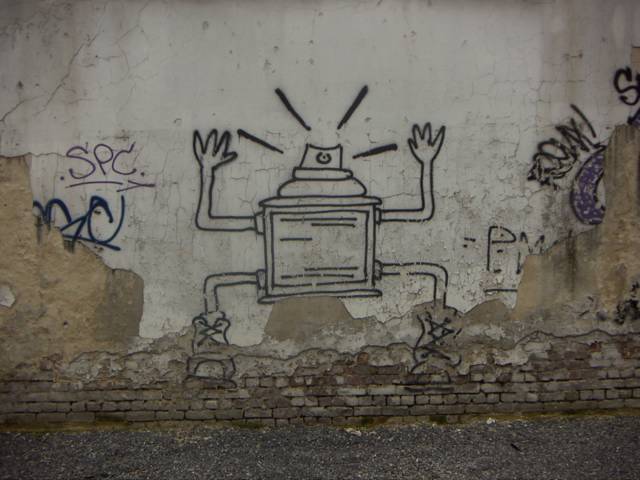
Waiting for the train back home from work, I noticed that the opposite platform was lacking the above ornament. It used to send a cartoonish KAPOW!!! message to the worker objects passing it on their way to a day at the office, but how many of them were equipped to handle this message (pardon the language, I'm studying Object-Oriented Programming at the moment).

The KAPOW!!! has been scrubbed away to a mere ghost, something slightly distorting our vision of the "real" surface underneath. And for what? For what has someone's hastily-scribbled artwork (artwork vs. vandalism = freedom fighting vs. terrorism ?) been deleted, taxpayers' money been spent? To semi-restore the -ish coloured tiles (-ish as in an unidentifiable and purposefully characterless brownish-yellowish) to their former bland glory.

I can understand conserving beautiful, pleasing or interesting things against defacement. Were these walls part of a larger scheme encompassing the whole of the station, I would understand. As it is, the station is one of the ugliest I know. Not only is it ugly, it is slowly but clearly deteriorating and its design is a failure. Hence, our dearly departed KAPOW!!! was a freedom fighter attempting to liberate us from this oppressive ugliness. As is usual with such things, it is only when such occultation by the dominant order (here represented by the scrubbing service) of alternative, occasionally better, realities, was made clear to me that I noticed the numerous other ghosts on the stations walls, turning the place into a veritable graveyard of better futures aborted in the name of an unnameable colour.

Similarly, if someone were to blow the Palais de Justice to bits on aesthetic grounds, I would approve.

Saturday, September 18, 2004

Nate Dorward


Nate Dorward goes online with The Gig. Probably best known in music reviewing circles for calling Evan Parker's solo soprano "bagpipe music for eggheads," Dorward is also known for drawing attention to himself with idiosyncratic use of the ampersand and "Artist, Title" nomenclature. Make sure to check out the *excellent* review of Mal Waldron's One More Time.

& there's nothing marmoreal about it.

Friday, September 17, 2004


Just in case you didn't fully get it the first time. Big up to Mike B.