Saturday, February 03, 2007

Courvoisier/Eskelin/Courtois - 23/01/2007@Vooruit, Gent


Sylvie Courvoisier - p (website)
Ellery Eskelin - ts (website | myspace)
Vincent Courtois - cello (website)

[Followed the Paolo Angeli set]

This trio has done a number of tours over the last few years. Though they started out using compositions and more traditional instrumental roles, they're now resolutely into the kind of total improvisation that requires fluidly finding an appropriate place in the flow of events. As such, leads were passed freely, or disappeared altogether, as each member swam in the others' sounds. They laid out liberally, creating space and silence and vast expanses of possibility just by standing (or sitting) there and intently observing whoever was playing. Ellery's frequent use of breathy, almost unarticulated lines seemed to sum up the band's sense of barely-there looseness.

When Courvoisier unleashed short, furious motifs amidst stormy flurries and elbow slams, Cecil Taylor came to mind, but she maintained a surprising and delightful amount of lightness, like lightening without the thunder. Her use of prepared piano* was always apt. Courtois made discreet use of a distortion pedal, to similar effect. When it created hums and static to accompany piano clatter and breathy tenor drones, a desolate, lunar surface was evoked.

While there was a significant amount of free floating, no-one hesitated to dig into a groove or melody. After several minutes of listening to Courtois develop a sombre melody, Ellery's first intervention of the concert was to play a wavering, thin-voiced version of it and progressively digress and gather strength. Sometimes Courtois happened upon a busy thrum that echoed more classic free jazz, but overall, the concert was like an improvised negotiation within which each member knows when to cede and when to make demands.

* Courvoisier associates this term with John Cage's notated and rigorous kinds of preparation and employed a different one in the post-concert interview to describe her own improvised use of implements to modify the piano's sound, but I can't remember it right now.

Paolo Angeli - 23/01/2007@Vooruit, Gent


Paolo Angeli - g, voc (website)

A few years ago (seven, to be exact), I could still have written that Paolo Angeli had shot the acoustic guitar into the 21st century. That impression was triggered partly by the breadth of Paolo Angeli's music, but mostly by his thoroughly customised instrument. The almost anatomical close-up photos on his website give only an inkling of his setup, but there are good shots of it here.

His guitar had a foot like a cello and rested diagonally between his legs. At the bottom of its face was a cello's or bass's bridge. At the base of each string, a mechanical hammer was hooked up to a foot pedal, arrayed three on each side. Sympathetic strings were strung across the hole, perpendicularly to the main strings. Some kind of sample trigger was built into the side. Above the guitar's head, that of a cello head was added, but went unused. Looking at the photos on his site, I think that the extra bridge and head are meant to allow a more cello-like configuration. Along with the acoustic enhancements, Angeli also had some effects and looping pedals attached. It was as if the Sardinian had grafted an exoskeleton on to the guitar.

P (aka LeMo) can be a deflating critic. His first comment to me after Angeli's set was "All that for that," referring to a discrepancy between the means and the results. I see his point, but disagree. To play a single note on a piano requires this incredible machinery that results from hundreds of years of evolution. How much music can live up to that? So the criteria shouldn't be applied to Angeli's hyper-guitar just because it's jaw-droppingly unusual. The results, the that, had to be judged on their own.

Angeli played an uninterrupted bric-à-brac of a suite that mashed together fluid, unusual and amazingly-voiced chord sequences, simpler, plucked or bowed melodies, looped-up rhythmic layers that seemed to draw on Sardinian folklore and dances, kora-like patterns, objects ranging from toothpicks to library cards stuck in the strings to create a laptoppish sound, low-key bass lines and wistful melodies reminiscent of minimal electro, spurts of noisy improv filling in the cracks between all that, and, in the end, a bit of ancestral-sound singing. It was amazing, amusing and just a little unsatisfying.

There was certainly more to it than mere grandstanding: Angeli's range and technique were mind-boggling and during the best moments I felt as if he were issuing a challenge to all instrumentalists to really explore what it was their instrument could do. Still, I rapidly lost sight of any overarching structure or principle guiding the moment-to-moment shifts, and with that, any sense of real purpose behind them: for what reason are all these things strung together, rather than developed as discrete songs? All that was great, but why?

You can hear excerpts from a duo album with Hamid Drake here.

Tuesday, January 30, 2007

tech note: permalinks

Each post now has its own page, which will make them much easier to link to, should you be inclined to do so and make those listed under "specials" in the sidebar easier to reach.

samiland is my land

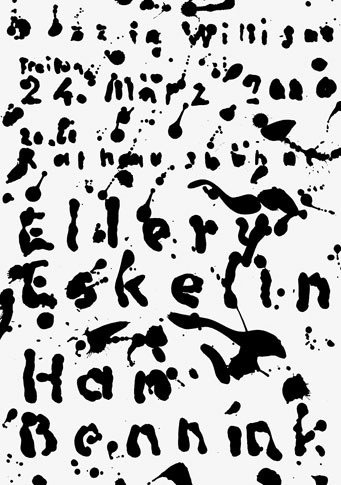
eskelin / bennink


A selection of Niklaus Troxler's posters for the Willisau Festival.

+
A yoik is not a song but a resonant melodic phrase, sung unaccompanied and repeated through various iterations with no fixed beginning or end. Traditionally utilised to induce a trance state in Sami shamans, it is a music essentially animist in nature. Yoiks are not sung about something but considered a rhythmic signifier of the actual thing itself, be it a place, an event, a family member, associate or an animal, especially reindeer. According to Sami practice, a yoik is not composed but received through adjagas. After a yoik is first invoked, it shimmers into eternity, hanging in the air like a memory, waiting to be recalled.
(...)
Ande Somby begins to yoik, merrily repeating a chain of syllables. 'ME GO NA CHA ... ME GO NA CHA.' Round and round it goes, faster and faster, like a tongue twister. Then the chain abruptly changes. 'DA CLIN KEE ... DA CLIN KEE ... DA CLIN KEE.'
- Arctic Magic
The parallels with Eric Dolphy's famous quote and the "stream-of-conciousness" of Olu Dara and Phillip Wilson (see below) are striking.

+

Ethan Iverson had set the bar vey high for D:O guest posts, and Taylor Ho Bynum has upped it further with his contribution. Taylor had already discussed some of these issues (cornet vs. trumpet, etc.) on his blog, but here they're laid out more clearly.

+

A few hundred (thousand?) birds will always beat industrial forms of light and magic. [via stop the play and watch the audience]

+

David Murray's MySpace page is dedicated to his Black Saint catalogue. The blog has him reminiscing about those albums. Of Murray's Steps, he says:
The four compositions on this date represent the best of what my octet had achieved on a recent tour. Getting from Nickelsdorf to Milano by train was very difficult though as Steve was thrown in jail off of the train for slugging a customs officer in the face. When this happened my leader abilities were seriously challenged so I told all of the band and their girlfriends to get off of the train. We went to the railroad border police station sat in front of the police, leading [sic] with them to let Steve McCall go. Finally we succeeded and were able to cross the border into Italy and go to Milano to make this recording session.


+

John Fordham reprised Nate Chinen's story about the 1973-1990/Behearer phenomenon for the Guardian's blog back in December. I found the article via Net, Blogs and Rock'n'Roll, which sums up the process and describes it as "uncharacteristically neat."

Back in June, Fordham prefaced a state of UK jazz address with this odd comment: "Jazz musicians and fans rarely ask where jazz is going." Really? He also got a classic Iverson quote, on being dropped from Sony, despite good sales (in jazz terms): "Whatever the Bad Plus have sold, I'm sure it didn't pay for coffee in that huge building Sony has on 56th and Madison."

+

The much-blogged IAJE gets a stern talking-to from Paul de Barros and runs to George Varga's arms for a pick-me-up cuddle. [via Arts Journal]

de Barros says that "while the [jazz] scene may be vivid and exciting, it's an artificial construct, sadly untethered to any specific time and place or anything actually going on in American society." That assessment is undermined by saxophonist Chelsea Baratz when she says "It's not one niche now, [there are places in New York where, on the same night, you can hear] unbelievably groovin' hip-hop, played by jazz musicians, [more cerebral music and] straight-up bebop."

de Barros is "sad" to hear "a genius like Ornette Coleman... so stuck in the racial paradigms of the past." Coleman, interviewed by Greg Osby, and "seemingly annoyed that IAJE was largely patronized by white academics," asked "If we were white people, would this conversation be the same?" Out of context, it's hard to judge such a statement, but the answer seems too obvious to be controversial. Varga is saddened by the very opposite: "Significantly, [James] Moody was the only speaker whose salute to [Ella] Fitzgerald also touched on the segregation and rampant racism of the era in which he and she achieved stardom." The theme continues, as in de Barros's article jazz is said to have "fallen into the hands of a lot of white males" and become "like a museum." de Barros agrees, but the relationship between white-ification and museumification is unclear, as "jazz postage stamps and the Jazz at Lincoln Center colossus" are cited amongst the reasons for jazz having "shed its outlaw skin." (implying that Duke Ellington and the MJQ, for example, might have considered themselves outlaws...). More (much, much more - be afraid) on this topic to come soon.

In Varga's article Ramsey Lewis's takes everyone to task:
"Jazz people are passive people," he charged. "They don't spread the word. We don't go to non-jazz people, and say 'Have you heard this?'"
I guess he'd disagree with Bill Shoemaker's assessment that
you can’t cross market jazz out of its niche market condition, nor can you grow an audience significantly beyond its current numbers. The task, then, whether you’re a label, venue or festival, is to maximize participation of the existing audience

+

Top 50 Worldwide album sales in 2006

Thursday, January 25, 2007

jazz and blogs #13d: mp3 is now!


I've been slow to add MP3 blogs because I'm not much of a downloader, so you probably already know about the following, which offer up complete, OOP albums. They lack Destination: Out's distilled air and insightful annotations, but if a quick smash'n'grab is what you're after...

church number nine
Coïncidence: browsing through LeMo's voluminous record collection, I discovered that this takes its name from a Frank Wright album.

Nothing Is
Enlightened by the above discovery, I googled Nothing Is. Result: Sun Ra.

Orgy In Rhythm
The pattern is well-established: Art Blakey. The cover of Jack McDuff's Sophisticated Funk: genius or atrocious?

jazz and blogs #13c: return to the new world


Back in the birthplace of jazz, trombonists are stirring.

Rocketship
A trombonist from San Francisco. Leader of Disappear Incompletely, which does electro-jazz Radiohead covers, perhaps explaining his interest in comparing the Mehldau and Bad Plus approaches.

The Spit Valve
Jeb Bishop has had time to create a blog and wipe it clean before I found out about it? I have only myself to blame, as I'd have found out about it earlier if I'd paid better attention to Scratch My Brain's blogroll. You can get the old posts on the RSS feed, or Bishop's liner notes about free improvisation on Rocketship.

Avant Front
Discussion of old and new avant-jazz albums and issues. Can't really agree with his Ed Blackwell/Charles Moffett comparaison, though. [via St. Louis Jazz Notes]

jazz and blogs #13b: off the continent


Hispanophones, Germans, Dutch... Where are the British jazzbloggers? I don't have a single one on my blogroll, but there must be a few out there. Here are a few I've just found:

BBC Jazz Blog
Multi-authored. Oh-so-Britishly, it reports on George Shearing's knighthood and attempts to get Stan Tracy a lordship.

Babel blog
The Babel label houses some great groups. Polar Bear, Acoustic Ladyland and trumpeter Tom Arthurs's Centripede are the ones I know. Check out the forecasted 2007 UK jazz trends.

JazzWise Magazine MySpace blog
Excerpts from the magazine's feature articles.

Off Minor
CD and concert reviews, mostly.

Birmingham Jazz Blog
An extremely fledgling outgrowth of Birmingham Jazz.

jazz and blogs #13a: in all languages


A number of "jazz and blogs" posts back, I started to fear that the supply of blogs to list here would dry up, but that does not seem to be the case at all. In fact, I had to split up this edition into four parts, due to its sheer size.

Jazz may be a universal language, but you may not understand all of this part's multi-lingual pot-pourri.

Jazz@Volume 12
From Gent, Belgium. Kind of a Flemish version of me, but with infinitely better concert photos. Bruno went to over twice as many concerts in 2006 than I did... The link is to the "jazz" category, but there's a bunch of other stuff, too.
[via Tony Verstraete at the Courvoisier/Eskelin/Courtois gig]

euskir's txoko
From Euskadi (a.k.a. Basque Country) Argentina but often written in both Castellano Spanish and (often) English. I learnt that link is enlace, which is pretty poetic. For the hispanophones out there, there are links to several other spanish-language jazzblogs, such as...

Jazzero
From Argentina. Leads to a jazz-inspired painter, a 1967 video of Miles's quintet in Berlin and interesting thoughts on fusing and mixing from bassist Luciano Peralta.

Jazz Blogger
A jazz and photography blog in German.

Keep Swinging
From The Netherlands in English and Dutch. The concert log is an impressive construction, which starts on the first of October, nineteen-sixty-four! [via Off Minor]

Hyongoo
The Chinese are famous (amongst other things) for rip-offs and bootlegs. Korean blog Hyongoo proudly upholds that tradition flaunts etiquette by baldly reproducing my posts (photos and all) and those of others. Most ironically, there's a Creative Commons license which allows sharing, but requests attribution...

Wednesday, January 24, 2007

pierre van dormael


[I initially planned to put this in the Zéro DB post, but since that turned out to be more about Nic Thys, this didn't fit in any more. I hate to lose an opportunity to gush about Pierre Van Dormael, so here it is, in its own post.]

In the late '80s and early '90s, Pierre Van Dormael (myspace) led Nasa Na, a quartet made up of Fabrizio Cassol, Michel Hatzigeorgiou and Stéphane Galland. It is an almost mythical ensemble, as no recordings were ever officially issued. Its legacy partly lives on, however, in a little trio his sidemen went on to form, called AKA Moon.

Like Nasa Na, Pierre's career is great, yet mostly obscure: he seems to often be hidden at the root of things. He claims that it is after seeing him in concert that Steve Coleman started employing multiple tempos. He also wrote or played on a number of pop hits, as a session guitarist. A couple of years ago, he even toured in Canada with the Québecois version of Star Academy (Fame Academy in the UK, or American Idol + the reality TV element of all contestants living together and being filmed 24 hours a day).

In 2002, Pierre released Vivaces, a masterpiece that went pretty much unheard. In it he laid out his worldview: complex rhythmic superpositions perfected during a 3-year stay in Senegal and esoteric harmonic relationships are balanced with sweeter, almost sugary melodic elements. A few years ago, he told me that he stopped being a session guitarist because it had sucked all enjoyment out of music. He then had to rediscover the "degree zero" of being able to take pleasure in the sound of a single note.

The result of that rediscovery is visible: on stage, he's just as likely to tear through a harmonically idiosyncratic and fascinating run as to let a single note ring out and throw his head back in the ecstasy of simplicity. Djigui, his album with electric bassist Otti Van Der Werf and kora player Soriba Kouyate included a supremely relaxed "Ain't No Sunshine When She's Gone" recorded in the hotel bar after the show that constitutes the bulk of the music. When Bo Van Der Werf, the leader of Octurn, commissioned a composition from him, he replied "Is it okay if I write something that can be popular?"

De Werf has just released the result of that commission, Octurn's North Country Suite. You can hear some of it on Pierre's MySpace page. I haven't heard the album yet, but judging by the samples, it picks up where Vivaces left off, and leavens Octurn's more sour pre-Magic Malik style with references to his own pop loves. Pieces are anchored by a lush, repeated sequence of piano chords and an unobtrusive rhythm section, but the lines played by the guitar and horns above that criss-cross at odd angles and speeds. The melodies are affecting, yet twist in improbable directions.

That kind of sums up Pierre himself. A conversation with him can veer off into deep topics, stop abruptly and resume at any point. Or he'll just down a few Orvals and ask the audience to sing along.

Tuesday, January 23, 2007

Zéro DB + Nic Thys/Pierre Van Dormael/Stéphane Galland - 21/01/2007@Théâtre Molière, Bruxelles


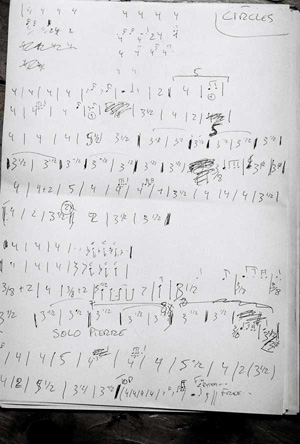
Zéro DB, directed by Aurélien Bodinaux, follows Nic Thys in New York and Brussels as he works on and records a composition called "Circles." He composed it 15 years ago, but didn't do much with it at the time and it was never performed, or even titled.

The film recounts the process through which an idea takes form outside the musician's mind. In this case, how "Circles" becomes a recording. In the beginning, Thys talks about the process in general, and its dangers: that the actual music might not sound as good as imagined. During an early brainstorming session, the director blurs the voices of the three people in the room, creating a metaphor for the process. Unfortunately, the film soon abandons this poetic aspect to become little more than a slightly quirky documentary following the flow of events: Thys recording some demos by himself, rehearsing with Pierre Van Dormael and finally all the musicians playing their parts in the studio.

Thys has just returned to Belgium after 7 years in New York, so the showing also served as a welcome back party of sorts, with many friends, family and colleagues in attendance. Everyone in the large crowd was amused to see Thys's increasingly hirsute beard and touched when Otti Van Der Werf dropped by the studio to add some handclaps.


Nicolas Thys - el b
Pierre Van Dormael - acoustic g
Stéphane Galland - perc

After the film, a clean-shaven Thys came onstage to play duets with Pierre Van Dormael. The first two pieces were sort of Belgified country songs that hid their contrapuntal and structural complexities under unassuming melodies and relaxed yet alert playing. Thys remarked that his older songs were more complicated than his new ones, because his life was more complicated then. It seems to me that he is perhaps better able to communicate and challenge simultaneously. I've recently noted a similar change in Octurn's music, due to Magic Malik's influence, though their level of complexity is much higher. Maybe it's a generational thing.

The third and last duet was inspired by Thys's visit to his wife's family in New Mexico and its amazing landscapes. He started alone, playing a steady bass line and a melody above it. It was relatively simple and, appropriately, sounded like Johnny Cash singing a cowboy song. When the guitar joined in, the form was stretched and extended, but the basic feel was never lost.

Stéphane Galland joined them at this point, on tubs, a metal pipe and a few other metallic implements I couldn't see. It was amusing to hear him play his amazing Galland-isms on these much brighter and drier surfaces, using just sticks, no feet. The opportunity was there to create a sort of hi-tech washboard band, but that connection wasn't explored, fortunately or unfortunately. It did, however, allow for really clear interaction between the three instruments. They played "Can Festis," which you can hear on Pierre's MySpace and "Circles," the evening's running theme.

The crowd called them back for an encore, to which Thys replied: "Well, this is unexpected. When you've run out of written and rehearsed material, what do you do? You play jazz." They then proceeded to play "Moment's Notice" - at least, that's what I thought at the time, but I'm not so sure any more. In any case, they brought their 3-way counterpoint and the weird harmonies they, Pierre especially, are masters of, to a more standard jazz form, which the guitarist acknowledged with a winking "St. Thomas" quote.

Sunday, January 21, 2007

Frederik Leroux/Toine Thys duo - 20/01/2007@Caravan, Brussels


Both Toine and Frederik (website) have recently released albums that draw on various forms of pop and rock as much as they do on jazz, so it was interesting to hear them play standards in an unadorned setting. Non-jazz influences were allowed to creep in, though: Frederik's scratchingly noisy comping on Monk's "Evidence" recalled some of Angular's heavy rock outbursts, while an arrangement of the Beach Boys' "God Only Knows" brought the pair closer to Rackham's melodic sensibility.

Despite the ambient noise level, they eventually managed to settle into a luxuriant, unhurried space driven as much by a song's sound as by its chords. Toine told me afterwards that he would like to model this duo on the Paul Motian Trio's rubato abstraction. Though no real attempt was made to do so in this instance, it was easy to imagine it happening.

Caravan is a café-restaurant, and confirmed my dislike for restaurant gigs, but is a good place to have a meal: it's small and unpretentious, but well-decorated, the food is good (I was told) and very affordable, the desserts are excellent (I had two, the banana and almond cake and the tiramisú). The soundtrack after the concert included Fela Kuti's "Water," a sign of good taste. The only problem is that you might be disturbed by the musicians in the corner.

Since last December, I've been hearing a lot about Le Comptoir des Etoiles, which has started holding three concerts a week (on Wednesday, Friday and Saturday) and filling Brussels's disappearing after-hours jam scene. I expected it to be a dive, but, while cramped, it's a lovely bar that's really devoted to jazz and manages to express that in a way that isn't cheesy. The grey-and-red walls are covered in polaroids, photos, framed Blue Note album covers and silver, hand-written inscriptions. Toine and I got there at maybe 1:30 AM and at 2 he generated enough enthusiasm for a round of standards and bop tunes to start up again. I was particularly taken with Frans Van Isacker (Franco Saint De Bakker myspace), an alto player I'd never heard before who had a real Cool Jazz sensibility.

Saturday, January 20, 2007

Le bal des boîteux - 19/01/2007@next to the CC Belgica, Dendermonde


Lieven Nijs - g, banjo
Joris Blanckaert - accordion
Jeroen Baert - vln
Tim Vandenbergh - b
(band myspace)

When I walked out of the CC Belgica after the Dhafer Youssef concert, I saw through a window that right next door another concert was taking place. It was still quite early and the lineup looked interesting, so I went inside. It turned out that it was also the opening of an art exhibit, which meant free drinks.

Le bal des boîteux's songs jovially blended popular music, classical and rock in a way that would not have been too out-of-place on Yann Tiersen's Amélie Poulain soundtrack. The bass would hit a rhythmical ostinato, the guitar chugged rock-ish chords (he had a very small amp, so the volume level was appropriate in regards to the other, unamplified, instruments) while the accordion and violin played short, repeated melodic motifs or twirled around each other to create denser textures. The excellent bassist would often slip almost imperceptibly between emphatic accompaniment and jazz-like soloing.

I was reminded of this drum and whistle band we randomly came across in a Kilkenny, Ireland bar, back in 2002. They shared a sense of a long tradition of a popular music that, in LBDB's case, pilfered liberally from more "sophisticated" or contemporary genres, integrating them smartly enough not to lose its popular core. That process seems to me a really timeless one, conceptually similar to Tatum playing Dvorak.

Just when I began to think that they could occasionally have done with a percussionist, Nijs introduced an old Casio keyboard. A few buttons were pressed and the knowingly cheesy canned beat it issued underpinned a really simple, almost naïve pop melody. In a hilarious moment, a one-bar break allowed the Casio to come through in all it's glory.

The tracks on their MySpace page come from their two albums, have more musicians and are more produced. Unfortunately, they're not nearly as good as what I heard in this informal setting.

Dhafer Youssef - 19/01/2007@CC Belgica, Dendermonde


Dhafer Youssef - oud, voc (website)
Eivind Aarset - g, elec (myspace)
Audun Erlien - el b (myspace)
Rune Arnesen - d (myspace)

At the very beginning of the year, I heard Anouar Brahem's Astrakhan Café over at M's (you may remember him from Lisbon) parents' house in France. I was totally enchanted and, as soon as I got back here, I bought it. It was surprising to me how close Dhafer Youssef got to the open-ended-but-not-meandering feeling of Brahem's acoustic oud-clarinet-percussion trio with this electric Norwegian band (Youssef's last album came out on Bugge Wesseltoft's JazzLand label).

Erlien would generally lay down hazy, syncopated, slightly dub-ish vamps, creating a little push-pull friction with Arnesen's drums, which generated much more forward momentum, but without being overwhelming. Eivind Aarset did an amazing job providing enveloping textures, whether from his laptop or real-time sampling, and carefully-dosed guitar sounds. He also used a drier tone to produce an uncanny guitar version of the oud. On an unaccompanied intro to "Soupir éternel," he played few notes, but each one was sublimely coaxed out of the instrument. When Youssef joined in, it was to play and sing a simple, sing-song modal melody that, uncharacteristically, sounded almost medieval. Youssef's voice was strong, deep and clear. He sang wordlessly, but drew clearly on his Tunisian origins.

More typically, the band would string together percussive melodies (or were they melodic riffs?) separated by pauses and suspensions. The longer the concert went on, the more it seemed that all this occurred by happenstance, as if tune fragments were plucked from some vast store, expanded upon and then discarded. This patience and the lack of the quite common, almost teleological drive towards a big climax was refreshing. Sometimes it was just a matter of a livelier melody sharpening a form's edges, but it could be even less than that: the sound engineer modifying the sound of the drums, for example, could be a peak.

One of the last songs upped the energy level by adding some blues and rock into the mix, before settling into a simmering groove that set Arabic riffs into slightly more conventional rock band dynamics. Overall, Youssef suggested a palette that was clearly bounded yet with seemingly endless space to roam.

giovanni's return


A new Secrety Society concert has been posted, with a revamped "Perils Of Empire." The ominous-movie-score first section has been reinforced, but the second section has lost much of the drunk-Sicilian-stumbling-back-home feel that I loved in earlier versions. There are probably lots more tweaks to discover, but this one was the easiest. Maybe it's always been like that, but the way "Lizard Brain" (a feature for baritonist Josh Sinton) end reminds me of something from Paul Dunmall's Moksha Big Band.

+

To answer Jack Reilly's question (even if it's rhetorical): yes, absolutely! He's back (and it's been way too long) with a GIOVANNI PETRANICH missive to Down Beat that takes Brad Mehldau and Pat Metheny to task over their percieved disdain for (...one guess...) Bill Evans. Of course, it wouldn't be Jack Reilly Giovanni Petranich if Metheny wasn't consistently misspelled Matheny. If anyone has February's Down Beat, is the letter actually published in it (or does that issue contain the Metheny/Mehldau article)?

+

Yvinek has a lovely Michael Brecker rememberance, which includes both real and dreamt interaction with him.

+

Bobby Broom posts an article, which contains this Sidney Bechet quote: "It was like they were trying to find out in this music what they were supposed to do with this freedom..." He's referring to the dawn of jazz, but the sentiment resonates today.

Broom then returns us to the old "jazz fundamentals" debate:

The move to look away from the elements of jazz that have remained constant through the ages... is a blatant dismissal of the jazz spirit. That is to say, by ignoring these necessary elements we undermine jazz and relegate it to a slow death. If I come across as radical, then try the following experiment: Remove these two characteristics—a sense of swing and blues feeling—from the list of musical attributes of your favorite jazz musicians, then assess what remains. Would they still hold up as major players and contributors in jazz?
I would argue that a significant amount might remain, depending on the player and as suggested by, say, the SME's Karyobin (to take a random example that's close to hand, but adds and subtracts a lot more than just blues and swing), which is not to denigrate swing as a key jazz invention and blues as a key contributor.

erg links to a Bobby Broom video which is full of blues (I love Kobie Watkins's drumming on this one).

Friday, January 19, 2007

when wynton writes, we weep

Nate tipped me off to Jazz ABZ: An A to Z Collection of Jazz Portraits, a book of poetry for children, written by Wynton Marsalis. NPR has written and recited excerpts as well as an interview with Marsalis. The entries on Armstrong, Basie, Coltrane and Lady Day are reproduced on that page.

He also sent me a choice quote from the Ornette poem:

"Ooh oozy oomp. Ow! Oompah varoom! "Oolong of oodles," opined Ophelia
portly opened pour posted au pair opposite polly-opals pro quo quakkis
oak Quintana Roo quoth roccoco cue co-wrote,

"Our round droll groom drools orange o'er trolls to trounce known knolls,"
where Homer wrote, "Nor ornament, nor orthodoxy, nor ornithology.
Or-Or-Or-Or-Ornette!!"
Now we know who's been writing all that seemingly randomly-generated poetic spam mail. My knowledge of poetry is near nil, but 26 poems in which the amount of alliteration absolutely achieves an avuncular accumulation of avowedly absurd, aggrandised assessments and arcane afterthoughts appears ill-advised, to say the least. Also, putting Dizzy Gillespie under Z for DiZzy is a stretch. I'm not surprised Zorn and Zawinul were cut, but what about Zutty Singleton? However, some of the illustrations, the cover and that of Armstrong in particular, are nice.

Finally, Nate asks "Idle question: how many good poems have been written by jazz musicians?" and suggests Cecil Taylor, Henry Threadgill and Joe McPhee as places to start looking. The one time I saw Taylor, he recited/performed a poem. I had trouble hearing him, as I was right at the back and the top (third balcony) of Flagey's main hall and Taylor wasn't speaking into a microphone, but it was something about the evolution of, well, just about everything on the planet and was pretty cool, at least as a barely-heard theatrical performance.

The floor is open to your contributions (as it always is).

jazz and blogs #12


My Thang
Christian McBride. The brilliant and touching article on working with James Brown is a must-read (but hurry, it'll be taken down on the 22nd). Contains the classic phrase "James Brown telling me that I 'ain’t nothing' would be the biggest compliment I could have ever gotten." [via Settled In Shipping]

Bottom Lining
An improvising bassist from England. See his brilliant rundown of 10 moments that characterise his free improvisation experience, as a performer and listener.

Perfect Sounds
Chris Monsen from Norway. His 2006 Top 10 list links to an all-Norwegian Top 10. As an insider, he's not too happy about it, but outsiders might find it useful as a quick primer. Chris also has a spin-off blog dedicated to grading his record collection. [via a Destination: Out comment]

So Anyway...
Saxophonist Brian Patneaude, who has already decided on his 2007 Top 10. Typo aside, it's an interesting contemporary jazz list which, apart from Dave Holland's Critical Mass, avoids the usual suspects.
[via Jazz & Blues Music Reviews]

Jazz (or Jass)
About.com has pages on everything, it seems, but I had never thought to check out their jazz content. John Matouk is doing a pretty good job. He's done a lot of list-making recently: Top 10 albums, tracks and "alternative jazz" of 2006.

Anthony Wilson
Guitarist, of Diana Krall fame among others. [via Song With Orange]

J.B.: Jazzitude Blog
New blog started by Jazzitude.

Thursday, January 18, 2007

VVG Trio - 17/01/2007@Jazz Station, Bruxelles


Bruno Vansina - as, ss (website)
Gulli Gudmundsson - b (website)
Teun Verbruggen - d (website | myspace)

The concert started with "In Orbit" and "Miss Apple," two tunes from In Orbit, one of last year's better Belgian jazz albums. "In Orbit" serves as the trio's theme song, and they played a variation of it to close the concert. The first time around was meditative, the second upped the rhythmic drive, but in a flattened-out way reminiscent of In A Silent Way that allowed Vansina a lot of leeway to stretch the already langourously-phrased melody even further. Gudmundsson's lightly distorted arco added something of the textural effect the keyboards and guitar created on that album.

In both versions of "In Orbit," Gudmundsson sampled himself in real-time, a technique he returned to often. Sometimes just to densify the overall texture, a jazz equivalent to a rock band's second guitarist, but on a new composition of his, the magnificent elegy "Too Soon," he layered several slow and spare pure-toned melodies on top of each other, in the end achieving something like an entire section portraying a sunrise. Vansina added a mournful melody on soprano, but the greatest moment was a section utilising the bassist's incredible control of bowed overtones, that sounded like an ancestral reed instrument coming from far away.

These examples hint at the interesting space the VVG inhabits. While Bruno Vansina is clearly a contemporary bop-inspired player, lots of details progresively muddy that categorisation. His soloing, especially on soprano, seems to come just as much from a more folkloric way of concieving melodic variations on top of set chords. Gudmundsson's bass parts encourage this perception, as chords often span several bars (which can be a fairly long time when playing a slow mid-tempo 7/4) and are firmly established with a fixed, syncopated rhythmic pattern. Rhythmically, the VVG slipped easily between rumbling free time, boisterous back-beats and quiet funk. In fact, only once did they engage in 4/4 swing - not out of of obligation, but because it made sense at that point.

My concert-going habits may lead readers to believe that there are only two drummers in Belgium, Teun and Lionel Beuvens, but I assure you that that is not the case. It's just that I never tire of the way Teun manages to generate grooves that are busy and detail-filled, yet absolutely limpid and highly interactive with everything else that's happening.

Teun and Bruno, as entreprising thirtysomethings, started their own label, RAT Records, a few years ago. Both VVG Trio releases are on it, but they've also started branching out, with two excellent albums that present quite different takes on the jazz/rock/pop/improv nexus: Rackham's Juanita K and Othin Spake's The Ankh.

The next VVG Trio album will be recorded live in March, with returning guests Magic Malik on flute and Jozef Dumoulin on piano. They were both present on the second, live, disc of In Orbit, but hadn't seen the music before playing it. The result was fascinating, in an exploratory, messy way. I asked Teun if they'd learn the music beforehand this time and he replied "I hope not. They play better when they don't know the music."

jazz in vlaanderen

JazzFlits's first issue of the year brings news of a study on the state of jazz in Flanders commissioned by the Flemish Community. Some of Simon Korteweg's, the study's author, findings:

- most jazz musicians can't make a living playing jazz (no surprise there)
- jazz's audience is increasing steadily and now represents 11% of concert-goers
- in 2007, the jazz sector will get 700,000 euros worth of subsidies, which is 3% of the Flemish government's music budget. Korteweg recommends boosting this share to a more representative 11%, or 2 million euros.

JazzFlits also includes an update on Steve Coleman's activities, written in English by Paul Blair.

+

Ben Ratliff's Little Richard concert review drastically shortens the distance between Richards and Pharrell Williams:

"It’s so nice just sitting here, being beautiful," he said. "I feel so unnecessary."
(...)
"My mama had 12 children, and we were pretty but we were poor," he regaled. "All that beauty, and wasn’t nobody on duty. All that honey and no money."
(...)
"Could I get two black ladies to dance?" he ventured. "I’d like to have two fat white ladies, too. Juicy ones. And two Mexicans."


+

Belinda Reynolds has an article entitled "Can Jazz Educate More Than Classical?" I think that her argument is a little muddled (or, in any case, I have trouble following it), but some of the comments are particularly outrageous. Jazz's doom 'n' gloom contingent is large, but I'd never yet heard anyone say, as commenter "the people" does, that "jazz, in reality, has little to no impact on modern American culture." Unless modern means "in the last 5 minutes."

Wednesday, January 17, 2007

sandke on brecker

Doug Ramsey publishes a candid, must-read remembrance of Michael Brecker by Randy Sandke.

Tuesday, January 16, 2007