Monday, October 30, 2006

the other other dre

Sound of Jazz informs me that drummer Dré Pallemaerts is soon to record his first album as leader, with Mark Turner, Bill Carrothers, Jozef Dumoulin and Stéphane Belmondo, on the Belmondo brothers' B-Flat label.

Dré's remixing work on Octurn's 21 emanations was excellent and he is perhaps Belgium's best jazz 'n' more drummer (his most recent sideman appearance is on Erwin Vann's excellent Let's Call Ed, with Jozef Dumoulin and Michel Hatzigeorgiou). I've never heard him as leader, so I'm looking forward to this one.

Friday, October 27, 2006

othin spake alert

The Wack Attack Barrack "is the Nr 1 e-label in Belgium." I first heard of it last night on the radio, while driving home from Fly's first Belgian concert. In WAB's jazz section, you can listen to and/or buy Jef Neve's and the VVG Trio's debut albums, each of which is 2-3 years old. Teun Verbruggen drums on both.

Teun's just released his own debut, with his guitar/keyboards/drums trio Othin Spake. I raved about an OS concert back in February and fully expect to rave about The Ankh (RAT Records) soon. Not just because it's the first CD in which I am cited in the thank you's, or even because the packaging is beautiful (no point in putting up a picture, as the shiny-black-angel-wings-on-matte-black-background isn't exactly screen-friendly) - continuing the trend I identified a few weeks ago - but because the music is a glorious, fully-improvised mess of grooves constantly falling apart and distortion coalescing into melody.

If you believe that Keith Jarrett circa Cella Door is the best the Fender has ever sounded in jazz and thought "Finally!" when you first heard Bojan Z's xenophone, then Jozef Dumoulin is the Fenderist for you. He's not quite as cataclysmic as Sun Ra at the Fondation Maeght, but that's not necessarily a bad thing. Jozef and Teun manage to structure - or should I say, guide - the maëlstrom without sounding square or forced and it's often hard to tell Jozef and guitarist Mauro Pawlowski apart, which is precisely the point. It should be up on The Wack Attack Barrack soon. In the mean time, you can listen to a track on the Rat Records website.

Wednesday, October 25, 2006

under water


I'm currently submerged in work. You know it's bad when you stay home and work into the wee hours rather than go see Randy Weston. However, I'd like to


  1. bid bon voyage to Darcy. I was planning on trekking to Cologne for the concert, but unfortunately I've ended up having to go to Paris that week-end. It would have been my first trip to Germany since I was nine months old and my slightly older cousin and I were a novelty two-black-babies! smash hit with the Germans. Or so I'm told.

  2. Direct you to this excellent article on Texan trumpeter Dennis Gonzalez. I'll talk some more about Gonzalez at a later date.

Friday, October 20, 2006

who's new?

I promise that positive posts (ie. not just reactions to something else) are coming soon. In the mean time:

Peter Breslin has added some lively comments to the Dave Douglas interview and the Ornette debate (officially declared a dead horse). Peter expands on the latter on his own blog.

In the comment, he also mentions "certified, laminated Jazz License"-holder Branford Marsalis. Parisian bassist Manuel Marchès recently went to see Marsalis and came away impressed but a little unsatisfied. He also opines (translation mine):

Ten years ago, when Branford's creative modernism was routinely contrasted with Wynton's classicism... I never understood what that meant, but now I know it was wrong and that the most classicist of the two is not who we thought it was. It should have been known since The Majesty of the Blues and Wynton's other neo-New Orleans septet albums, which are more innovative, in terms of form at least, than Branford's Trio Jeepy.
Branford's recent listening session does indeed seem to confirm (after a number of repertory albums) that Marsalis family reunions are a lot smoother than in the Sting days.

Note: the only Branford I have is Requiem, which I like.

Thursday, October 19, 2006

alarming

Nathalie Loriers/Chemins Croisés - L'arbre pleure
A nice album with a quintet featuring Gialuigi Trovesi and oud player Karim Baggili. The first track's expansive arrangement deftly plays with texture (low-register piano rumble, clarinet roars embedded in the middle of the band, a delicate handoff from unaccompanied piano to unaccompanied oud) and varied instrumental roles (piano seamlessly shifting from melody to groove to rumble as different instruments come in). The constant negotiating between and superposition of east and west (abrupt Arabic rhythms vs. fluid jazz phrasing, modal melodies vs. elaborate harmonisation) is handled with subtlety.

See also the recently reissued Silent Spring.

+

So Percussion! Alarm Will Sound! Swinging microphones! Things that groove! Things that don't! Rock sax vs. classical sax! All that and more, in Darcy's epic review of a Steve Reich celebratory extravaganza.

See the comments to Scratch My Brain's post for an interesting back-and-forth between Jeff and Darcy.

+

Last Plane To Jakarta relays an alert on an out-of-control police officer's rampage in a Houston club. Scary.

+

More cheerfully, Just Outside describes a birthday party souvenir.

Wednesday, October 18, 2006

off the leash

Dave Douglas says:

"I get disappointed when I go to Europe," Douglas says, "and I'm sitting in some cafe and I'm talking with the musicians and promoters and somebody says: 'Isn't it ironic that the country that gave us this music is only capable of looking back? In America, it's all about playing Louis Armstrong music, recreating the 50s, and wearing old-fashioned suits.' I hear this all the time. I'm trying to prove that there is also progressive music in the U.S."
European arrogance/generalisation is as insufferable and ignorant as its American counterpart.

"What we do now on the frontier of composed and improvised music," he says, "has to do with learning a lesson from all that crazy experimental freedom in the 60s and 70s. We're learning to harness that and most 'free' music has some sense of structure now."

He is about to expound on that, when his dog Finley arrives on the porch barking loudly. He stops to hook a leash on her collar. But then he does not attach it to anything. Although Finley is free to drag her chain around, she doesn't. It strikes me as a kind of metaphor for harnessed improvisational freedom. Whatever, the dog stops barking.


I'm looking forward to seeing Douglas for the first time soon.

[via Greenleaf]

outage

For the last few days, be.jazz has showed up as a nearly-blank page in Internet Explorer. As I use FireFox exclusively, I hadn't noticed. Thanks to Nate for alerting me.

Apparently, the problem arose when I embedded a Google Video player. That's ironic, since Google owns Blogger. If you've succesfully embedded a GV player on a Blogger blog (or had the same problem as me), please let me know.

Don't let that stop you from watching the video in the post below, however.

Saturday, October 14, 2006

planet earth doesn't produce sun ra


I just saw part of a documentary called "Sun Ra: Brother From Another Planet" on BBC 2. Lots of footage from concerts, movies/videos and talking heads such as John F. Swzed, Amiri Baraka, Marshall Allen and other Arkestra musicians. And lots of Ra's own thoughts, obviously. Ra playing a keyboard angled at 80 degrees while spinning like a top is quite... something. It's weird that even here, the possible written elements ("Sun Ra would write out entire solos for you") are seen as legitimating the music in ways improvisation alone could not ("My daughter could improvise that." "But could she write it?").

It was late and I was drowsy, so by the end it was all a blur of glittering gowns. Luckily, it's been partially youtubed (cf. the beginning of part 4 for spinning Sun Ra) and completely google(video)d (which is the same thing now, I guess).

Friday, October 13, 2006

fighting for martial love


This week (9 - 13 October), France 2's 1PM news did a daily segment following three participants in this year's Concours Martial Solal. Click on "Feuilleton: 'le son d'impro'" in the window on the right to skip to the segment.

Sébastien is technically very impressive, but manages to come across as a jerk at every appearance.

I actually have both of Wajdi Cherif's albums. The first one, especially, is an enchanting piano trio arabo-jazz blend.

Ilan leads kids as young as 7 down the evil paths of improvised contemporary music. His scores and playing utterly confound the competition's accompanists.(each contestant is accompanied by the same bassist and drummer and has 10 minutes to acquaint them with their composition). Ilan seems like a great, free-spirited guy (the gloves, the rodeo shirt, the customised stool). In the first episode, a friend of his provides a delectable background pipe smoking shot. Will his unorthodoxy be accepted? What will Martial say?

Solal himself is also featured, of course, talking and playing.

The brief excerpts from the final are scary, and not necessarily in a good way.

the shark-tailed dog


A surprising article on Rudresh Mahanthappa's Codebook in Wired. They've chosen the geekiest angle possible, obviously (the article contains music samples).

the tune "Further and In Between" is based on the cyclical number 142857. Like all cyclical numbers, this one has some very strange properties; for example, if you multiply it by 2, 3, 4, 5 or 6, you get the same digits in a different configuration (for example, 2 x 142857 = 285714).

By mapping particular musical pitches to each digit and running through his multiplication tables, Mahanthappa came up with a winding, circuitous melody that makes a surprising amount of sense. That's partly because he wedded it to a strong, swinging rhythm, and partly because he gave himself permission to fudge things a bit in order to prevent the math from overwhelming the music.
Math-rock (I considered crypto-jazz, but that sounds too sinister) was never truer to its name. I haven't had much time to spend with Codebook since I bought it at Mahanthappa's recent Brussels stop, but the bits and pieces I've heard suggest it to be impressive. Definitely complex, but not as nerdy as the article suggests (or as "accessible to the general public," which is the author's over-enthusiasm speaking). Iyer's suppler approach constrasts with the altoist's relentlessness and is blowing me away, at the moment.

+

Ethan, on Ornette, pragmatically and passionately defines a harmolodics for the rest of us. The post is titled "Prelude," hopefully there'll be more.

A question for the experts: what with all the substitutions of substitutions and other crazy harmonic strategies out there, has the line between playing changes and not playing them blurred out of existence? Or is it more a matter of intent? ie. Playing a system that makes it sound like you're not playing the changes qualifies as playing the changes, whereas playing "the idea of [changes]" (as Ethan puts it) doesn't qualify?

+

Bebo Valdes listens with Ben Ratliff.
There are books of sheet music by Rachmaninoff and Chopin; a photo of him in a tuxedo, tall and commanding, on the cover of “Cha Cha Cha & Mambo for Small Dance Bands,” a book he wrote and published in Havana in the 1950’s, aiming at the English-language market; paintings by Haitian artists; Joseph Schillinger’s “System of Musical Composition,” the dense theoretical books beloved by intellectual musicians of the 1940’s and 50’s that break down melody, harmony and rhythm into mathematic logic. There is, incongruously, a shelf of pop-music lead-sheet books like “100 of the Greatest Easy Listening Hits,” all well thumbed. Then there are some recent awards, including several Grammys, and a ceremonial key to the city of Miami.
Note that the awards are positioned below the easy listening hits.
“Even though I’m Cuban, I’m really an American arranger,” he reflected. “Because the way I write has as much to do with American music as it does with Cuban music. And at the same time it has to do with the fugue.” (An example of his fugue writing comes in the middle of “Devoción,” a beguiling part of his “Suite Cubana.”)

It was pointed out to him that fugues have little to do with Cuban or American music. “Yes, but I do it anyway,” he said. “Why shouldn’t I, if I know how?”
+

Settled in Shipping has gotten into the habit of spending a lot of time on trains to New York. Follow him around.

+

Phil Freeman on the perpetual joys of rediscovering Bo Diddley and Chuck Berry. A quibble: no way does a two-CD collection qualify as a box set.

+

While I find the other three the tracks on Adam Benjamin's MySpace page horrendous or kitsch (his user name is E-Jazz-Q-Lation, after all), "Countdown" makes an unexpected amount of sense recast as digital Mwandishi-meets-electro-samba. More about It's a Standard, Standard, Standard, Standard World on Greenleaf.

+

In the don't-know-the-music-but-like-the-blog category: John Mayer.

Tuesday, October 10, 2006

of ornettean shaping

a Granada street


HurdAudio has written a great rebuttal to "Shaping Jazz." He opposes Brubeck's academy-bound careerism with artistic growth and progress and points out the limitations of Western/non-Western thinking.

TeledyN has another one. It bobs and weaves improbably from Ornette to whales to Denardo to "the static status quo smooth jazz black blues-bros suit and tie martini and ubiquitous cigarette world of New York 1959" to Stéphane Grappelli and Isadora Duncan and we're still only halfway through.

a simplicity plan.

on the way to the Alhambra


Listening to Ornette Coleman's At The Golden Circle, Volume 1, I find it hard to imagine that anyone, in 2006 (or even 2005), could fail to see "Faces And Places" as a heir to Sonny Rollins's earlier free-swinging trio recordings (and I love the bottomless resonance of Moffett's cymbals). In his liner notes, Ludvig Rasmusson says that "Ornette Coleman has been able to change our entire concept of what is beautiful," which he certainly did, just as all of jazz's initial innovators had to. Is a higher achievement possible?

Further, "European Echoes" and "Dee Dee" seem melodically and harmonically far more simple than old-fashioned bebop, or, at least, less formally organised. Jazz's history is often reduced to a narrative of growing complexity that chased away the audience, but it seems to me that, just as often, simplification was the way forward. The elimination of dixieland's front-line counterpoint and of stride's and ragtime's elaborate left hand gave the soloist more room by flattening the background. Kind Of Blue replaced bop's zillion chords with a couple of modes, after hard bop had put the working man (who parties hard) in the thinking man's stead. In A Silent Way did something similar in spirit 10 years later by doing away with telepathic rhythmic and harmonic interplay and putting ambiance and melody in its place. As free jazz's "unfettered" expressivity grew too dense, "Theme de Yoyo" channelled it into popular forms, with arrangements, vamps and beats. After jazz-rock spiralled off into meter-shifting extravaganzas, Downtowners made their own looser, dirtier version. While the institutional powerhouses were busy buttoning up and bowing to the past, others decided to expand sideways into hip hop and electronica. Alongside unwhistleable melodies based on arcane harmonic systems, there are other, immediate, pop-influenced ones.

I may of course be wrong, but this see-sawing between simplification and complexification seems to me either under-recognised ("jazz got complicated and lost the masses" vs. "Complexity = progress! March on!") or looked down upon ("can't play bop/chords/swing/blues/Armani suit music"). But often, those musicians who were able to deploy simple elements to better leverage the power of the complex ones were the best. They shifted the emphasis around, but forgot neither past nor present, simple nor complex.

calorie free jazz

Destination: Out's A Beginner’s Guide to Free Jazz makes for an excellent playlist. The single element I love most about Sun Ra's "Angels And Demons At Play" (title aside) is the semi-random clacking sound. That kind of semi-randomness is fairly rare and quite disturbing. As is Patty Waters's Janet Leigh screaming on "Black Is The Color Of My True Love's Hair."

One comment calls the list dumbed-down. While I disagree with the tone, I can understand the sentiment. As free jazz, I'm not sure how well it works, as there is no "straight-ahead free jazz" like, say Ayler's Spiritual Unity (the first album that would still qualify as free jazz today?). However, as a primer to the wide variety of avant-garde jazz, it's great.

Check out the links in the post as well. Common Misconceptions About Free Jazz makes some good points.

+

DTM tells us about Jazz Diet Pepsi. Other consumer goods to have tapped into this ever-lucrative musical genre include the Honda Jazz and, perhaps, the Hyundai Getz.

+

visionsong leaks some details on the 1973-90 aftermath.

Monday, October 09, 2006

be.my guest: Philippe Elhem on Kris Wanders and the New York Downtown All Stars


UPDATE: a factual correction.

[Philippe is an eminent member of the Brussels Free Jazz Gang (and a fine vintage at that: Chateauvallon '72). He also writes for many prestigious music magazines and is a cinema buff. His report picks up where my Dave Burrell Trio concert review left off.]

It's too bad you didn't stay, at least for the first set: Kris Wanders's concert was remarkable. He's a really curious character and his story isn't all that far from Henry Grimes's.

Wanders was part of the first wave of European "Free Music," playing with Fred Van Hove, Peter Brötzmann, The Globe Unity and Schlippenbach, then, over thirty years ago, he exiled himself to Australia and rapidly ceased giving any signs of life. Many even thought him dead.

All of a sudden, he reappears out of nowhere, contacts a few people, reunites his old band puts together a new band and goes on a European tour! Peter Jacquemyn compared him to Brötzmann ("They're on the same level") and, for this concert at least, he wasn't wrong.

I talked with Wanders - he speaks very good French. He's very kind and humble and had the excellent idea of giving me his only recording (made in 2004!). One could easily confuse him with Brötzmann and the album greatly resembles the best of FMP's output, minus any "retro" flavour the music could have had, as the Australian musicians he plays with are young. (...)

On Friday we went to Lille for a fabulous concert by the NEW YORK DOWNTOWN ALL STARS QUINTET with Herb Robertson (as leader), Tim Berne, Sylvie Courvoisier, Mark Dresser (what an incredible bassist) and Tom Rainey. We almost missed it, as we got lost in Lille. Two long suites, one per set, everything was fresh and the musicians themselves said it was the best concert of the tour.

Tim Berne is still as unfriendly as ever. Strange character. I think that there's some humour in his way of being, but it's hard to know just how much.

Sunday, October 08, 2006

euro house music

UPDATE: see Jazzques's report. Beer flavours corrected.
UPDATE: photos added.


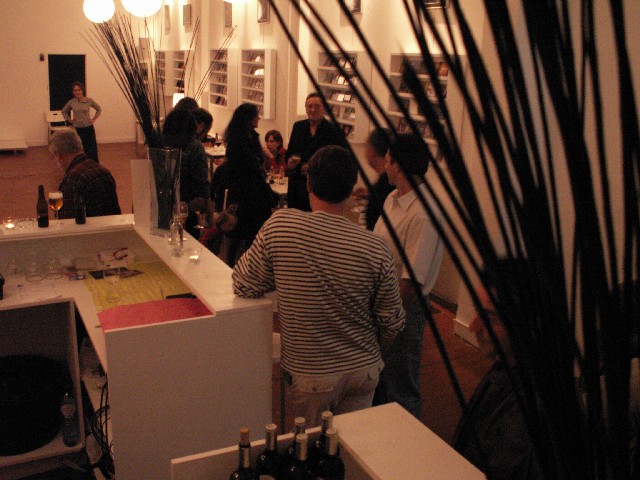
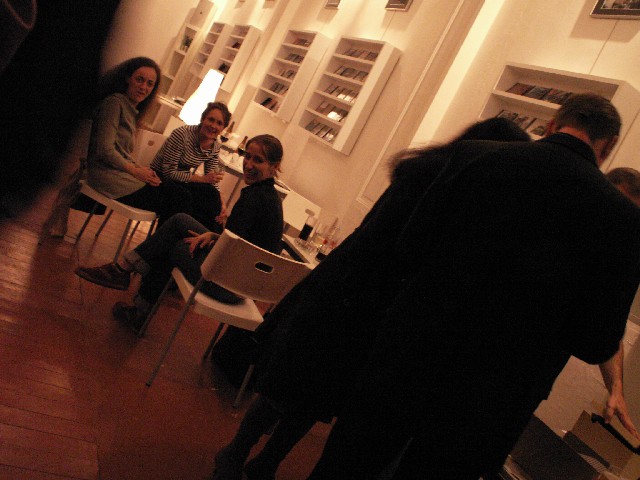
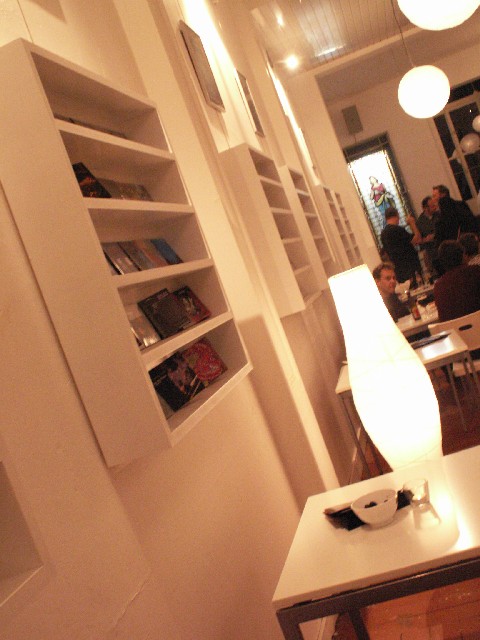
Yesterday I stopped by at the grand opening of the European Music House. It's destined to be a combination bar/music store/office space (I'm not sure what kind of business will be taking place in the offices). It's still a little bare, but should fill up rapidly.


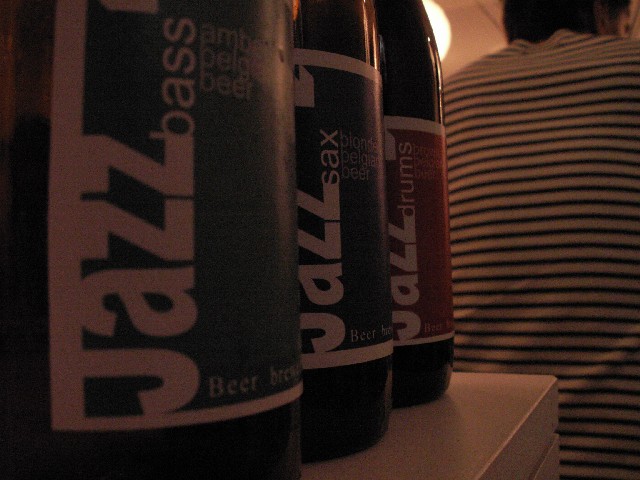
Also, they've launched their own line of beer: Jazz Sax (blond), Jazz Bass (amber) and Jazz Drums (brown). I've all but stopped drinking beer, but made an exception. The Bass is delicious and the Sax good as well (I'm not really a blond fan). They'd run out of Drums before I had a chance to taste it. These beers should be available in other jazz clubs soon.


Along the walls they had already put up a sampling of the CDs they'll be selling.


The display reminded me of something I've been thinking about recently. Namely, how ugly or boring most Belgian jazz CD covers are. De Werf, for example, puts out a lot of great music, but the packaging is almost always terrible. Recent exceptions have come from either the albums being on French labels (Octurn's 21 emanations) or the musicians using their own designers (Pascal Schumacher's Personal Legend).

Younger musicians putting out their music independently have also recently been bucking the trend, drawing either on an indie/Downton/DIY esthetic or on Dutch zany/coolness.

l-r: rawfishboys, VVG Trio, Frederik Leroux, Red Rocket


These covers also reflect an evolving music: Frederik Leroux's Angular reminds me of Chris Speed and Happy Apple and throws in some light hard rock riffs; Red Rocket's Mitten scatters glorious Sigur Róssian slow-rising soundscapes amongst more abrasive free-jazz-rock (or free-rock-jazz).

EMH pictures by Jazzques

Friday, October 06, 2006

the whitless strike back

"Whitless" (sic): see here.

For those of you who haven't seen it, the masses have been extending the Ornette-Darius debate in a way too multi-threaded and densely-argued to summarise right now. Check it out.

+

The award-winning Steve Smith and the Germany-hitting Darcy James Argue have both contributed excellent super-listening suggestions:

Darcy:

Cyclops can't/won't dance, but he does enjoy the math rock (power+control).

Steve:
Hollywood probably would set Preacher to a soundtrack of Lamb of God and Rob Zombie, but I personally hear the '80s Touch & Go roster -- the Butthole Surfers and the Jesus Lizard, especially.

The young Cerebus was into Wagner and Basil Pouledouris, but from the time he was Prime Minister onward, he had no use for music. That was definitely true during his papacy and the long years he spent railing against feminism. He might have embraced traditional religious music in his final years, but in his last days I suspect Wagner's "Liebestod" from Tristan und Isolde was playing in the back of his head.

And TBP validated the Spiderman connection.

Thursday, October 05, 2006

a brief history of Sax


A summary of the incredible story of the birth of the saxophone, as told in this excerpt from Michael Segell's The Devil's Horn: The Story of the Saxophone, from Noisy Novelty to King of Cool:

Fiery Belgian Adolphe Sax was determined to conquer the world, one invented or redesigned instrument at a time. Unable to be a prophet in his own land, he turned to the risibly bad French military bands. Sax knew his instruments were the Air Jordans these bands needed to equal the mighty Prussians.

The establishment and the instrument-making industry resisted, but Sax had friends in high places. A battle of the bands was organised on the Champ de Mars, during which Sax himself strode into battle, a saxophone under each arm. The souped-up, Sax-led group blew away the traditional band, and drove the 20,000 attendees wild. The newly-empowered French military bands rose, Hoosiers-like, through the international ranks, winning prizes left and right. The saxophone had arrived.

The rest, as they say, is history, until rock 'n' roll arrived and it all went downhill.

be.myspace


The be.jazz scene is slowly gathering under Rupert's banner. Here's a roundup. If you know of others, please add them in the comments.

On the keys and mallets:
Jef Neve (who recently signed to Universal Records. Maybe he'll be on Star Academy soon?)
Pascal Schumacher (luxemburgisch sounds like you're drunk)
Alexi Tuomarila ("Jazz / Death Metal / Regional Mexican")
Michel Bisceglia
Sabin Todorov
Eve Beuvens
Ewout Pierreux
Anne Wolf

On long strings:
Christophe Devisscher (already knows the way to Amarillo) and
Daniel Romeo (hot and funky)
Nic Thys
Yannick Peeters
Olivier Stalon
Manou Gallo (our Meshell)

On short strings:
Pierre Van Dormael (quite simply one of the greatest)
Benoist Eil's two bands: Animus Anima and Le sens du désordre
Quentin Dujardin
Cécile Broche (violin)
Karim Baggili (oud)
Giacomo Lariccia
Pierre Lognay

On vocals:
Kristen Cornwell (Australian blend)
Mélanie Di Biasio (slow and sultry)
Tutu Poane (South African import)
Kaat Hellings (a knotty sadness)
Anu Junnonen (Finnish import)
Maurane

Winds 'n' things:
Rawfishboys, Red Rocket, Skakk Trio and le petit cirque (Joachim Badenhorst is bad, man)
Nicolas Kummert (big and smooth)
Toine Thys and Take The Duck (rocking and jazzing)
Bert Joris
Thomas Champagne
Erwin Vann
Robin Verheyen (Orval addict)
Toots Thielemans (hipper than you think)
Gilles Repond
Joe Higham
Antoine Praewerman
Steven Delannoye and Sammy's On The Bowery
Nicolas Dory
Erik Bogaerts


The drumming core:
Teun Verbruggen (thanks again for the lift home from the Octurn concert!) and RAT Recordings (look out for the upcoming Othin Spake album with Mauro Pawlowski)
Lionel Beuvens
Eric Thielemans
Lieven Venken
Stéphane Galland (known to wear an S on his chest)
Adrien Verderame

Bands:
Walrus
Slang (jazz-rock-ethno-Coltranien)
Collapse Quartet
The KMGs (funky soul power)
Uppotukki Orchestra
Monk By Four (gives an idea of the ambiance at De Hopper)
Wayne Shorter Tribute
Orvalectiq

Places:
Jazz Station
Jazz Break
A Jazz Experience Rijkevorsel
Jazz Olive

Pens:
Jempi (mover, shaker and scribe)
Nath

Wheels of steel:
DJ Grazzhoppa

Affiliates:
Reggie Washington (Reggie Washington!)
Jean-Luc Lehr
MuStique

tech note: comments

Haloscan says that having post titles in the comment window "will be added in the future." In the mean time, if you use the comments RSS, you'll get the post titles (and be notified of all new comments, obviously).

I'm happy enough with Bloglines for my RSS feeds, but it is far from perfect.

housing jazz, euro style

As the FNAC's music selection continues to sink into irrelevance through dwindling choice, others are filling the space.

The European Music House, located above the Sounds, is opening this saturday. Here's the press release:

European Music House | Official Opening | October 7th - 2006 - 3pm

Marc DANVAL & Miel VANATTENHOVE presenting (5pm)
Jos L.KNAEPEN PHOTOS | Exhibition
PROGRAMME presented by Pascal NOEL

Philosophy

A very relaxing place where you can listen to and buy Jazz, World and New Music CDs and DVDs.

Simultaneously, The E.M.H is an information, promotion and archives Center for European music represented in the E.M.H. philosophy.

Pratically

The E.M.H will be open daily (except on Sundays) from 10am to 8pm.

This may exceptionally vary but will not be in competition with other Concert venues.

Location

The E.M.H. will be located on 160M2 in Brussels, the capital of Europe, directly above the oldest Jazz Club in town : “The SOUNDS Jazz Club”.

This location will allow various activities to confirm the identity of the European Music House.

Activities

Arts exhibition - Films screenings – Conferences - Projects development - European relationship – Events - Music promotion

Info:

00 32 2 644 97 91
www.emh-belgium.eu
rue de la Tulipe, 28 (Sounds 1floor)
1050 Brussels