Friday, February 23, 2007

musician questionnaire: 3/4 of take the duck


Took place after this Take The Duck concert. I conducted it from memory, which explains the order of the questions and that a few are missing. I also added a couple of questions.

Taking part were: Daniel Nösig (DN), Robert Jukic (RJ) and Karl Jannuska (KJ), who, coincidentally, once had Ethan Iverson as housemate. Toine Thys initially resisted doing it in person, preferring the safety of email. When he saw how much fun the others were having, he attempted to join in, but I cruelly made him lie in the bed he had made for himself.

GIVE US AN EXAMPLE OR TWO OF AN ESPECIALLY GOOD OR INTERESTING:

Jazz album:
KJ: Miles Davis Kind of Blue;
DN: John Coltrane A Love Supreme;
RJ: Wayne Shorter Juju

Classical piece:
KJ: Bach "Goldberg Variations";
RJ: Scriabin "Sonaten";
DN: Mozart "Eine Kleine Nachtmuzik"

Melody:
KJ: "Happy Birthday," "O Canada" [sings it, conversation ensues about the knowledge of one's national anthem];
DN: "All Or Nothing At All";
RJ: "Four"

Underrated practitioner of your instrument:
RJ: Neal Caine [Backstabber's Ball, on Smalls Records, is excellent];
KJ: Dave Laing, Bob Moses;
DN: Thad Jones ("He's well-known as an arranger, but not as a trumpeter")

Smash hit:
KJ: Nirvana "Smells Like Teen Spirit";
RJ: Guns 'n' Roses "Paradise City";
DN: Guns 'n' Roses "Knocking On Heaven's Door"

Should have been a hit:
RJ: Meshell Ndegeocello Peace Beyond Passion, Radiohead ("They should have sold even more than they did");
DN: James Brown Soul On Top;
KJ: Beck Sea Change and Mutations

Harmonic language:
RJ: Monk, Shorter;
DN: Coltrane;
KJ: Cecil Taylor

Rhythmic feel:
KJ & DN simultaneously: Elvin Jones;
DN: Dave Holland, Ray Charles;
RJ: Clarence Penn, Sam Jones, Art Blakey

Favourite drummer and album:
RJ: Art Blakey, Live at the Village Vanguard;
KJ: Frankie Dunlop on Monk's Live In Tokyo;
DN: Brian Blade, Fellowship, Tony Williams on Miles Davis Four And More, My Funny Valentine

Voice:
RJ: Betty Carter;
KJ: k.d. lang, Groucho Marx;
DN: Sarah Vaughan

Track that you can't help but dance to:
[this question caused a lot of singing of Michael Jackson basslines and horn parts by Toine and even some spontaneous dancing by Karl]
RJ: Prince "Get Off", James Brown "Get Up";
KJ: Led Zeppelin "Whole Lotta Love", Tower of Power "Knock Yourself Out";
DN: Peter Gabriel "Sledgehammer"

Folkloric group:
RJ: Troitsa;
KJ: Doc Watson;
DN: Totó [Columbian singer, not the rock band]

A pop tune:
RJ: Aerosmith/Run DMC "Walk This Way", the whole of Sting's Ten Summoner's Tales;
DN: Falco "Amadeus";
KJ: "Live To Tell" Madonna

Hidden early influence:
RJ: Jimi Hendrix ("In 7th grade, I dressed like a hippie and was an outcast");
KJ: Starship's "We Built This City On Rock 'n' Roll", Genesis Invisible Touch;
DN: Duran Duran Irina

Take The Duck - 17/02/2007@Jazz Station, Bruxelles


Toine Thys - ts
Daniel Nösig - tp
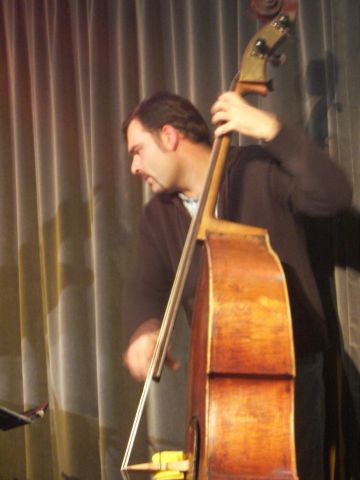
Robert Jukic - b
Karl Jannuska - d

See previous concert and Jazzques review. The setlist was fairly similar, but there were a few welcome newcomers.


"Kalkilya" was a slow, slightly sad two-horn dialogue in 7/4. It superbly demonstrated the results of Nösig's and Thys's 9-year partnership, with all the knowing repartie of an old - but still lively - couple. Afterwards, Toine announced that it was about a Palestinian town of the same name that was encircled by the Israeli wall. I thought having that instrumental dialogue to represent a situation where dialogue has been literally cut off was interesting.


Robert Jukic's "Alter Swede" was a boogaloo with a slowed-down bridge that drifted on just long enough for you to be happy when the beat returned. "Duck's Food"'s contrapuntal theme led to a lighter, low-key key mood that Thys took advantage of to introduce a new softness to his tone. Nösig then built up a more a more forceful, lilting groove that carried over into the theme reprise.


Even though it was Karl Jannuska's first tour with the band, you wouldn't have known it from his hook-ups with Robert Jukic, especially when the horns dropped out: some of the concert's most intense moments came when Jukic and Jannuska paired off for a duet, as they did during the drummer's "Third." Because each member lives in a different country, the band only gets together when one of them manages to put together a tour. Let's hope that Jannuska sticks around for the next one.

Thursday, February 22, 2007

musician questionnaire: pascal schumacher quartet


[The whole quartet took the questionnaire together at the Sounds, which explains the lack of details (but I love Jens's bonus question answers), but ensured lots of unprintable jokes and conversation that ricocheted between english, french, dutch and german.]

Pascal Schumacher (PS) is a vibraphonist from Luxembourg. His Quartet has released two excellent albums and has just recorded its third. He won the Django d'Or Nouveau Talent in 2005. (myspace)

Jef Neve (JN) is a pianist. His Trio recently made its major label debut with the amazing nobody is illegal and is proving immensely popular. (myspace)

Bassist Christophe Devisscher (CD) recently recorded and toured with the resurrected English singer Tony Christie and is a member of his wife Kristen Cornwell's quintet.

Jens Düppe (JD) is a German drummer. He replaced Teun Verbruggen in the PSQ last year and is a member of the Cologne Contemporary Jazz Orchestra and (sometimes) the Brussels Jazz Orchestra. He's the only I got to ask the bonus questions to.

GIVE US AN EXAMPLE OR TWO OF AN ESPECIALLY GOOD OR INTERESTING:

1. Movie score:
PS: All the James Bonds, Kill Bill;
CD: Cinema Paradiso (Ennio Morricone);
JN: The English Patient (Gabriel Yared);
JD: Le merveilleux destin d'Amélie Poulain (Yann Tiersen)

2. TV theme:
CD: "3rd Rock From The Sun", "Frasier";
JN: "MacGyver";
PS: A-Team;
JD: "Alf"

3. Melody:
CD: "Godfather Theme" (Ennio Morricone Nino Rota);
JD: "Ballad of the Sad Young Man" (Frans Landesman/Thomas Wolf) as played by Keith Jarrett on Tribute;
PS: "Still" (Elvis Costello), "Innocent Eye, Chrystal See" (Harmen Fraanje, from Ronja);
JN: Second movement of Mozart's Clarinet Concerto

4. Harmonic language:
PS: Debussy;
CD: The Beatles;
JN: Scriabin;
JD: Radiohead, African singing

5. Rhythmic feel:
JN: Shakti;
JD: Bulgarian music

6. Hip-hop track:
JD: "Feel Like Making Love" as covered by D'Angelo on Voodoo;
PS: "Die Da" (Fantastischen Vier);
CD: "Praise You" (Fat Boy Slim);
JN: Vanilla Ice "Ice Ice Baby" [I tried to discourage him...]

7. Classical piece:
CD: "Adagio For Strings" (Samuel Barber);
JN: "The Passion of St. Matthew" (J. S. Bach)
PS: The Military Orchestra of Luxembourg playing a swing version of "Eine Kleine Nachtmuziek" [sarcasm alert: Pascal had endured this the previous night];
JD: "Symphonie Classique" (Prokofiev)

8. Smash hit:
PS: "The Man Who Sold The World" (David Bowie);
CD: "Don't Dream It's Over" (Crowded House);
JN: "With Or Without You" (U2);
JD: "Smells Like Teen Spirit" (Nirvana)

9. Jazz album:
JN: "Songs" (Brad Mehldau);
PS: Xenophonia (Bojan Z), - (Nelson Veras);
CD: Live At The Pershing (Ahmad Jamal), Trio Jeepy (Branford Marsalis);
JD: Live at the Village Vanguard (Bill Evans), Bloomington (Branford Marsalis)

10. Non-American folkloric group:
PS: Milton Nascimento;
CD: Goran Bregovic;
JN: The Chieftains;
JD: Djavan

11. Book on music:
CD: Beneath The Underdog (Charles Mingus), Schoenberg's harmony book;
PS: Sonata Forms (Charles Rosen), Farinelli;
JN: Mozart's letters to his father;
JD: The History of Blue Note

BONUS QUESTIONS:

A) Name a surprising album (or albums) you loved when you were developing as a musician: something that really informs your sound but that we would never guess in a million years:
JD: Dave Sanborn Heart To Heart and Straight To The Heart. I know both... by heart.

B) Name a practitioner (or a few) who play your instrument that you think is underrated:
JD: Jorge Rossy - the Brad Mehldau Trio isn't the same without him; Billy Hart; Bob Moses - I once recommended that a saxophonist friend go to a Moses workshop I couldn't attend. He was the only one there!

C) Name a rock or pop album that you wish had been a smash commercial hit (but wasn't, not really):
JD: The only rock I know, I know because it sold a lot.

D) Name a favorite drummer, and an album to hear why you love that drummer:
JD: Brian Blade, Fellowship. He's a busy player, but manages to sound warm and transparent.

after telex

you don't even want to know what Milou (Snowy) did to the Castafiore


The KMG's (myspace) are going to the Eurovision. I still haven't seen them (but Jazzques has), so now I feel behind the curve. I have seen its keyboardist Piotr Paluch a couple of times, though, most recently last December with his quartet. Normally I'd say something like "It'll be weird seeing him on TV," but I generally end up not being at home to watch the contest, anyway. Best of luck to them, as they'll have to battle through the semi-finals.

Wednesday, February 21, 2007

Maak's Spirit - 16/02/2007@Jazz Station, Bruxelles


Laurent Blondiau - tp, flh (website)
Jeroen Van Herzeele - ts
Jean-Yves Evrard - g
Sébastien Boisseau - b
Eric Thielemans - d

By the beginning of the second set, insanity had clearly taken over. Jeroen Van Herzeele was sitting on the right edge of the stage, band leader Laurent Blondiau and Jean-Yves Evrard were roaming around in front of the stage, almost among the first row of chairs and tables. Eric Thielemans had switched over fully to his electronic kit and stiffened his gestures to match his 80s-electro groove. It was hard not to think of a wind-up monkey drummer. Sébastien Boisseau was attacking his bass with the bow. They slipped imperceptibly in and out of a shrieking free-rock undercurrent. How had it come to this?


Every Maak's Spirit album differs markedly from the last. Le nom du vent was a spacious and intimate sextet conversation, while Al Majmaa (Igloo) added Gnawas and kora player and turned into a trance-groove party album. 5 (De Werf) is made up of music written by Jean-Yves Evrard, the band's guitarist and resident savage genius. On stage, he's like a grand, drunk, old Shakespeare-trained English thespian, who'll mumble something intricate, suddenly bellow and then come up with something beautiful, all the while maintaining a kind of tattered dignity. Of course, Evrard's rips, tears, spark-shooting fast runs and cleanly plucked soft grooves show that he's fully in control. Why else would he wear a black jacket with "Naïf et Violent" in a 3-D silver glitter font on the back?

5 is garage jazz, literally: it was recorded in a low-ceilinged room, musicians huddled close together and sounds like a bleached-out, over-saturated photograph, with Jozef Dumoulin's Fender Rhodes further thickening the mix. The sound quality enhances the music's sense of urgency: the opening "Sonnerie" and the three parts of "Datta error" scattered throughout the album charge out of the gate with hard-edged, big band-ish lines, sturdy swing and explode into fierce collective improv.

There's another, quieter, side, too. "Interlude" is a textural, slightly worrying ambient piece full of long tones sounded off in the distance and recurring cymbal rattling. The most hard-hitting track, though, is "Strange Meeting." A woman with a singing African accent (South African? Nigerian?) recites a poem about domestic abuse. Both her words and her intonation express the inextricable jumble of strength it takes to absorb the pain and weakness it takes to stay, love and hate, resilience and despair of the situation. It's a powerful, bone-chilling moment.

Finally, the profundity and rage are tempered with some absurdity, as in "Trois mûles bleues"'s seemingly random objects listed in a faux-childish voice over an ebulliantly ramshackle beat. There's been a spate of amazing jazz-rock albums coming out recently (Othin Spake, Rackham, the upcoming Animus Anima) and 5 is perhaps the most idiosyncratic of them all.


Contrary to the album's claustrophobic feel and aggressively lo-fi sound, on stage they took advantage of a wide dynamic range and left empty spaces, so the music became warmer without mellowing much. They started, as does 5, with "Sonnerie," but introduced it by way of a heart-felt guitar lullabye, which Thielemans underscored with quiet patter and Van Heerzele highlighted with equally quiet, but more emphatic long, high notes. Finally, the whole band came in and went hard into the the intricate theme's acute ricochets and rambunctious swing.

Amid this rushing energy, humour was always close to hand. Whether it was Blondiau jabbing his mute over Van Herzeele's bell or Thielemans insisting on playing a silly melody or purposefully stiff, 80s-electro groove on the electronic portion of his kit, there were lots of moments when I was just cracking up. No-one else seemed to be, though, so maybe it was just me.

The sonic room opened up by the absence of Dumoulin's Fender Rhodes (he isn't part of the touring band) was taken advantage of in the quieter passages. Never more so than when they reached back to 2003's Le nom du vent for a langourously elongated, Malian-style guitar groove whose seductive power was enhanced by the overall quietness. Boisseau played a free-yet-appropriate arco solo, alternating swathes of noise and keening melodies. The horns eventually joined in from off stage, adding an oblique fanfare that regularly crested and faded away to offer contrast.

Tuesday, February 20, 2007

musician questionnaire: joachim badenhorst


[Lately, I've been harassing people to get them to answer the Do The Math Musician Questionnaire. Unlike the original, most of mine were done in person, not by email. As Joachim was the first to reply (by email!) to my query, he gets to launch the Belgian version of the DTM MQ. Hopefully, the panorama of answers in upcoming installments will offer a little insight into the scene and people over here (but not only, as there are some international guests).]

Joachim Badenhorst is a clarinetist and saxophonist. His groups (Rawfishboys, Red Rocket and Skakk Trio) illuminated 2006. You might be able to get the Rawfishboys record if you ask nicely, Red Rocket should be seeing an official release, and you can hear all of them (and one more on MySpace).

The Charlie Parker comment won't surprise anyone who's heard Joachim play.

GIVE US AN EXAMPLE OR TWO OF AN ESPECIALLY GOOD OR INTERESTING:

1. Movie score: Noi Albinoi (Dagur Kári directed this -beautiful- movie, also
made the -beautiful- music for it with his band Slowblow), Twin Peaks (Angelo Badalamenti), Vengo (Tony Gatlif).
2. TV theme: "The Simpsons" (Danny Elfman)
3. Melody: "Sunny" (Bobby Hebb), "So nice" (Magic Malik).
4. Harmonic language: Bach, Django Bates (i love his reharmonisation of "Quiet
Nights Of Quiet Stars" on his cd Quiet Nights).
5. Rhythmic feel: Vijay Iyer, Dino Saluzzi.
6. Hip-hop track: "Get it together" (Beastie Boys)
7. Classical piece: Stabat Mater (Pergolesi)
8. Smash hit: "Hope There's Someone" by Antony and the johnsons.
9. Jazz album: Eric Dolphy with Booker Little Far Cry, Mick Goodrick In
Passing
(amazing band, John Surman plays soo good on this album...)
10. Non-American folkloric group. Husnu Senlendirici, Giora Feidman.
11. Book on music. Give my regards to eight street (collected writings of
Morton Feldman).

BONUS QUESTIONS:

A) Name a surprising album (or albums) you loved when you were developing
as a musician: something that really informs your sound but that we would
never guess in a million years: Charlie Parker: In A Soulful Mood. This was
the first jazz record i bought, it blew me away. funny enough my favourite
tracks were always "Loverman" and "The Gypsy" where Parker plays a bit more
fragile, later i found out he was very sick when he recorded these.

B) Name a practitioner (or a few) who play your instrument that you think is
underrated: Ned Rothenberg, Hayden Chisholm, Ben Goldberg, Gilad Atzmon, Frank
Gratkowski, Loren Stillman, Julian Arguelles, Frederik Ljunkvist.

C) Name a rock or pop album that you wish had been a smash commercial hit
(but wasn't, not really): Either/Or (Elliot Smith), Nearly God (Tricky).

D) Name a favorite drummer, and an album to hear why you love that drummer:
I love Toma Gouband (Toma Gouband Trio with Brice Soniano and Harmen
Fraanje on Cristal records (a new cd is coming up with the same trio + Magic
Malik) and Sean Carpio (Mikkel Ploug Group feat. Mark Turner on Fresh Sound New Talent).

noël akchoté blindfold test


A mordant blindfold test by guitarist Noël Akchoté. Translated excerpts:

Otomo Yoshihide/Bill Laswell/Yoshigaki Yasuhiro "Pocket" Soup Texture
"Generally speaking, when an original musician is surrounded by a rather ugly bass, resulting in a pointless disc that's very long and never gets going, Bill Laswell is never far away."

Tiny Bell Trio "Les croquants" Constellations
"If this music had been played by Philippe Deschepper, Jean-Luc Capozzo and Jacques Mahieux, it would have touched me infinitely more. It would have had a past, a life, meaning, an inimitable way of rolling along all by itself and wouldn't avoid the simple emotion of melody or even the feeling of the bal. What we're listening to sounds a bit forced. (...) I think that this is exactly the time when I got out of the jazz scene. Middle of the 90s? That's the time when we went from Paul Motian's trio with Frisell and Lovano, Tim Berne's groups, etc., to stuff like this. Dave Douglas or Axel Dörner, in a different genre, bore me pretty deeply (unlike Herb Robertson or Steven Bernstein)."

Miles Davis "Medley (Gemini - Double Image) Live/Evil
"If I take my generation, for example in jazz, I think that there are, what, four or five very strong personalities and excellent musicians and then if I'm more subjective, I'd say that there's one totally unique, immense, profound, full and sensitive exception and I'll name him: Guillaume Orti. (...) Anyway, I wasn't going to talk about Miles one more time."

Derek Bailey/Jamaaladeen Tacuma/Cavlin Weston "S'Now" Mirakle
"Ah, finally some jazz guitar. (...) The two guitarists that were very important in my evolution towards more open playing were the two I encountered first, Derek and Keith Rowe... And it's not coincidental that the two of them come, to put it briefly, from Charlie Christian and early jazz. For me, they have somewhere in the back, in very different ways, melody, swing and something of the Broadway song. Today, still, if I'm honest, it's the early jazz guitarists I'm passionate about. (...) Let's say that after René Thomas, Sonny Sharrock and Derek Bailey, music and the guitar in particular, go completely elsewhere. It's in electricity, rock, sound for sound, that things reinvent themselves."

Naked City Torture Garden
"I think John Zorn and this music was a kind of hope of getting out of the jazz ghetto... It seemed possible to imagine loving jazz and being open, young, active, alive. Not just a subscriber to specialised magazines and a bachelor looking for that impossible-to-find record. (...) For me, Zorn is two things: a great improviser, especially in free improvisation and a great producer. There's a Spielberg/DreamWorks side to him, even if I much prefer Spielberg."

Monday, February 19, 2007

clapping again


Clap Clap is reborn. The general format is a weekly essay. I don't know if Mike polished up his style during his hiatus, or refreshed his thoughts or it's just that early burst of born-again enthusiasm, but the first three essays (the compared funerals of James Brown and Gerald Ford; Paris Hilton; Lindsay Lohan's interview with Devendra Barnhart) are awesome. I loved his old blog, I just might love this one even more, already. And, of course, you're not reading Eppy if you're not reading the footnotes.

Saturday, February 17, 2007

Take The Duck - 15/02/2007@Le comptoir des étoiles, Bruxelles


I guess the "Robert Jukic International Quartet" was a Charlie Chan-style contractual dodge, since Take The Duck (website | myspace) is playing at the Jazz Station today. Toine Thys (myspace) has been mostly equated with Rackham lately, but this is actually his longest-running group, a jazz-jazz band co-led with the Austrian trumpeter Daniel Noesig (myspace) since 1998. The personnel has shifted recently: it was only Paris-based Canadian drummer Karl Jannuska's second gig with the band.


They came out guns blazing with a rambunctious bounce. Right away, the difference between Jannuska and whoever it was that I had seen previously was evident: Jannuska is an excellent drummer, upfront but responsive and tight. There's something a little frantic in his body language, but not in his sound. The composition of his that ended the first set underlined that distinction, as a more-or-less unison line played over an intricately arranged, shifting rhythm part that started, stopped, raced ahead and then stuttered. During his solo, Noesig progressively loosed himself from the form, bringing a satisfying unity and forward motion to its strict cycles.

Bobby Timmons's "Dat Dere" provided a slice of classic 32-bar bluesy hard bop that the trumpeter bit into with delight. Sitting just out of arm's reach of his bell, his clean, precise playing and fat sound were a joy. On "Emergency Staircase," Jannuska was highlighted again, as his mobile, Latin-ish straight-eight was killer, and took the energy to a peak when he made this drumset sound something like timbales.


The front line plays on the classic trumpet/saxophone division of labour, the former more lyrical, the latter more muscular. "Juanita Kligopoulou" (which you can hear on its MySpace page) is a great, Calexico-like dusty Mexican border-town of a song that, among other things, relies heavily on that front-line collaboration. Song is the key word here, which makes it unsurprising that it is also a part of Rackham's repertoire. Noesig lyrically intoned the melody, while Thys obbligatoed, reinforced and dialogued, roles switching freely without ever losing the song-feel. There were no clear breaks for solos, but rather a complete song with sections of more loosely improvised melody. Another thing shared with Rackham is Thys's signature sound: a way of occasionally emphasising longer notes with an attack that's halfway between a growl and a Spanish rolled r.

Mike Del Ferro/Frank Vaganée Group - 15/02/2007@Palace Music Club, Brussels


Mike Del Ferro - p (website | myspace)
Frank Vaganée - as, ss (Jazz in Belgium)
Jos Machtel - b
??? - d

After the restaurant gigs, now I'm going to concerts in the bars of dauntingly swank hotels. I figured out why I don't like them: if I went somewhere to hang out and talk, I wouldn't enjoy having music I didn't like inflicted upon me, either. The crowd was surprisingly attentive, but the lurking possibility still disturbed. Also, I paid 4 euros for a Stella, which is not so much reassuringly expensive beer as totally terrible beer. For that price, though, I made it last.

The Palace Music Club is in its second season, I think. Its particularity is that Philip Catherine is its godfather. Their Thursday concerts are mostly ignorable, but from time to time they have a worthwhile jazz group (Catherine himself is playing there in April).


Mike Del Ferro and Frank Vaganée co-led a band that made a couple of CDs ten years ago, but hadn't played together since. Every tune explored a slightly different area: bright bop blues, a soft, romantic 3/4 ballad with a pop-tinged melody, a calypso, "an Italian opera song" that sounded like an inspirational ballad and finally some uptempo, interval-leaping, stop 'n' go bop.

Vaganée is the leader of the Brussels Jazz Orchestra and a good straight-ahead player. On "La Golondrina," he milked long-note prettiness for all it was worth, using his purest, most voluptuous tone. Del Ferro took a more diffuse and reflective approach to his romanticism, but dug into "Bunga Bunga"'s calypso rhythm with relish.

It could have been an okay gig, but there were sound problems that made the bass (Jos Machtel, also from the BJO, has this really strange right hand technique, plucking with his thumb) and drums boomy and overwhelming. Mostly, though, the drummer, whose name I didn't catch, wasn't really happening, so I left after the first set. I had another place to be, anyway...

Thursday, February 15, 2007

jazz and blogs #14


Soundslope
Good discussion, links and videos.

the hotel pianist
[Great while it lasted (maybe you can still catch the rss)] Cocktail jazz's answer to Jeremy Denk? A sample of thp's incisive wisdom:

(Later, I wondered, was John Cage the original hotel pianist? He had the imagination to compose a piece in which the audience is the soloist. That is the exact description of the music of the hotel pianist.)
A great (and unprecedented?) combination of music and office gossip. [via Rifftides]

Bay States
Some politics, too, but Chris Rich discusses a lot of jazz issues from the point of view of a grizzled jazz scene mover 'n' shaker.

Jazz in Chicago
Podcast interviews with musicians from Chicago and beyond.

Tom Hull - on the web
Professional jazz critic. The Jazz Prospecting series provides insight into his work methods. Seems like a bit of a grind. I like the term "the cutting edge of the not-so-avant-garde," which I generally call "progressive."

Jazz Chronicles
Jazz writer James Hale [via Nate]

Jeff Parker's MySpace blog
Not a lot of posts, but some interesting ones.

Lulu's Back in Blog
Line-drawings as song illustrations. My favourite.

Critica de musica
Álvaro Teixeira. There's an "automatic translation" link at the end of each post, but it's even harder to read than the original Portuguese.

Wednesday, February 07, 2007

Karim Baggili / Osvaldo Hernandez - Musée des Instruments de Musique, 06/02/2007


Karim Baggili - g, oud (website | MySpace)
Osvaldo Hernandez Napoles - perc

I first heard Osvaldo Hernandez on the Apikon-Dia trio's weird and excellent album. If you have no idea of what maracas virtuosity might be, Hernandez can give you a few hints, as he did soon after I walked into the room, in the middle of the second song. His almost painterly arm and wrist movements produced a surprisingly wide range of rhythms and sounds.

I first encountered Karim Baggili on Nathalie Lorier's recent, East-meets-West L'arbre pleure. On that album, Baggili, who, as a Yougo-Jordanian established in Belgium, is a bit of a cultural crossroads all by himself, plays the Easterner, sticking to oud and Arabic themes. In this duo, though, he started with the Spanish side of his playing, on acoustic guitar. His songs applied classical or semi-classical technique (in the sense of playing bass lines, accompaniment and melody at the same time), rich harmony and well-paced and -textured arrangements to folk-ish material, thus balancing lyricism with rhythmic drive, light-footed and complex harmony with soulful flamenco chords. More subdued material, such as the romantic "Luna," avoided sappiness by keeping some ardent passion bubbling just beneath the surface.


For a beautiful rendition of the well-known "La Llorona," Baggili and Hernandez sang together. Short guitar solos separated the verses, extending the waltz's tragic-romance suspense. Lyrics such as "yo soy como el chilo verde, llorona/picante pero sabroso" are common in Cuban songs, for example, but I wondered what they could mean in this sadder context (there were more poetic lyrics, too, about crying flowers, but I can't find a version of the song with them online and don't want to butcher the line) and thought of Dave Douglas's comments on cultural context. Of course, my poor Spanish doesn't help matters, but the meanings of stock phrases such as that one seems as deeply embedded as those in the blues or hip hop, not really accessible to outsiders.

The Middle-Eastern side of Baggili's equation was addressed on the two pieces that followed. First came a dance-based oud-derbouka tune. Hernandez then used the tabla/udu drum hybrid pictured above to create a less domineering sound and more open setting for a looser set of improvisations, connected by a few pre-set themes, one of which I recognised from L'arbre pleure. They segued from happy-go-lucky line-spinning to phrases that seemed profound and yearning, even when Baggili's plucking was fast and insistent. When Hernandez took a tambourine solo, he reminded us once again of how these tunes were all about their rhythmic phrasing and accents.

Tuesday, February 06, 2007

Gilles Repond Quartet - 03/02/2007@Jazz Station, Brussels


Gilles Repond - tb (myspace)
Pascal Mohy - p
Sam Gerstmans - b
Max Silvapulle - d

It's strange how there are some musicians, like Sam Gerstmans and Pascal Mohy, who are good players, around my age and play a lot of gigs, but that I never see, perhaps because they run in circles I don't frequent much. I don't think I'd ever heard of Gilles Repond, but I trekked out to the Jazz Station's 6 PM concert anyway, because it's not too often I get to hear trombone up close. I missed most of the first set, maybe my opinion would be different if I hadn't.


Gilles is a quiet and tidy player. Perhaps a little too tidy, as things sometimes took on a bit of a cruise ship feel (not that I've ever actually been on a cruise...). The writing reflected that, too: uncluttered, but lacking a bit of oomph. During the "Lost Suite," one movement got off to an enlivening start, with an urgent, siren-like motif, then dissipated into rubato, in Grachan Moncur style. Multiple possibilities seemed available then, so when Pascal Mohy came in for an untroubled, medium swing solo, it was a very puzzling, energy-deflating decision, one too typical of the set.


After the suite, a couple of standards reinvigorated the music. The arrangement of Billy Strayhorn's "Johnny Came Lately" extrapolated part of the theme's phrasing into a groove for the A section and reverted to swing for the bridge. Mohy and Gerstmans provided, as they regularly did, concise and interesting solos.

"St. James Infirmary" was a great showcase for Repond's growls and slurs, as he revelled in the use of a metallic plunger mute. When he put it down, his power and clarity seemed enhanced, and he dug into the behind-the-beat feel with relish.


On Repond's MySpace page, you can hear excerpts from his debut album, Lost.

Bart Defoort/Nathalie Loriers Quartet - 02/02/2007@Music Village, Brussels


Bart Defoort - ts
Nathalie Loriers - p
Philippe Aerts - b
Mimi Verderaeme - d

I'm not sure why this was billed as the Defoort-Loriers Quartet, as it was clearly the saxophonist's: he made the announcements and wrote almost all of the original tunes. Jazzques has chronicled the various line-ups Defoort has been trying out recently. I haven't seen them, but these four are pretty much the best exponents of contemporary straight-ahead jazz in Belgium. If they get to continue playing together, it's hard to imagine a better combination.

Maybe I was still exhausted from the previous very late night and therefore softened up, but it was really great to hear this, at least for the first 1.5 sets. Perhaps the late Whitney Balliett's definition of jazz as the sound of surprise has become over-used: sometimes, jazz is just the sound of delight, and that's fine. This quartet's swing - so unpretentious, relative to its high quality, that it seemed understated - was precisely that. Unlike Defoort's rather detached 2003 album The Lizard Game and band, this group actually sounded like it had something invested in these tunes.

Defoort is a player who's nimble without being imposing. His tunes often had some stop 'n' go edge, but never really transferred it into the blowing sections. His solos developed unhurriedly and even at their most frenetic, he remained soberly unexuberant. His sound was relatively light and contained, but grew warmer and more ample on standards like "Darn That Dream" and "My One And Only Love." It's only on the rhythm changes-based "Hope You Got It" at the end of the third set that he unleashed some uncharacteristic bluesy honking.

Philippe Aerts contributed the only non-Defoort original, "Forward." Its neatly-accented tenor-piano-bass unison line, with no supporting chordal playing, made the quartet sound like a big band section. Maybe that's not too surprising, as all three are regular Brussels Jazz Orchestra members.

Ever since listening to last year's reissue of Silent Spring, I've become a Nathalie Loriers convert. Her consummate grace and light, caressing touch mean that she never gives the impression of straining towards a peak. Perhaps this is a more feminine conception of musical architecture. On "Central Park West," her light-hearted stroll-in-the-park of a solo was underscored by the rhythm section's loosely bossa-tinged patterns. While her beautiful Bill Evans-styled intro to "My One And Only Love" was an unsurprising deviation from her core style, she also held her own on a Defoort original that built up to a Coltrane Quartet 6/8 feel, with tumbling drums and Aerts solidly hitting the chords' roots for Loriers to freely develop complex voicings over.

I very rarely go to the Music Village, mostly because of its relatively high prices and misgivings about the audience it attracts, but I have to admit that it's very tastefully decorated and boasts what are probably the only toilets where you can admire Brad Mehldau promoting Hanlet pianos while standing at the urinal. The pillars in the lines of sight remain as annoying as ever, though. I bumped into Flagey's PR person, Muriel Hasson, who reminded me that McCoy Tyner is holding a two-night stand there in March, with Charnett Moffett and Eric Gravatt. Hopefully, he'll be accepting interviews.

Monday, February 05, 2007

Chris Potter's Underground - 31/01/2007@CC Luchtbal, Antwerpen

sales fever

Chris Potter - ts, bcl (website | myspace)
Adam Rogers - g (myspace)
Craig Taborn - Fender Rhodes (myspace)
Nate Smith - d (myspace)

Dave Holland's Prime Directive was one of the first contemporary jazz albums I bought. For a long time, it served to measure the growth of my understanding of jazz: I loved the melodies and rhythms right away, but a lot of the rest was way over my head. Progressively, as I returned to it every few months, I followed along more and more. It remains a favourite recording of mine.

Chris Potter was, of course, a big part of Prime Directive and the subsequent DHQ albums. On last year's Critical Mass, though, my impression of his playing was often one of empty histrionics. Talking with people after Potter's Underground band's concert - even with people who professed to admire him as a saxophonist and to have enjoyed the show - a similar emptiness lingered behind the fireworks: impressive, but not particularly satisfying.

As I consider Miles Davis's Cellar Door band to be an unsurpassable example of jazz-funk, I was most pleased when, on the opening "Underground," Craig Taborn brought Keith Jarrett and Michael Henderson together over Nate Smith's muscular groove. Drummer and keyboardist would often hook up like this throughout the concert, seemingly to the exclusion of anything the other two may have been doing. This disconnect posed an intractable problem: over that kind of rhythm, there isn't really much you can do except burrow into it, which, was clearly the last thing Chris Potter was going to do.

The saxophonist was fast, loud and virtuosic almost all the time, whether over a hard groove or the slow, ballad-ish "Celestial Nomads." When he did take a more percussive approach, it didn't seem sincere. Taborn's a fantastic pianist, capable of complex feats, but also knows how to work the simplest gestures into an exciting groove (his abilities were put to amazing use in Tim Berne's trio with Tom Rainey when I saw them in the PP Café last February - or was it February 2005?). My favourite Taborn moments came when he used the Rhodes less pianistically. On a great intro to "Zevya," he used the pedals to achieve a very soft attack, and for the saxophone-Rhodes duet that prefaced the encore of Billy Strayhorn's "Lotus Blossom" he gave the chords a strange, distorted beauty. Potter's use (or non-use) of rhythm and space was totally different, almost diametrically opposite.

On bass clarinet, Potter was more lyrical. On "Togo," introduced as a traditional African song, melody had room to breathe for the first time, as he wound variations on the modal tune and accompanied a surprisingly quiet Taborn solo with a gentle riff. The mood changed when Potter picked up his tenor and dove into a duet with Nate Smith, who ably avoided too much Coltrane-Jones mimicry by tethering his powerful playing to the tune's original African polyrhythm and by unexpectedly interrupting his flow to build tension.

"Next Best Western" epitomised the problem, but also suggested a way out of it. It started with an unaccompanied and unfettered display of Potter's virtuosity, but I was never overwhelmed by it in the way I have been by, say, Evan Parker. Later in the tune, the tempo was slow, but only Taborn's cool falling chord sequence hewed to it. Adam Rogers brought a frantic riff and Smith stoked a busy groove, while Potter played emphatic flurries. The overall density pushed the saxophone further back in the mix, creating a more collective and interesting dynamic.

Perhaps the band's internal balance wasn't what it usuallly was: we were informed that Adam Rogers was so sick he had almost given up on playing the gig altogether. His participation was understandably muted. Maybe last-date-of-European-tour fatigue played a role, too. They're currently touring in the US (see Potter's MySpace), I'd be interested in your reactions if you see them.

Pascal Schumacher Quartet - 01/02/2007@Sounds, Brussels


Pascal Schumacher - vib (website | myspace)
Jef Neve - p (website | myspace)
Christophe Devisscher - b (myspace)
Jens Düppe - d (website)

This is the sixth Pascal Schumacher Quartet concert review I've written on this blog, to which I must add a couple more for Citizen Jazz, not to mention reviews of both PSQ albums and a feature article for Flemish arts magazine Rekto:Verso. This would be overkill if the band hadn't evolved steadily (and maybe it's overkill anyway?), notably with the recent change of drummer. Jens Düppe provides a steadier, more swing-rooted beat, compared to Teun Verbruggen's super-interactive style. The difference between the two is captured in Jens's answer to the DTM musician questionnaire's "pop or rock album that you wish had been a smash commercial hit" question, which should be up soon.

The last PSQ concert I saw, in October of last year in Gent, was pretty lacking in energy, but introduced me to some of the new compositions they'll be recording for their third album. This concert, with those new tunes and some even newer ones, however, was strong.

With Jens, it's become a four-composer band, making it difficult to fit everyone's pieces in, perhaps explaining why none of Jef's were played. Also, the scope of the influences and rhythms they're bringing in is growing all the time, exemplified by the Arabic base of Christophe's "Sita's Walk" and the collective, uncentered groove Pascal's "Piata's Paint Thing" bursts into. "Monday Night at the Cats Club," also by the vibraphonist, was particularly striking, for a band used to making grand gestures: the menacing, low-lying piano chords that changed at unexpected times and the steady jingle of bells attached to Jens's foot created a menacing atmosphere, like an acoustic version of minimal electro. The difference with the pair of Pascal's older tunes that they played, the compressed, multi-thematic "Leap Year" and the bursts of rock that punctuate "Kitchen Story," was huge.


Jens contributed two pieces. "Kaa" gets its title not from the snake in The Jungle Book, but from a frequently-used Thai token of politeness. It's a mid-tempo ballad made slower by the bass's 3-over-4 pattern and the four simple, lovely chords it drifts through, over and over. The more challenging and percussive bridge livened things up, though. "Toast And Salty Butter" demonstrated Jens's affinity with African music, as its South African-style chords and polyrhythmic groove triggered a melodic, '70s Jarrettian solo from Jef, and a particularly singing one from Pascal.

The oldest tune they played was Christophe's "Chucho's Groove," a sturdy 9-beat bass vamp that everyone hovered around. Familiarity allowed for some silly frolicking, as when Pascal achieved sci-fi FX by speeding up his fan. He seems to be manipulating sound more adventurously, of late: the new "A Bad Memory" was the first time I've seen him use a bow, a practice that, a few years ago, he saw as being confined to contemporary classical.

A Monk medley that starts as "Misterioso" and ends as "Blue Monk" had failed to take off in Gent, but turned into a heavy-duty blues workout this time. It started with a vibraphone intro that toyed with "Misterioso"'s ascending intervals and the vibes-specific overtones they created (a bit like the intro to "Summertime" on Change of the Moon), then morphed organically from a heavy 12/8 to a 4/4 shuffle to some classic Jef Neve clowning around with hilariously simple, sing-song blues lines, one hand on the keyboard, the other on the strings, and ended with a series of intense bass-drum exchanges.

Sunday, February 04, 2007

Jef Neve Trio - 30/01/2007@Vooruit, Gent


Jef Neve - p (website | myspace)
Piet Verbist - b
Teun Verbruggen - d (website | myspace)

Just a short note, as I have a review of Jef's great nobody is illegal coming up.

Contemplating the packed Vooruit, my joy at Jef's new-found stardom was tinged with sadness, as I couldn't help but think back to the same room, two-thirds empty for Dave Burrell, last October.

The first set got off to a slow start, despite the evanescent quality of new composition "Remorse." Three of the six tunes played were ballads, and while they showcased the trio's ability to use stillness and silence to great effect, they weren't really arresting. Things started to warm up with the driving "Wakeup Make-Up," which elicited Jef's first leap from the bench. His body language is a fairly precise indicator of the music's quality: the more he jumps around or laughs, the better the music being played is. They ended the set in style, with "Second Love," which, while less agitated than the album version, swelled to relatively gigantic sonic proportions.

The second set was brilliant from start to finish. A revised and retitled Schubert "Impromptu" allowed Jef to fully channel Mehldau in both his playing and title: "Sehnsucht." "It's Gone," from his second album of the same name, gained a surprisingly funky syncopated undertow that Jef either dug into with sparse, percussive lines or floated above with translucent chords.

One of this trio's particularities is that every composition has a strong narrative drive: new motifs or moods are introduced, finnicky rhythm accents are placed in strategic places, the band grows busy and relaxes together. This whole process, though, has grown increasingly organic: certain elements can be stretched when the need arises, so that there's never the feeling of a rush towards the next cue or section. "Nothing but a Casablanca turtle slideshow dinner" - a classical-to-bop-to-afrocuban fantasia as exuberant as its title - clearly used the in-built freedom, as Jef engaged in an extended duel with Teun by slapping the piano's strings, as Piet kept up a frenetic vamp.

requiems


I had just used a variation on Balliett's "sound of surprise" in a concert review when I learned of his death. Ben Ratliff has the facts. Doug Ramsey has a lot of great quotes. Alex Ross links to two classic articles.

+

Taylor Ho Bynum wrote a moving rememberance of his friend Lorraine Hunt Lieberson.

+

Jessica Williams doesn't often post to her blog or Currents, but whenever she does, it's a must-read. The latest one about transformation-through-Glenn-Gould, is typically open and passionate. [via Rifftides]
+

stop the play and watch the audience on the, um, unique and apparently mostly loathed Shooby Taylor.

tous ensemble


Brian Olewnick has a round-up of seven essential Art Ensemble of Chicago albums. I only have one of the seven (the amazing Les Stances à Sophie), it sounds like I have to get a few others.

+

Visionsong reports on a Dave Douglas workshop. It's really interesting to read about Dave's ideas on the expression of identity in music, and the challenges posed when the identity/culture of the performer and the audience can no longer be taken for granted.

+

J@LC faces fund-raising difficulties because of jazz's lack of philanthropic culture. Having to raise tens of millions of dollars every year doesn't make the task any easier, either. How do the Wall Street ties fit with Wynton Marsalis's upcoming From The Plantation To The Penitentiary? He says: "We're not taking a moralistic view. It's not, 'Let me tell y'all how I'm different from you.'" I guess that's good, because "Super Capitalism"'s denunciation of rampant greed could be applied to Marsalis himself.

I must admit that my favourite sentence in the article is a worthless one: "The smallest venue, the 140-seat Dizzy's Club Coca-Cola, had to book artists each night to live up to its billing as a club offering jazz 365 days a year." You don't say?!

+

"92% of the Rolling Stones' revenues comes from performance, not recorded music." [via The Rambler]