
Just in case you didn't fully get it the first time. Big up to Mike B.
Friday, September 17, 2004

aka
Tim prefers the first name-less Mr. Sark, but he would, being English, and Sark being every English public school boy's (and girl's?) dream (not implying that Tim went to a public school).
Gotta love the pairings:
Jack Bristow/Arvin Sloane: different only in their megalomania. At this point, is it even possible to consider Jack a "good guy?" Whoever it is that plays Sloane has a fantastic way of displaying Sloane's aura of self-satisfied evil: how he loves asking Sidney to regain her trust, or now working for the CIA, while clearly flaunting his joy at plotting and setting up his next move, patient as ever ("30-year odessey," the CIA thinks 2 years have changed anything?).
Sidney Bristow/Mr. Sark: Again, potentially two sides of the same coin, although the moral difference between them is still much bigger than that between Bristow Sr. and Sloane. "My loyalties are flexible" vs. bend the rules/yell at superiors whenever necessary. Has Sidney ever managed to beat Sark in a fight? I don't think so.
Dixon has unfortunately joined the ranks of the Black sergeants... Given institutional power but neutered as a character.
A character perhaps more rarely mentioned: Jenifer Garner's jawbones! They work overtime at making her temples bulge.
How many languages has S. Bristow spoken over the course of the show? I'm willing to suspend disbelief about all the near-misses and just-in-times, recognising the make of a gun by the click of its safety, etc. but speaking dozens of languages is a bit much. Speaking of which, the most unbelievable moment ever, for me, was when Bristow and Dixon infiltrate a military base in Kazakhstan or something, speaking Kazhak (or was it Russian?). I know we're all PC and everything, but come on: a Black guy you've never seen before, in that region's military, speaking the language? It's hard to imagine anything more suspicious.
Wednesday, September 15, 2004
the mind out of the jar

Doing some repetitive mailing work in a quiet environment, my thoughts drifted freely, yet in a fairly focused manner. I wondered how long I had been at it. At that moment, Miles Davis's comment on how time passes differently when playing over In a Silent Way or Bitches Brew type grooves. Or, at least, how the perception of time is modified. It seemed to jibe with what I was experiencing toiling away at a far more prosaic task. I wonder if that's how Miles and Wayne Shorter and others felt when playing over open yet regular yet non-strictly (ie. human) repetitive beats: more time to think, ponder, place strategically, layer, develop... or simply float freely and enjoy the space, the quiet, the details. Of course, this vein was already being mined (compare the first, chord-packed, versionof "Milestones" with the two-chord second, Kind of Blue, Shorter's compositions on Miles Smiles and Waterbabies, the ballad form in general...), but there wasn't really a similar warping of the perception of time (the ocean vs. the mountain range, as outlined in the second Mons en Jazz post).
Tuesday, September 14, 2004
i don't have time to wait for you to sign a contract, there's a world to be saved
While Flemish TV1 (a station that, thankfully, sub-titles rather than dubs) procrastinates on buying the latest season, newly-discovered Internet miracles and the ongoing eons of the potent nerdishness/generosity mix have delivered to me Alias Season 3. Yes, I know it's already over and done with in the US - leave me to my thrice-renewed bliss, as Sidney becomes ever more like her father, her father (eerily reminiscent of the freshly-captured Saddam Hussein when Sidney visits him in prison) becomes ever more like her mother, old bad guys get new haircuts and new bad guys get blasted.
Most astonishing image from Season 2: the Bristows in India, automatic-weapon-gunning-down Pakistani insurgents together, side-by-side, as a family. It was touching. A family that kills together, stays together.
Marshall remains my favourite character, though his move to the CIA seems to have dimished his role somewhat: 3 episodes in and no tech-op briefing replete with bad joke and embarassed-to-find-it-funny downwards-looking smile from Sidney? The Sloane-Marshall chemistry used to be beautiful (until the ugly kidnapping episode: "We're doing everything we can").
a sitcom for us
I'll be watching.
The pitch is; Steptoe and Son but in a recording studio. Two deadbeat guys who run a cheap recording studio beneath a railway station in outer London. Each episode will feature a no hope band desperately trying to emulate some successful band of the moment. Our heroes will attempt to cope with their awful music and personalities and much hilarity will ensue. The program will begin with the stars opening up the studio in the freezing cold, and will end with the song the fictional band have been recording.
and later
So far I've come up with Cheaper Sounds as the name for my as yet unwritten sitcom. Bit of back story too: the two protagonists are ex musicians from the Eighties and are always trying to get the bass players of the bands to "play like Mark King of Level 42". Of course, I'll be writing all the songs (I love a context I do)
Saturday, September 11, 2004
be.horror #1 &
Forgot to mention:
- Funny/irritating pudgy inoffensiveness of Prince Philippe, sub-Di-ness of wife Mathilde, wiping her eyes as little Elisabeth goes off to her first day at school (must admit that Elisabeth is pretty cute).
- One of the great losses since January 2002 as far as be.jazz is concerned is that of Adolphe Sax's face from the old 200 Belgian franc bill. Now, good old King Baudouin casts a sidelong gaze, sole-like, out of every coin. The non-commital imaginary monument bullshit on the bills is the same as everywhere else.
- The stone'n'dust paths in the Royal Park (opposite the Palace), which frame patches of grass. Yes, I really want to walk on dust that swirls up at the slightest wind. Cheap bastards.
- Leopold II. More on him later.
be.joy #3

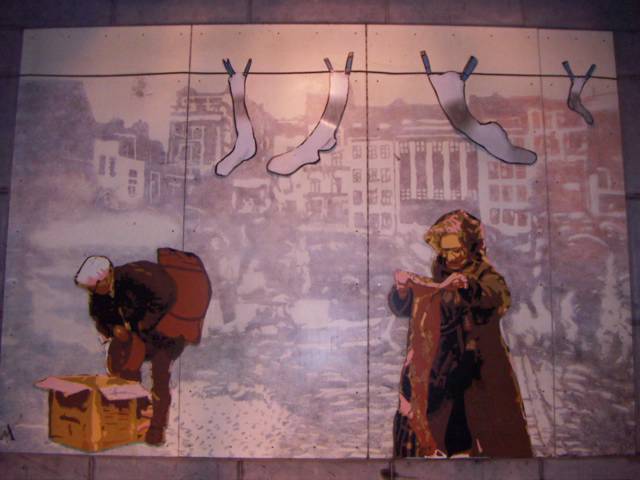
Belgium is the heartland of the bande dessinée (BD, literally "illustrated strip"), despite the fact that the French have bought pretty much all of the major publishing houses.
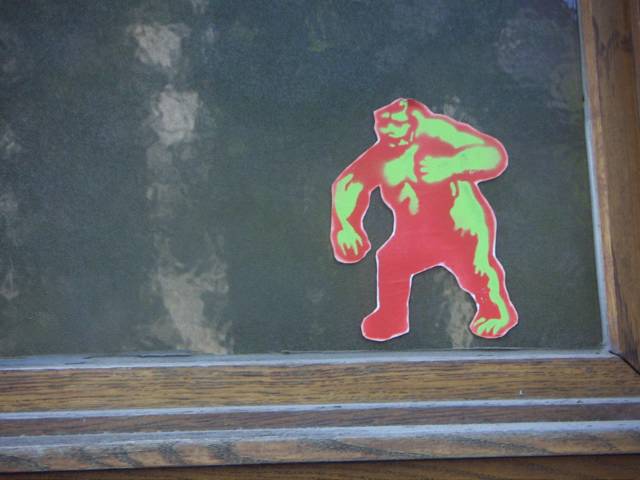
Mural paintings celebrate this heritage. More landmarks that one happily stumbles across. Above is one I discovered only recently, I don't even know the character's name (does anyone out there know?). More of this to come, especially if I can make it out to my very favourite, the one of Blake & Mortimer.
be.tourism
Let myself be seduced by unorganised yet productive free time yesterday: time to kill made into time to hunt. Oh, the spoils.
Bruxelles-Chapelle/Brussels-Kapellekerke train station, base of operations of Recyclart. Underneath the tracks, an art gallery. As I take pictures, a passer-by engages in art criticism: "Beautiful, isn't it? The true artists of the 21st century!" I'm tempted to make a snide comment such as "Yes, they did make this in the 21st century," but refrain.
There's a low-level fear of getting jacked, but it's a bit early for that (9 PM). A more real peril are the cars that appear with little notice, as these pictures are taken from the middle of the street. A little living never hurt anyone, though.
The demi-monde atmosphere is reinforced when an old car pulls out of a next-door junk yard and clambers atop a tow truck, but not before having spewed out cubic metres of smoke, percluding further shooting for sanitary and visibility reasons.
Bruxelles-Midi/Brussels-Zuid train station. A clean modern rail overpass, gleaming white, bordered with blue lights, greets international travellers. Walk underneath and smell the piss, observe the bums. A few streets away, North African men congregate in cafés that will never be deemed hip. No women in sight at all. A bit further down, Angolians discuss at a Portugese café. It's nice hearing some portugese spoken. Will they pop into the X-rated cinema (3 screens!) a few doors down?
be.joy #2
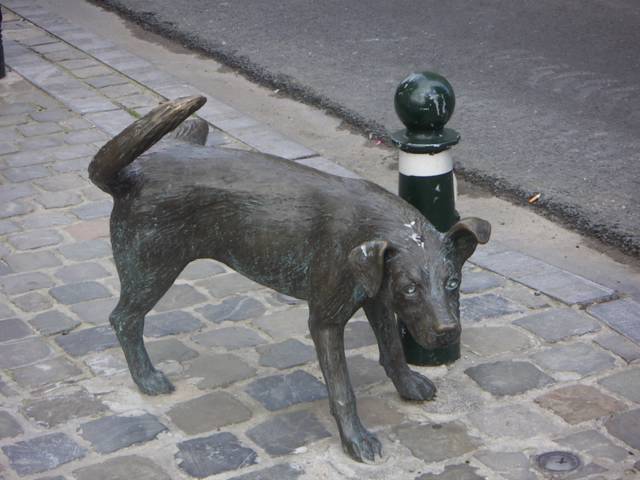
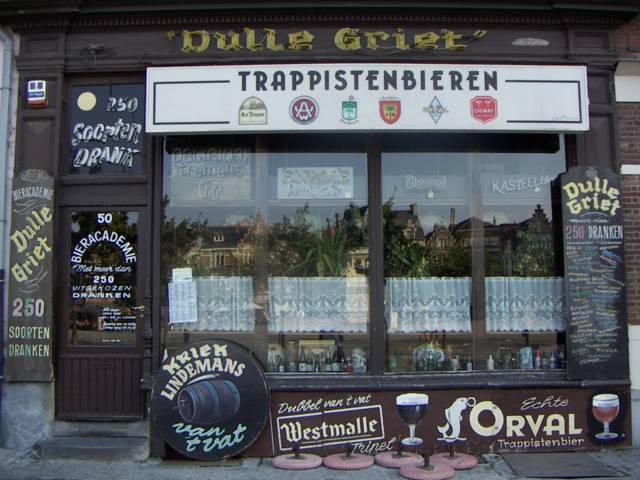
You've got a day to spend in Belgium? Get out of Brussels. What will you do there? See the ever-disappointing sights: Mannekenpis, the Grand-Place (stumbled across a stupendously underwhelming light-and-sound show there last night: blinking lights! rotating squares! in time to music!) and its environs, the omnipresent shops of the Rue Neuve, see the dull grey horror of the Royal Palace? You won't even make it out to the Atomium, perhaps the only major monument of interest in the city. No, head out to Antwerp or, better yet, Ghent (maybe check out the bar pictured below).
Brussel's joys are strewn about haphazardly and meant to be stumbled across rather than studiously trekked to. Like the little fellow above: he's awesome when you come across him unaware, but I would never tell you "You have to go see this."
Thug Love: The Artistry of Ben Webster
A half-finished (quarter-finished) message rescued from the purgatory of long-abandoned draft-dom and unleashed upon the world, with its flaws in full display.
Tupac Shakur had the words "Thug Love" tatooed in an arch above his belly, so applying the term to Ben Webster is hugely anachronistic, yet oddly fitting. The three elements I see as constitutive of Thug Love as an aesthetic are Love (romantic or physical), Violence (real or implied) and Hedonism. The ways Tupac expressed this are clear enough, but how did Webster do something similar non-verbally?
Huge sound (huge bearing no relationship to loud) and incurable relaxedness meant that Ben Webster had a foot in the stylistic camps of the two tenor giants of the time, Coleman Hawkins and Lester Young. But his head was somewhere else again. This combination made his playing voluptuous in ways neither of the other two masters were, while oozing sensuality and romance. A tender embrace given by visibly muscly arms and, to the over-eager potential rival, a "fuck off" glare illuminated by table-for-two candelight. The breathy edges of a tender whisper can coalesce into a trenchant growl at any moment. Conversely, a brawny run can trn into a delicate tiptoe just as quickly.
Webster's hedonism comes from revelling in the groove and the sheer act of playing. His trademark sky-bound bent notes seem to be cries of unfettered pleasure.
Monday, September 06, 2004
Mons en Jazz - 05/09/2004, Mons

Only a few minutes away from home, ahead of me is an enormous military armored vehicle, preceded and followed by a police car, apparently fearing attack. On Mons's main square, the 76th Army Band is preparing to play for the people. The leader is a trombonist and singer: shades of Glenn Miller.
The stage was first occupied by Unlimited, a group featuring festival co-organiser Fred Delplancq on tenor (his debut CD Witches Dance is pretty good), François Descamps on guitar, Manolo Cabras on bass and Marek Patrman on drums. Mostly modern Euro mainstream: a mix of post-bop/early Metheny-style not-too-electric fusion/a bit of domesticated free jazz. Some good moments on third song: a pillowy gauze of mallets-and-plucked-bass shifts into roaring guitar rock, which dissovles into satisfying free-ish sax over noise groove, with Cabras attacking his bass particularly fiercely, before Delplancq slowly re-imposes order with the initial tranquil melody. The last song of the set, in gentle ternary rhythm, could have been a Dylan cover.
L'âme des poètes: Pierre Vaiana on soprano, Fabien Degryse on acoustic guitar and Jean-Louis Rassinfosse (again) on bass. Seen them three times, always great fun. They play covers of great and less great French chansons (Brel, Ferrer, Dassin, Brassens...). Essentially, they push the old-style swinging instrumental solo such as you might find in Brassens's music ("Les copains d'abord") as far as it will go: always melodic, not too adventurous harmonically, strong beat, not too serious. Many bad-but-funny puns from Rassinfosse, audience ringtones accompanying the set-closing "Gaston," which ended with a quote of the default Nokia ringtone. The song is about Gaston not picking up the phone, after all.
The Erwin Vann Quartet plays early 70s style fusion (think Big Fun). Rather than sharply delineated, mountain-range peaks and valleys, the music is oceanic: a unified surface that swells and dips, high tides and recedes, at its best suspending time. Miles did say that with this kind of music, five minutes pass very quickly.
On his Fender Rhodes + pedals set-up, Jozef Dumoulin (one of my favourites) put some of the danger that used to reside in keyboards in jazz (Corea and Jarrett with Miles literally hardly knew what they were doing and reacted to what their instruments threw at them) by putting timbre (dirty, dusty sounds rather than bombastic wannabe guitar pyrotechnics) ahead of notes (the true jazz way?). Dre Pallemaerts used his laptop at first, but when he picked up sticks left no doubt in anyone's mind that he is one of the best drummers around here today, if not the best.
Only two pieces, the first extremely long, the second actually containing a recognisable head, climaxing when Vann (the saxophonist's feet and pedals pictured above) laid free playing deep inside the swirling jazz-rock-funk of the other three, making for a wonderfully dense sound-cube.
bop shorts
Charlie Parker's break on "Night in Tunisia" 28/03/1946
Like Neo dodging bullets. Minus the CGI. An opening to a new world. He didn't have to dodge bullets much longer, though, finding other, slow-motion, ways of doing himself in.
Thelonious Monk behind Kenny Hagood on "All The Things You Are" (for example) 1948
Under the cloak of invisibility (inaudibility?) proffered by Poncho, sends out weird noises to those in it for the vocals (not many, then), subversive coded messages to those in the know (not many then, what about now?) , auto-sabotage of commercial endeavours to the salesmen. [He was enamoured with the long, tight tumble down the keyboard, though, wasn't he? People forget how big a sentimentalist Monk was.]
Aside: Björk looking oddly like Catwoman on Medulla's cover. Perhaps the album to make me love (rather than intellectually like and only occasionally enjoy) her.
be.horror #1
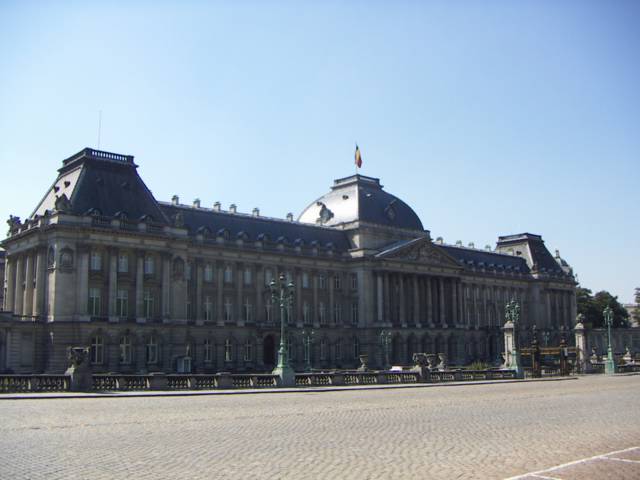
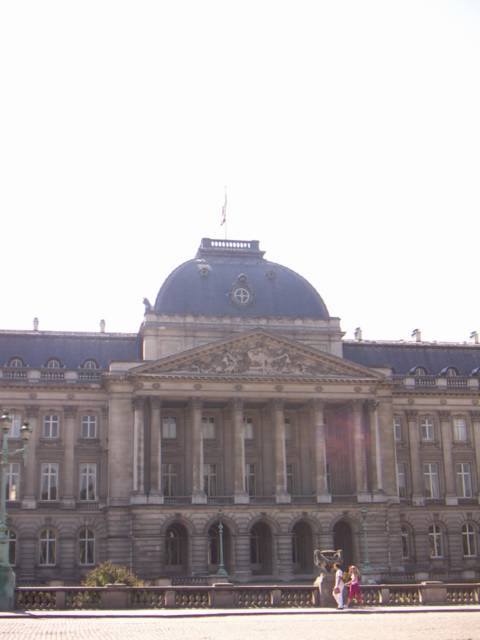
The royal palace. Hideous, obviously.
One of the advantages of being French is being a citizen rather than a subject. There's an attachment to that status, especially as a descendant of slaves. Of course, the irony is that the French president and his (don't expect a her any time soon) ministers occupy former royal palaces. Reminds me of certain pigs Orwell wrote about.
"We don't play the classics, we play the post classics"
Kyle Gann launches a radio station. Hear what his blog talks about.
n/p Julius Eastman "Evil Nigger": solo piano playing a tremulous, dramatic, fairly long motif repeated again and again, changing from time to time (modulation, new material) and a faint "1 2 3 4" count-off giving a rock'n'roll touch. Pretty cool.
Saturday, September 04, 2004
Mons en Jazz - 04/09/2004, Mons

Mons seems to be a lively place. Driving in, I passed by a couple of 16-18-year-old (let's say 17) girls, one with hair dyed a lively pink, passed out in front of a public establishment, their friends around them, assisting. It was 8 PM. When I left the city, at 2 AM, things were only just getting started (that is, for those who hadn't already passed out). Police and a TV camera surrounded my car, never a good sign (especially when you consider the duct taped state of my rear bumper). It turns out they were breathalyzing people. Unfortunately (because I've never done it and would have passed), I didn't get tested.
Last year, the festival took place mostly in the nearby Hall, but now it's being held entirely in the K.fee, a great club I've already mentioned, presumably because of last year's disappointing turnout. Also, this year's line-up is 100% Belgian. The place was packed. Festival's in a club don't seem to be much of a tradition here, but it does generate a nice atmosphere straddling festival formality and logistics and club intimacy.
The Bart Quartier Quintet kicked off proceedings in surprising fashion, playing Dave Holland's "Looking Up." It was the first time I'd heard anybody cover a recent Holland composition, but it makes sense, as they're often great. The line-up was pretty similar to Holland's Quintet as well: Quartier on vibes, leader of Belgian mainstream sax Bart Defoort on tenor and curved soprano, Nico Schepers on trumpet, the inimitable Jean-Louis Rassinfosse (see below) on his signature 5-string double bass and the ubiquitous Jan de Haas on drums.
They gave a rather tepid set. When you've heard the Dave Holland Quintet several times, it's difficult for others to compare, especially when sticking to a similar arrangement. Defoort sounded thin and Rassinfosse weirdly agressive. A couple of bland Quartier compositions followed, before "8 AM" started kicking the set into gear: during the head, drums rolled, vibes and bass looped very cool independant chord cycles (the vibe chords dissonantly echoing the 9 PM church bells that had just rung outside). Unfortunately, they abandoned thorniness in favour of straight-forward funk for the solos. On the following ballad, Schepers made a powerful, heart-felt theme statement and the strong, not-too-complex harmony offered the soloists nice melodic paths, which they exploited effectively. A Mike Mainieri tune was the first real uptempo burner, and Schepers wowed, letting loose a Hubbard/Morgan salvo. The group was obviously gelling, Defoort's sound was getting thicker, but while they were winning the battle against lack of group identity, they were losing the one against festival set time constraints. They closed with another Quartier tune, "Doodle," a sort-of blues that found everyone far funkier than before.
Philip Catherine's trio took the stage next (don't worry, he was only briefly on all fours), with regular drummer Joost Van Schaik and irregular bassist Sal LaRocca filling in for Philippe Aerts. I'm not much of a fan of this trio, they just seem overly cushy with each other. This was made clear earlier in the year during the Brussels Jazz Marathon, when Rosario Giuliani sat in on "Mr. P.C." and blew them apart in the space of a few minutes, forcing Catherine to get up from his chair and respond in kind. A similar thing happened here, but in a quieter vein, when guitarist Pierre Van Dormael stepped onstage for Catherine's "L'éternel désir" and the standard "Autumn Leaves" (which was amusing to me, as only a few days ago I discussed learning "Autumn Leaves" with Van Dormael). The second guitarist made the leader space out his phrases and consider the weight of each one more carefully.
Before all that, though, the trio wound its way through a couple of Catherine tunes, which allowed him to display his usual melancholy iridescent pedal-controlled chords. "Letter From My Mother" was especially strong, with a great melody hiding gushing emotion under the British restraint of a little waltz. They blew on "All The Things You Are" and "Bewitched, Bothered and Bewildered" (which contained a great, "how's he going to resolve this" harmonic digression from Catherine) and closed with "More Bells," the two-beat of which allowed Van Schaik to loudly and joyfully play around with the off-beat during the song's climax.
The previously-seen Van Dormael followed with a quartet that's played several times now (a notable feat, as most of the guitarist's groups have, by his own admission, played only once). Van Dormael has a totally unique harmonic sense that allows him to sculpt intricate melodies out of seemingly inhospitable intervals. Mix this in with his blues leanings, African sensibility (notably in his approach to space) and desire to unite the intellectual and the emotional, and you have a musician who never ceases to amaze me. The first time I saw this quartet, I was amazed and transported for about 25 minutes. This time, I was a bit disappointed. Van Dormael was consistently fascinating and bassist Otti van der Werf (on his battered 4-string electric) has a pared-down, deeply groovy style, but throughout the 1.5 hour-long set, the tempo and general feeling hardly budged. Anne Wolf, excellent on piano in her own trio, continued to annoy on keyboards, using mostly cheesy pan pipe patches (the same as she always uses, aren't there any other settings on those things?) and occasional strings, with a balafon/marimba sound at one point that was, I must admit, rather nice. Still, though, I have yet to hear her play anything on keyboards that sounded really good, as she mainly restricts herself to weak, often out-of-the-groove blues scale + modulation wheel noodling. But I'll repeat how good her own trio is: very (which makes her performances with Van Dormael all the more puzzling).
The set ended with Dylan's "My Back Pages," whose melody provided a more focused and forward-moving context and Van Dormael's "Hip Hop Etude no. 11" which had a great, funky bass line inevitably de-intensified by the above-mentioned keyboards. Things started getting crazy when Van Dormael took the mic down the first row, making people shout "Woo!" into it. Then Rassinfosse got a hold of it and started scatting. When that ran out of steam, he turned to free-associated and free-morphing words rather winningly (anyone who's seen him on stage knows he's a great entertainer). Then Van Dormael played a famous disco-funk bassline I can remember but can't place and sang a bit of "I Shot the Sheriff," all for no apparent reason, but it was fun.
Second and final day of the festival tonight.
Thoroughly Blooming
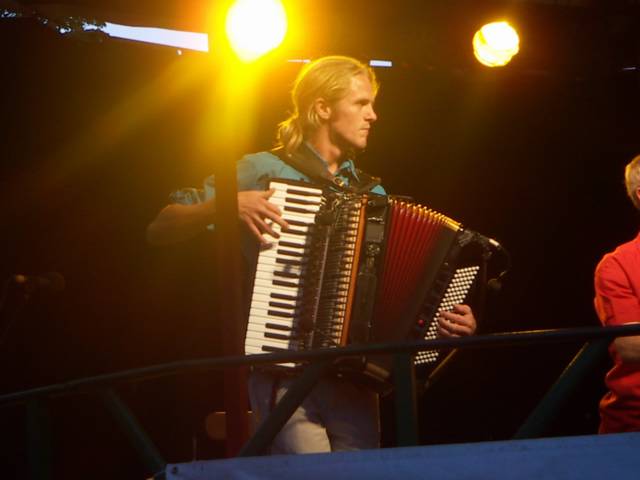
I mentioned him in the second day of my Euritmix round-up, accordeonist Tuur Florizoone has now popped up in the comments box to the same post, providing links:
Tricycle, the band I saw, releasing their debut in december;
Quentin Dujardin, guitarist whose last album is very good, representing the North African trip whose influence is felt in atmospheric, wide open spaces and a fabulous Arabic violinist (he is to the muezzin what the bluesman is to the preacher);
aNoo4tet, which I know nothing about.
Friday, September 03, 2004
Sébastien Tamisiau - 03/09/2004, Braine-l'Alleud
My future-ex-next-next door neighbour provides me with occasional brushes with live classical music. Last night he gave a small public performance that was essentially a rehearsal for his rapidly upcoming final exam.
I missed the first piece entirely and part of the second due to someone's car blocking my driveway (an all-too-frequent occurrence, maddeningly). What I did hear, though, was most of Shostakovich's "1st Violin Concerto" (at least, I think it was the 1st). I didn't know it at all (unsurprisingly...).
When I arrived, during what I suppose was the first movement, the music was very emotional, but in a very harsh, grey and sharp-edged (not quite dissonant, but almost, a great knife-edge to balance upon) way and the mood never let up. Afterwards, one person commented on that, that the violin seemed to meander endlessly, and I guess one could feel that way, but I enjoyed that feeling of never coming up for air, just the relentlessness of it.
That all sounds rather grave, and maybe S. thought so too, as the next movement (BTW, I hate the "no clapping between movements" thing, it's so unnatural. That release is needed, much more so than unhappy and unfulfilling coughing and in-seat-shifting) was deliriously demented: sinister fairground music, piano accompaniment that suddenly became lighter and more consonant, sounding like Mozart or something. The delirium was palpable: the movement started with dance-related piano phrases countered by irregular staccato violin chord blasts sounding like a funk rhythm guitarist who'd lost track of the One.
The following movement was a necessary release (especially given the no clapping rules & regulations): grand, straight-forward (almost poppish, really) piano harmonies let us weep at the (presumably) futile outpourings that preceded it. It put the first movement in a different light: both emotional, but one driven, implosive and tense, the other relaxed, open and simple.
The feeling that there's a fourth movement that I'm totally forgetting is nagging at me. Maybe the experts can fill me in (and blow holes into my description).
Thursday, September 02, 2004
Description of the Tremplin Jazz 2004 (in french). The author is rather lukewarm on most of the six participants (including the winners, the Pascal Schumacher Quartet), but is is taken by Listen, a Norwegian sax/piano/tuba trio and even moreso by TTPKC & le Marin, a three saxes (+effects) and drums band.
Pierre Godard's parting shot is an odd one: Out of the six ensembles supposed to represent modern jazz, none truly improvised, a sign of the rather curious evolution of a genre which used to represent the paroxysm of musical freedom? I can't speak for the five other groups, but it's difficult to understand how the PSQ is "not improvising."
Subscribe to:
