Saturday, May 21, 2005

Alexi Tuomarila Trio - 16/05/2005


Alexi Tuomarila - p
Brice Soiano - b
Lionel Beuvens - d

It's been such a long time that I haven't been going to concerts regularly, that until last monday I'd forgotten about one of its principal dangers. Indeed, Antwerpen is a city in mutation, and a single false move - in my case realising too late that I was in a right-turn only lane - resulted in a half-hour spent wondering where I was as I weaved between roadworks and cement blocks carelessly and dangerously strewn in the street. As a result, I only caught the tail end of the first set.

I hadn't seen Alexi for a very long time either. He's made two good CDs with a quartet, but is currently playing quite different music with a completely different trio. While the Finnish folk music influence was present when he dug into his back catalogue, there was something different about Alexi's playing: slightly funkier, but at the same time sounding deeper and graver than before. This dual evolution was made plain on the last song of the set, during which a funky bass vamp underpinned abstract piano lines that reguarly hinted at the dance forms underneath.

Soiano and Beuvens kept up loose rhythms that transitioned easily from fast swing to open 60s post-bop to 70s funk and touches of Afro-Cuban rhythms and free. Their greatest challenge, though was probably overcoming the monday night Hopper crowd: past the first couple of tables, you would have been hard-pressed to realise music was being made over in the far corner.

Monday, May 16, 2005

Jorane / Saule et les Pleures - 15/05/2005, Brussels


Jazz is life... well, almost. It's nice to see a non-jazz concert that isn't The Roots!

Saule and the Pleures ("Willow and the Weepers") realised an excellent and all too rare mix of intelligent and clever lyrics, a good voice and equally good, surprising and original, even, music (or, more specifically, arrangements). In chanson française à texte, you tend to have limited (to be kind, *cough* Vincent Delerm *cough*) singers and above average lyrics. The music can vary from Brassens's extremely stripped-down rigour to more Gainsbourgian mash-ups. Saule sang about toilet ladies, a painful night at the opera (but in a way that was funny because you felt that he actually liked opera) and other everyday topics; the music was close to the chanson template (drums, double bass, acoustic guitar/singer, electric guitar, keyboard/percussion), but at times rock or hip-hop intruded (and mock-opera on the above-mentioned song), hinting at open minds. Their first CD is coming out later this year and if there's any justice it will do well, as in their short set I heard at least two potential hits.

Jorane: a girl, her voice and her cello (and a guitarist). I first saw her on Ray Cokes's show on Arte and thought my girlfriend's family would be interested in seeing her (her littlest sister plays cello).

More mystical/hippie than the opening act, she opened with transporting grainy cello notes and wordless Celtic/New Age-y vocalising and later tried out some slow, langourous, Orientalising melisma. At one point I feared that that was all there was (which would have been okay had I been lying down, or at least sitting), but they regularly veered into dynamic rock (the guitarist made good use of his pedals when on acoustic guitar and threw in some steel guitar for variety), notably after Jorane recounted the tale of an interviewer claiming to detect Led Zep influences in her music and inevitably launched into an LZ-inspired rollick. She also played electric and acoustic guitars, which set the scene for more folk- or blues-rock oriented songs.

Sunday, May 08, 2005

Junk food


Elodie Lauten:

Does improvisation have a bad name? I had a discussion about improvisation with a friend who had graduated from Juilliard. He sat at the piano and placed his hands on the keys randomly and laughed... and said improvisation was junk. After years of training and dedication to play anything written for an instrument, doing something spontaneous is a sin, a criminal act, or at least a ridiculous behavior.

It's strange, to me, that after a century of jazz and decades of easy access to improvised musics from around the world and the knowledge of the place of improvisation in classical music, such opinions can be so glibly tossed around. Lauten herself recognises some of the value of improvisation (Improvisation is not junk, it is hard work) but also fails to take it (within the context of a medium-sized blog post) as a practice in itself that needs no other justification (creation of a work, under-rehearsal, cost-cutting).

I wonder if musical training that put improvisation and personal creativity on the same level as it does reproduction would not ultimately be better. Perhaps when Mozart could write "Twinkle Twinkle, Little Star" as a child because he felt free to improvise and create?

Een avondtje uit


Antwerpen is a great city, much better than Brussels. Crossing the city on foot, you start by the river (Antwerpen is among Europe's biggest ports) and on your way to a small bar you pass:

- a surprising multitude of sex shops, from the trendy feminine/woman-friendly brightly-lit and colourful variety, to the ominous "Toys 4 Boys" and its display of leather masks;
- innumerable little shops sporting the latest in interior design (the city has been an emerging European fashion centre since the early '90s and the people here tend to be a step ahead, IMO);
- old brick houses, one displaying a "Anno 1515" plaque;
- an open space surround by brick walls that have been taken over by the brightly-coloured fantasies and harrowing psycho-dramas of graffiti artists;
- churches;
- the statue of Brabo throwing the evil giant's hand (hence the city's name: hand-throwing);
- weird little odds and ends.

And the whole time, there is no loss of continuity in the mix of residential, cultural, sexual, social and religious spaces. Try doing that in the nation's capital.

To cap it all off, I discovered a delicious brown beer (Gildenbier) and listened to a sax trio playing standards passably ("Softly, as in a Morning Sunrise," "Satin Doll," "All Blues," "Stolen Moments") and then some blues in the company of a Chinese-born Antwerpenaar who is my girlfriend's grand-mother's partner and sings and plays guitar like a Mississippi backwoodsman.

Thursday, May 05, 2005

Henry Grimes Trio - 04/05/2005, Brussels


Henry Grimes - b
Marilyn Crispell - p
Andrew Cyrille - d

First of all, long live whoever was responsible for last night's concert being non-smoking. Being able to breathe freely and not coming home smelling of smoke is such an enjoyable experience that I'm surprised that anybody could still plead for the "atmosphere" of smoke-filled environments. I was a bit less taken with whoever was responsible for the concert starting an hour late (the musicians walked into the bar 45 minutes after the official starting time). Behind the beat, I guess.

I know fairly little of the three musicians. Grimes mainly from Don Cherry's "Complete Communion" (he was wearing a pink plastic medallion around his neck containing a picture of Cherry and him taken at that recording session) and the story of his re-appearance after several decades; Andrew Cyrille from a Trio 3 album and Marilyn Crispell pretty much not at all. A pretty good learning opportunity for 5 euros.

Grimes kicked off the concert with a long solo consisting of noise interspersed with rough-hewn versions of familiar intervals and progressions. When he picked up his bow and Crispell joined in, the amplified bass and the crappy piano joined forces, creating a poorly-audible result. Interestingly, during the 15-20 minutes that all this went on, Cyrille inaudibly rustled his brushes on a tom. When the drummer finally cut loose, the trio broke into very dense free improvisation, the kind that lacks dynamics, harmony or rhythm: like a cliff's sheer facade of natural granite, its pleasure resides precisely in this relative featurelessness, combing with imposing presence and visceral power.

Cyrille demarcated thematic sections (I feel like calling them chunks) of this 50-minute piece with a sudden, single, loud cymbal and drum crash. Crispell started to mull over a series of Spanish-tinged, percussive motifs to a quieter accompaniment, so that when the energy level returned to earlier levels, the music was clearer and less forbiddingly austere. The piano found itself heading in an atmospheric direction filled at first with swirling, dissonant arpeggios and later with "pretty" and even syrupy playing, while the other two provided a consistently (relatively) quiet-but-turbulent background.

The second piece was quite different in feel: Grimes was walking, the piano played in a more linear fashion, Cyrille was set on a sort of loose-limbed loop, so that there was a sense of tempo, of swing even. A loud cymbal-washing/daybreak/Coltranian intro section gave way to a concluding arco bass drone and simple and hopeful folk dance-like modal playing from Crispell. Just before that, Cyrille had produced a crowd-pleasing solo of various straight-up dance rhythms.

I thought that, at 11:15, the concert was over (and I wasn't alone in thinking that), but at midnight the musicians took to the stage (well, to the floor at the back of the bar) once more. I'll admit to not having been very focused (hey, I woke up at 6 that morning), but I did enjoy some unexpected quasi-Abdullah Ibrahim joyous hymn playing from Crispell.

Sunday, April 10, 2005

Fred Anderson Trio ft. Ernest Dawkins / Sticks & Stones - 09/04/2005, Hasselt


Sticks & Stones
Matana Roberts - as, cl
Josh Abrams - b
Chad Taylor - d

Fred Anderson Trio
Fred Anderson - ts
Harrison Bankhead - b
Chad Taylor - d
Ernest Dawkins - as, ts, stuff

The last time I had been to this Arts Centre in the east Belgium town of Hasselt, it had been to see the Peter Brötzmann Tentet. The Centre is a horrible concrete cube at the end of a covered driveway that gives the impression of walking into a mechanic's. The place's cubeness does nothing for its acoustics: music and noise reverberated and clashed noisily in my ears, a masochistic blend of pleasure and pain. This time, a trio and a quartet performed, so wild over-amplification was brought in to obtain the same effect. Still, as my main live contact with the Chicago scene had been through Ken Vandermark, I was happy to see another side of it.

Sticks & Stones opened, playing an attractive kind of modern jazz, one that mixed deconstruction with hard-blowing free jazz, some groove and occasionally reached back to something more old-fashioned. For example, the first piece opened with little noises, leading to a drum solo accompanied by Abrams on one of those latin double cowbells and Roberts adding another layer of rhythm with a pair of drumsticks used as a clave. Over a loose vamp, Roberts's clarinet wails were reminiscent of "Rhapsody in Blue" and old Spirituals. The next piece was a head-scratching arrangement of Monk's "Skippy." Roberts switched to alto (which she would keep the rest of the night) and regularly built up to furious late Coltrane/Ayler screams, only to pause to inject some rough-voiced melody, or muse in a more Greg Osby/Steve Coleman-playing-standards vein. It was at this point that I noticed the huge white flower perched over her right ear. Combined with her huge, flowing green-gold gown, she looked like a strange mix of Billie Holiday and Lester Young. After the show, she kept the flower, but changed into a black jacket with a portrait of Angela Davis on the back and a red fluffy skirt.

After a more restive (though occasionally agitated) take on Billy Strayhorn's ballad "Ishafan," Abrams and Taylor launched into a stormy accompaniment that Roberts rode with a langourous long-note melody. Abrams played a driving and involving solo before a tumultous drum solo led to an Elvin and Coltrane-type moment, with Roberts playing strident long notes and starchy trills, before ending the set gently.

At 76, Fred Anderson is so hunched that his tenor almost touches the ground, and yet his playing continues to retain the toughness and fleetness of a Johnny Griffin. This set was all about celebration: the 40th anniversary of the AACM, the joyousness and uplifting spirit of the unruly intertwining of two lines supported by a parade two-beat, Dawkins choosing a whistle or horn amongst his tableful of miscellaneous noise-making implements.

Between three long pieces, a short one celebrated the anniversary with Dawkins singing "A-A-C-M / 40 years!" and devolving into funny noises as the rest of the band powered on. Bankhead liked to dedicate his solos. The first, whose middle-eastern nature was reinforced by the bassist's muezzin-like vocalising, was dedicated to the Pope, while the second, a swinging, walking, slapping, sometimes running or hopping romp, was given over to "the spirit of Chicago, the big tenor sound." As Anderson played ferociously, Dawkins became a one man horn section, blowing both horns in a riffing exhortation. As an encore, a six note invocation was repeated over and over, before Dawkins took a solo full of bluesy smears.

Tuesday, February 01, 2005


I don't know Otti van der Werf personally (but I have interviewed his brother Bo, Octurn's leader and have seen Otti on stage many times), but I was surprised and saddened to learn of his brain aneurism. He's out of danger, thankfully, but needs some help. I'll be trying to bring him some.

Thursday, December 23, 2004

Waffling

I had been that way earlier in the day. It was colder now, so I stopped to get a waffle at the Belgrafrau stand on the no-man's street separating the beginning of the Rue Neuve from Place De Brouckère. It cost 1.65€, roughly the price of a bus ticket.

I don't know what those waffles are called. Chewy, with big squares and the size of two palms, it could have been topped with cream or chocolate. As usual, I took mine plain. There are also the thin brittle ones, a particularly delicious honey-filled varition of which can be found in Hema stores. Waffles, like French fries wrapped in a thick paper cone (or, less poetically, laying corspe-like in a plastic tray), connect you to the city. Its fast-fading warmth shielded me from the winter's early-evening chill, while metaphorically it drew Brussels closer. The wild neon illumination that somehow made the blackness of the night sky more vivid and present; the well-rehearsed progression from the UGC multi-mega-complex on the Place, up through Boulevard Adolphe Max's parade of unhelpful temping agencies and onto the final, ignominious stretch of pornland shops, cinemas and performance spaces that stop, meekly, at the junction with the broad and busy entanglement of the Boulevard du Jardin Botanique, the weirdly "Metropolis"-like quality of the CBD surrounding the Gare du Nord, the far-off white City Hall spire overlooking the Grand-Place, all of it became intimate.

Across the street from the smut stands the Brussels Sheraton and the glass pyramid that pales absurdly in comparaison with its Parisian forebear. Parallel to Adolphe Max runs a parallel world, the Rue Neuve, as swanky as a populist high street can get and remain in business: Zara is surrounded by multiple H&Ms; coming from the Sheraton, the ATMs of Fortis Banque greet consumers; at the other end of the street, Women's Secret bids them farewell.

I wasn't taking the entire tour this time. I needed only to go to Waterstone's to compare prices for Bob Dylan's "Chronicles." I had been wandering the aisles of the Dutch-language Standaard Boekhandel in search of a present for J... He's a Dutch teacher and generally gets books when a present is needed. I don't know his level of affinity for Dylan (if any), but thought it might be nice to get some lighter fare. Since his English is good, the 20€ Dutch translation was redundant. In a just-discovered English-language bookshop, large, but cluttered and exuding an air of small-scale conviviality, a nice counter-weight to the world-conquering indifference of Waterstone's and some fifty metres up from the Belgafrau, the book was 30€. As it turned out, Waterstone's had it at the same price. It remains a mystery to me how a translation of a new book can be cheaper than the original version. I ended up not getting anything. Reading the first few pages of "Chronicles" was exciting: it was about Dylan, but it could have been a work of fiction, which is good for the Dylan-ignorant such as myself and for those who want to offer it to someone of unknown Dylan status; the words "hophead talk" reminded me of "On the Road"'s ambiance.

Last week I went to see The Roots for the sixth time, at the Ancienne Belgique on Boulevard Anspach, De Brouckère's lower-class extension and the place to go to buy cheap computers. The following day, my daily commute partner called the AB the smallest venue he'd been to. I called it, perhaps incorrectly, the largest, which revealed to me how ignorant I am of the marginality of my musical experience.

Well over a year ago I had seen them from the balcony of the same room. This time I was down amongst the plebes and enjoyed myself more because of it. As I walked in, they were already onstage, playing "Boom!" The Roots have become an unabashed guitar(s, two, to be exact) band, and most of The Tipping Point's somewhat stilted songs were all the better for it. Energy, distortion, re-arrangement and facile volume did the trick. The sword swang the other way on "Why?" as the desultory guitar strumming that accounts almost entirely for the song's despondant atmosphere was drowned out by amorphous volume-induced parasites. In fact, it was probably the loudest concert I've ever been to: for the next few days the ringing in my ears caused interferences when I whistled, which sounds begnin but is in reality rather scary.

There were transistions from "Iron Man" to "Crazy In Love," the insertion of a half-Nirvana, half-Led Zeppelin riff into a TTP song, a reggae "You Got Me," a very fast "The Seed 2.0," what sounded like an aborted segue into "Drop It Like It's Hot," and so on. Singer Martin Luther again had his own section, but instead of the moving voice 'n' guitar of the previous concert, Luther's full-bodied and masculine soul voice was indentured to labourious group songs (with Knuckles moving from percussion to traps, a female bassist materialising from the wings and the lead guitarist). The concert's high point was an unexpected outbreak of pure funk. My first thought was "I need them to play this at my wedding." Of course, this thought surfaced only after several minutes, as the ancestral reptilian brain reflex of "Dance, fool" had taken over and shut down the higher cognitive functions necessary to articulate such complex utterances as "I need them to play this at my wedding." Dazed but very happy, I left the concert.

Going further back into the mists of time, I haven't been posting in part because I've been studying to become a Certified Java Programmer, which was accomplished at the beginning of the month. Now I'm working towards a Business Component Developer Certification, or some such thing. What does all this mean? Mainly, that I visit this site a lot.

Wednesday, December 01, 2004

wake-UP call


It's not everyday you're woken up at 7AM by your radio's tinny rendition of a slow-building thumping house beat mounted by honest-to-goodness David Murray-ish skronk (I'm uneducatedly guessing it's Akosh S.). Happy times. Turns out it's French DJ/producer Laurent Garnier's "The Man With The Red Face" (probably a reference to the saxophonist. See the 9-minute Bollywood video here (scroll down. There's also a 14-minute live video).

Weirdly, this was followed by a 13-year-old girl from Aalst reciting her brief award-winning poem about AIDS and (my first hearing of) the (gag-inducing) BandAid20 song.

Monday, November 29, 2004


It's nice to finally come across someone putting words on what you think you've been hearing. Ben Ratliff helps me out:

Aside from any personal language of harmony or rhythm, the overriding qualities of aggression and restraint are what have built post-bop saxophonists into major figures. Those that zealously explode (John Coltrane, Eric Dolphy) or forlornly implode (Wayne Shorter, Lee Konitz) create cults.
(emphasis mine)

and later

Mr. Alexander, by contrast, played on the beat. He used some of the same improvising patterns as Mr. Coleman, and a broad sound that stuck more often to the lower-middle register, which he occasionally escaped for unexpected effects like a fluttering figure that became a rough overtone shriek, as if a bit of Coltrane's wilder late period had been smuggled into more formal music.
(emphasis still mine)

I hear that all the time. Take Jacques Schwartz-Bart, who, at his best, fits both the Wayne Shorter forlorn implosion and Coltrane smuggling bills. For anybody, really, who is interested mainly in 60s style bop, but also a bit by free jazz, that use of overtones is part of the lingua franca. Which makes it slightly boring, which is why players who navigate the in/out line more subtly like Ellery Eskelin, for example, are more interesting and advanced, to me.

Ellery Eskelin Quartet - 28/11/2004, Lille


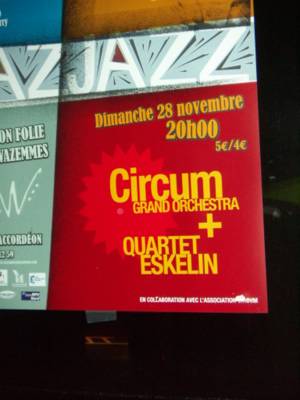
Everything went off without a hitch, incredibly: getting to Lille, finding the venue without getting lost, meeting up with Ellery, doing the interview, being fed (an unexpected bonus!), seeing the concert. The only slight downside was that I had to leave at intermission and therefore didn't get to see the second part of the bill, the Circum Grand Orchèstre.

The concert itself was extraordinary (the interview went well - I think I'm getting better as an interviewer, at least in terms of listening to the interviewee). The Eskelin band is now comprised of the original members (Andrea Parkins on accordion, keyboard and sampler, Jim Black on drums 'n' stuff) plus vocalist Jessica Constable, an English singer living in Paris. She used to be a special guest, but is now a full-fledged member. There are a few excerpts on the DVD of her with the band, which I liked well enough but now seem very embryonic, or at least unrepresentative, compared to what I saw and heard last night.

Talking with Ellery, he made it fairly clear that he felt that, as a trio, the band has pretty much covered what he had imagined for it and that new directions were opening with the punctual or permanent adjunction of other musicians. Personally, having several trio CDs and having heard it twice before, I considered its music very consistent. Ellery's talk of how the band changes when its constitution changes and how he views singers as totally equal with instrumentalists isn't mere talk: it was clearly on display on stage, to wonderful and surprising effect.

The concert started with (natch) just the trio playing a piece from Kulak 29 + 30, I believe. Each player took unaccompanied solos, each one bookendend by a group rendition of the songs strident theme. Then came the fantastic "It's A Samba" from the equally fantastic Arcanum Moderne (the repertoire seemed more wide-ranging than the other times I've seen the group, as they tended to stick with the then-current album's repertoire, with only a few deviations). "It's A Samba" revolves around a vintage Jim Black dirty groove in a - you guessed it - more-or-less samba style.

Was it Eugene Chadbourne who referred to this group as "The Beatles of the avant-garde"? Songs like this one are the reason why: there's a catchy tune, you can dance or mosh to it and, when Ellery locked on to a one note honk (perhaps a witty pun on "One Note Samba"?), its funk-drenched energy simply carries you away.

Jessica Constable came out and launched into a Celtic-sounding long-note lament over rising keyboard drones. I guess the facile comparaison for Constable would be with a more avant Bjork. While at times I did feel that they had a similar sense of dramatic construction, they're rather different. Constable doesn't have any childishness in her voice, for example, but I'm lacking reference points.

Drums and tenor joined in, keeping the slow, pensive atmosphere. This isn't a band you'd expect to have a singer in the first place, so, as you can imagine, Constable didn't fulfill the traditional jazz singer role. I think she sang pretty much the whole time she was on stage, truly equal to the other three musicians next to her. I'm pretty sure that she sang a lot of actual lyrics, but the only word I understood the whole night was "grandmother." Somehow, in this context the indecipherable lyrics thing made a lot of sense. For this song, Ellery expanded upon the traditional singer + obbligato format, but was only just in the background. The saxophone matched up to the voice with great sensitivity, and sometimes the singer took it upon herself to match the saxophone, to surprisingly good results.

Ellery's latest album, Ten is totally improvised, but the addition of a singer seems to have sparked a different way of writing or arranging, as the next piece had a lot of sharply delimited and controlled elements. It started quietly, with a few plinked piano chords, Black scraping his cymbals and Ellery musing quietly while Constable sang a fractured and delicate line, creating a rather enchanting (in the magical sense) whole. Then, tenor and drums hooked up to drop short, sharp and loud percussive blasts in tight unison, as voice and piano (Parkins had moved to the grand set up for the big band that was to follow) continued on as before. Come to think of it, it was kind of a boys vs. girls thing.

"For No Good Reason" started in chaos, with wild sampler whistles and crackles, drums flailing, saxophone blowing freely and voice scrambling itself through an effects pad (which Constable used well throughout). A couple of keyboard notes hinted at what was to come and suddenly those gorgeous, voluptous even, chords fully emerged, bringing order, as Constable added a bluesy twist, which Ellery complemented with some soulful lines. They erupted again into a great bit of skronk + beats + menacing, and still incomprehensible, spoken word, and when those chords returned for the finale, the music soared to a veritable apotheosis. At this point I wondered, believe it or not, if this new band was not even better than the old one.

The last two tunes before the encore were on the dancier side. The first one was slow and funky, reggae-ish even, when the stabs of Parkins's keyboard vamp focused on the off-beats. The groove's even-pacedness gave it a blissful tension.

Listening to Ten for the first time as I write this, with its different and changing line-up, it doesn't represent what the quartet sounds like, but I expect that the next album will document it. At least, I hope so!

Saturday, November 27, 2004


The imaginary choir for "Paranoid Android". It would have been glorious, I tell you.

Friday, November 26, 2004

Brad Mehldau - 21/11/2004, Brussels


First of all, a big, big thank you to my friend Jef!

I first saw and heard Mehldau solo almost five years ago, in Salamanca, Spain. The next day I bought Art of the Trio Vol. 4. I've since seen his trio twice.

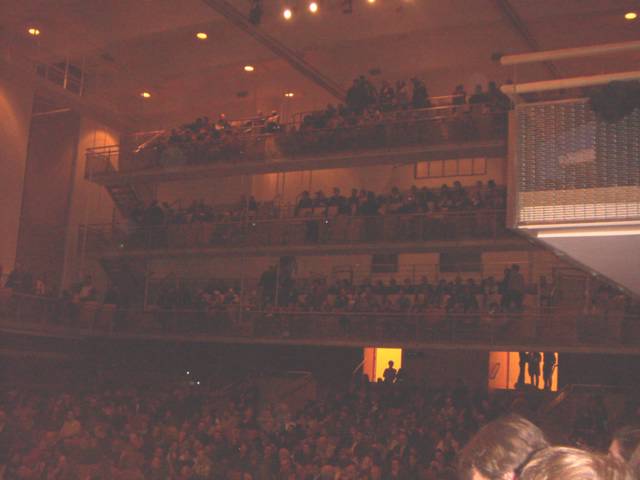
Flagey's main hall was full, all its 700 seats and vertigo-inducing three balconies. I was sitting directly behind and slightly above the pianist, ie. I was on stage left, a great position from which to observe his left hand.

Mehldau is the jazz world's great champion of Radiohead, so it was fitting that he start with "Knives Out." Most surprising about it was that it confirmed a trend I noticed the last time I saw him play (and goes counter to Francis Davis's implied opinion that Mehldau's style is not evolving): while the spare melody notes rang out, Mehldau would lay down a thick pea-soup fog of uncertainty, which sounded like a blend of ecstatic atonality and pensive dissonance. This harmonic daring is something I first heard him do on a stupendous intro to "All the Things You Are" and which I don't think he was doing before.

Then came a sad pop waltz with country overtones, Paul McCarthney's "Jump." Next came a Mehldau original, "Los Angeles." I haven't heard the Places album it comes from, but this driving and orchestral piece was the first instance of my main gripe with this concert: it's simply too much. Too much over-wrought drama, not enough humour. A tad more breathing space could have brought things into starker relief, especially as (due to the piano, the playing, the acoustics or my placement, I do not know) notes tended to blend together, obscuring overall shapes and rhythms.

I love the piano's lower register because it brings a physicality (the strings are so long, you can feel them vibrating, the wood shaking) and a menace (that rumble!) to the piano the other registers don't really have. Of course, it's not the most distinct register. Mehldau was down there all night (I think you could have counted the number of times he ventured into the upper fourth of the keyboard on the fingers of one hand), which was cool, but compounded the above-mentioned problem.

On we went to another highlight, Monk's "Monk's Mood." When I last saw the trio, their Monk was rather poor, but alone, Mehldau was great. His chords sounded like Monk's, his rhythm was steadier and he included plenty of digressions (or "harrumphs" as I think it is appropiate to call these monkisms), which amused until, astonished, you realised that a digression had flowed into the next statement. "Think of One" contained an incredible display of Mehldau's famed left hand independence in which it became another soloist alongside the right hand, while an accompaniment was still going. I have no idea where the accompaniment was coming from. It was a tour-de-force, but not bravura, if that makes any sense. And it swung.

Skipping ahead, he ended the main part of the concert with "a song I haven't played for a while," (yeah right) "Paranoid Android." Here's where I come back to the lack of humour. When he reached the loud guitar riff part for the first time, pounding it out, I thought it was pretty funny, kitsch even. Then I wondered if Mehldau saw even the slightest bit of humour in it (as The Bad Plus undoubtedly do in their rock covers). His body language says he doesn't, but who knows.

In an interview, Mehldau has said that the real challenge in covering newer pop songs was arranging them so they sounded good. That concern was made clear as he launched into an improvisation that weaved the further melodic elements into itself, so that there wasn't merely a tossed-off head, but also a body. Then came the majestic dirge part, at which point I had a sonic vision of the 700 listeners in the audience, which I could see as they were all to my right, stand up, become a choir (or a massive, real, choir suddenly emerging, maybe from under the stage, maybe) and gravely intone Thom Yorke's lyrics, whatever they are. It would have been glorious, but, unfortunately, it didn't happen.

The first of the three (!) encores was another Mehldau staple, Nick Drake's "River Man," which wasn't nearly as much of a tear-jerker as it was in Antwerp with the trio (where it was the second, and last, encore). The second encore was a slow, bluesy tune that offered a bit of the breathing room that was too often lacking. The third encore was The Beatles' "Mother Nature's Child." There's a great version of this on Joel Frahm's duo CD with Mehldau, Don't Explain, but on this occasion, it was nice but a bit perfunctory, especially as Mehldau ended it suddenly, as if to say "Okay, now that's enough of that."

Now that's what I call be.music #5


Jacques Brel "Ne me quitte pas"

Brel starts out promising the impossible to rekindle the fire in his loved one's heart (I'll tell you about those lovers, there/Who saw their hearts twice inflamed), and sounds like he could just manage to accomplish it, defying climatology and physics (I'll bring you rain pearls from countries without rain"), linguistics ("I'll invent nonsense words that you'll understand) and even death (I'll dig the earth even after my death to to cover your body in gold and light). His first companion is the piano, then strings come in, affirming his point.

By the penultimate verse, the singer has become more reasonable, a sign of his inevitable failure: Fire has often been seen springing anew from a volcano/That was thought too old/There are, it seems, scorched earths/That give more wheat than the best April. Stepping out of his own maddening, world-conquering subjectivity, he goes into an external realm of logic, which, in matters of love, cannot (must not?) prevail. The death of love and the realisation of the death of love have overcome the impossible promises. The piano has left him, replaced by an ethereal flute (the spirit rising out of the body?), the once-strong and defined strings are now amorphous, resigned and sluggish, doing nothing to buoy our rebuked lover.

In the last verse, Brel is no longer promising or affirming, but pleading, desperately. Still, he attempts to mask his lingering desire in sensible closure (I won't cry any more/I won't talk any more), but he's been consumed and will never let go (I'll hide there and watch you/Dance and smile/And listen to you/Sing then laugh). He can only plead now, plead just to be on the edge of love, on the edge of death: Let me be the shadow of your shadow/The shadow of your hand/The shadow of your dog.

Ne me quitte pas

Happy New Year!


I just got my first ©2005 CD, Mike Ladd's Negrophilia on Thirsty Ear (according to the website, it was released in June 2004...).

Tuesday, November 23, 2004

A day late and a dollar(s) short, but


On Monday, November 22, 2004, One Final Note's
Scott Hreha begins hosting a new weekly jazz program
on the Twin Cities' KFAI Fresh Air Community Radio.
The show will broadcast every Monday night from
10:30 PM to 12:00 AM CST, focusing on new releases
by independent artists and record labels throughout
the world.

KFAI broadcasts at 90.3 FM in Minneapolis, 106.7 FM
in St. Paul, and via the web at www.kfai.org.

Friday, November 19, 2004

Horrible liberals they may be, but they get it right, or at least interesting, this time


Another music industry in the Internet era article, courtesy of The Economist (and brought to my attention by The Rambler.

The number of music files freely available online has fallen from about 1.1 billion in April 2003 to 800m this June, according to IFPI, a record-industry body.
(...)
there is already evidence that data derived from the preferences shown on illegal file-sharing networks are being used to help launch acts
(...)
A poll by Rolling Stone magazine found that fans, at least, believe that relatively few “great” albums have been produced recently (see chart 2).


Of course, chart 2 simply reveals the age/tastes of the RSters: nearly all "500 great albums" were recorded between 1965 and 1975, and hardly any before 1960, and with a sharp decline leading into the '80s.

The boss of one major label estimates that, while catalogue accounts for half of revenues, it brings in three-quarters of his profits. If the industry stops building catalogue by relying too much on one-hit wonders, it is storing up a big problem for the future.
(...)
In the past 12 months, according to a manager who oversees the career of one of the world's foremost divas, his star earned roughly $20m from sponsorship, $15m from touring, $15m from films, $3m from merchandise and $9m from CD sales. Her contract means that her record label will share only in the $9m.
(...)
For example, Warner Music Group is thought to be readying itself for an initial public offering in 2005 and, as part of cutting costs in Belgium, it dropped artists this year. Among them was Novastar, whose manager says the group's latest album has so far sold 56,000 copies in Belgium and Holland.

(I include the last paragraph because, you guessed it, of the out-of-the-blue mention of Belgium. Novastar is Belgian and not Dutch, by the way.)

It is still unclear what a successful business model for selling music online will look like. People are buying many more single tracks than albums so far. If that persists, it should encourage albums of more consistent quality, since record companies stand to make more money when people spend $12 on a single artist than if they allocate $2 to each of six bands.
(...)
Apple forced the industry to accept a fixed fee per download of 99 cents, but the majors will push for variable, and probably higher, prices.
(...)
The best distribution of all will come when, as many expect, the iPod or some other music device becomes one with the mobile phone. Music fans can already hold their phones up to the sound from a radio, identify a song and later buy the CD. At $3.5 billion in annual sales, the mobile ringtone market has grown to one-tenth the size of the recorded music business.
(...)
In September, according to comScore Media Metrix, 10m American internet users visited four paid online-music services. The same month another 20m visited file-sharing networks. The majors watch what is being downloaded on these networks, although they do not like to talk about it for fear of undermining their legal campaign.

be.releases


De Werf is busy releasing records. The last time they released this much was the 10 CD one-a-month Finest in Belgian Jazz series back in 2002:

High Voltage by Hoppin' Around, gathering six up'n'comers in a middle-period Jazz Messengers style, has just been released.

Next month: DjanGo! I don't know any of the musicians (lots of guitarists, a couple of horns, a violin), but I guess the title says it all.

January: Baba Sissoko Quintet. Sissoko on n'goni, tama, djembe and vocals, with an interesting cross-section of be.jazzmusicians: Bart Defoort on modern mainstream sax, Fabian Fiorini on contemporary improvised piano, Otti Van Der Werf on groovy-in-weird-contexts battered 4-string electric bass and Reynaldo Hernandez on everything-inlcuding-jawbone percussion. I'm looking forward to hearing this.

February: the new two-tenor Ben Sluijs Quartet. I haven't seen it, but have heard good reports from reliable sources.

March: Jazzisfaction's second CD. The first, Issues was an excellent, Tomasz Stanko-ish affair, so I'm looking forward to this one too (and anyway, De Werf has released very few duds in the three years I've been here. Although they did have a short run of decent-but-forgettable mainstream bop releases in 2003).

April: Hendrik Braeckman Group. Okay, this one is less attractive to me, featuring Braeckman on guitar, Kurt Van Herck on tenor and trumpeter Bert Joris (who's always great). I suspect this one will join the above-mentioned decent-but-forgettable mainstream bop category.

May: Kris Defoort ConSerVations/ConVerSations, with the Dreamtime tentet, a conductor, a string quartet and a soprano! Should be interesting, at minimum.

Thursday, November 18, 2004

Lee Konitz Trio - 17/11/2004, Brussels


Lee Konitz - as
Ed Schuller - b
George Schuller - d
(I assume the two Schullers are related, they looked fairly similar)

The long search for a parking spot means I only hear the last two or so songs of the first set (one of which was "Cherokee"). For some reason, the doorman makes entry difficult.

Are you on the list? Did you reserve?

I'm thinking

What are you talking about? This is a bar! Let me pay my five euros and get in, I'm late enough as it is.

The room is pretty full, but not packed, as it was for the Archie Shepp/Amina Claudine Myers duo. A nice, surprisingly young and feminine turnout.

The only amplification is the bass amp, the air was clear, as the crowd had been asked not to smoke: as close to environmental bliss as one can get in a club. At intermission I slip to the front and sit on the floor almost lip-to-lip with the stage, Konitz's horn at times almost within reach.

The first time I saw Konitz, in May, it was a disastruous affair: Konitz was out of it and an attempted unison head with saxophonist Steve Houben had me burst out laughing, that's how bad it was. This time, however, is a different matter altogether.

The second set continues Konitz's usual standards'n'things repertoire. They function like the Jarrett/Peacock/DeJohnette Standards Trio, stringing together non-arranged songs (or, sometimes, fragments of songs) indicated by the leader's unaccompanied intros. For the first half he's brilliant, unfailingly melodic, sing-songy even. Then he starts to tire a little, resorting to more fragmented and shorter phrases.

The Schullers each strike a different pose. Although I'm not enamoured with his sound (being so close, the discrepancy between seeing him pluck strings and hearing the sound coming out of the amp half a meter away is somewhat jarring) Ed assists unselfishly, walking his accompaniment, staying inside in his solos and singing along to them discretely enough. George, however, takes more liberties, just as likely to swing straight-forwardly if busily as to deconstruct the tempo entirely with a nebula of polyrhythms and suspensions. He displays both sides on what might have been "The Night Has 1000 Eyes," to destabilising effect.

An amusing blooper springs up on the next tune ("I'll Remember April" or "April in Paris," I always get them confused): the rhythm section springs in after the intro with a latin beat, to which Konitz reacts by swiftly turning around and calling for fast swing. Later, harmonics on bass lead to the drummer tinkling some bells, which leads to Konitz playing a snippet of "Jingle Bells."

Tuesday, November 16, 2004


Soweto Kinch - Conversations With The Unseen

One of my favourite albums this year.

Soweto Kinch - "Intermission Split Decision"

The central track, where Kinch raps about growing up with jazz and hip-hop. You may recognise the anthropomorphism from Common's "I Used To Love H.E.R." You'll have to listen to the rest of the album to hear Kinch play alto.